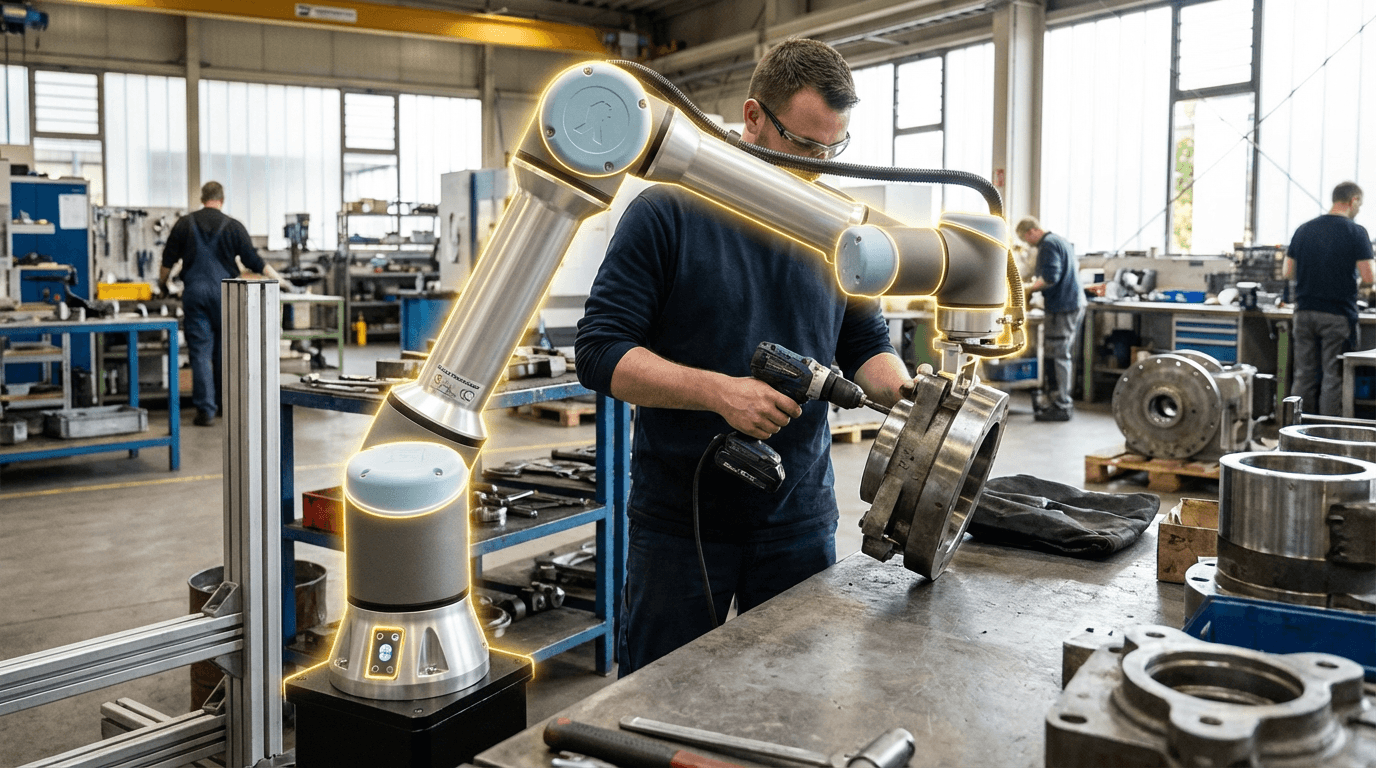
Collaborative Industrial Robots
Collaborative industrial robots, commonly known as cobots, represent a fundamental shift in manufacturing automation by enabling direct physical interaction between robotic systems and human workers without traditional safety barriers. Unlike conventional industrial robots that operate in caged environments isolated from human contact, cobots incorporate advanced force and torque sensing capabilities that allow them to detect unexpected contact and immediately reduce speed or halt operation. This is achieved through a combination of sophisticated sensor arrays embedded throughout the robot's structure, real-time motion monitoring systems, and intelligent control algorithms that continuously assess the robot's interaction with its environment. The mechanical design typically features rounded edges, compliant surfaces, and power-limiting mechanisms that restrict the force a robot can exert, ensuring that any collision with a human operator remains below injury thresholds established by international safety standards. These robots often employ lightweight materials and compact actuators that inherently limit their mass and momentum, further reducing potential impact forces.
The emergence of collaborative robots addresses several critical challenges facing modern manufacturing, particularly the need to combine automation's consistency and endurance with human workers' adaptability and problem-solving capabilities. Traditional automation solutions often require substantial capital investment, dedicated floor space for safety enclosures, and inflexibility when production requirements change. Cobots overcome these limitations by offering a more accessible entry point for automation, especially for small and medium-sized enterprises that previously found industrial robotics economically unfeasible. They excel in applications requiring frequent changeovers, variable product configurations, or tasks that benefit from human judgment alongside robotic precision. In assembly operations, for instance, a cobot might handle repetitive fastening or material positioning while a human worker performs quality checks or manages complex fitting operations that remain difficult to automate. This partnership model also addresses workforce concerns by augmenting rather than replacing human labor, allowing operators to offload physically demanding or ergonomically challenging tasks while focusing on higher-value activities that require creativity, inspection skills, or decision-making.
Current deployments of collaborative robots span diverse manufacturing sectors, from automotive component assembly to electronics production, pharmaceutical packaging, and precision machining operations. Research indicates growing adoption particularly in industries facing labor shortages or seeking to improve workplace ergonomics and worker satisfaction. The technology continues to evolve with enhanced sensing capabilities, improved programming interfaces that allow non-experts to configure robot behaviors, and integration with artificial intelligence systems that enable cobots to learn from demonstration and adapt to variations in their tasks. As manufacturing increasingly emphasizes flexibility, customization, and rapid response to market demands, collaborative robots are positioned to become standard tools in production environments. The trajectory points toward more sophisticated human-robot teaming scenarios where multiple cobots and human workers fluidly coordinate across shared workspaces, supported by advances in computer vision, natural language interfaces, and predictive safety systems that anticipate and prevent hazardous situations before they occur.
Related Organizations

The pioneer of collaborative robots (cobots), featuring the PolyScope interface which popularized low-code/no-code programming for arms.

A major South Korean manufacturer offering a wide range of cobots with high safety sensitivity and payload capacities.

A leading cobot manufacturer known for integrating vision systems directly into the robotic arm hardware.

Provides the eMine portfolio, including charging infrastructure and trolley systems for electric mines.


Develops the Franka Production 3, a tactile robot designed for delicate manipulation tasks and research applications.

Manufactures 7-axis cobots with an intuitive tablet-based interface for easy programming (acquired by Bosch Rexroth).

Develops cognitive robots including mobile manipulators that integrate AI, sensors, and safe human interaction.

A Chinese manufacturer of lightweight 6-axis collaborative robots used in automotive, electronics, and medical industries.

US-based manufacturer of the OB7 line of cobots, known for their 7-axis design which provides greater maneuverability.
Supporting Evidence
Research this in Signals
Signals turns a topic into a sourced research record you can inspect and rerun. Your first scan is free, and this one starts with Collaborative Industrial Robots already loaded, so edit it or scan as is.