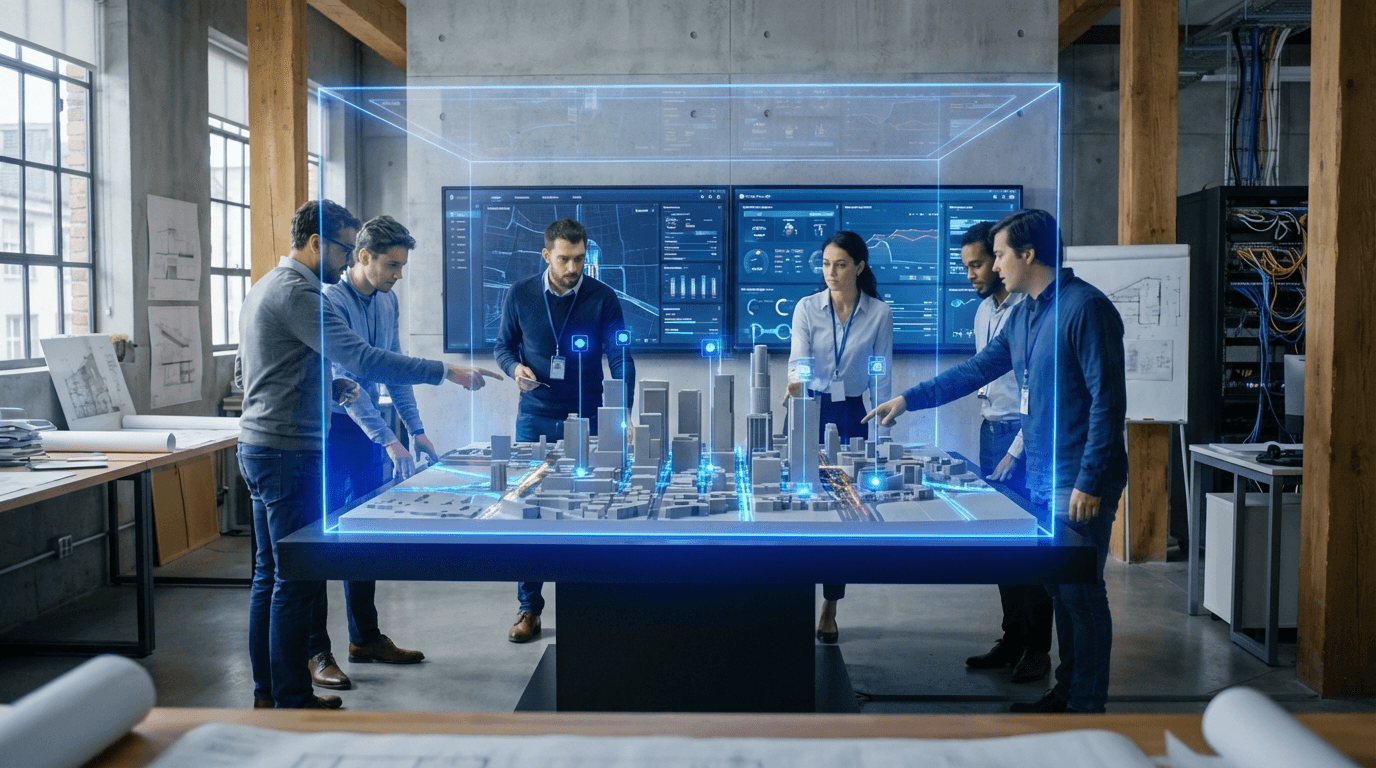
Urban Digital Twin Platforms
Urban Digital Twin Platforms represent a convergence of geographic information systems, Internet of Things sensors, and advanced simulation engines to create dynamic, three-dimensional virtual replicas of entire cities or specific urban districts. Unlike static maps or traditional planning models, these platforms continuously ingest real-time data streams from thousands of sources—traffic cameras, utility meters, weather stations, building management systems, and mobile devices—to maintain an up-to-the-minute representation of urban conditions. The underlying architecture typically combines cloud computing infrastructure with spatial databases and physics-based simulation engines, enabling the platform to not only mirror current conditions but also model how changes in one system might cascade through interconnected urban networks. This technical foundation allows the digital twin to function as both a monitoring dashboard and a predictive laboratory, where proposed interventions can be tested virtually before committing resources to physical implementation.
The fundamental challenge these platforms address is the fragmentation of urban data and decision-making across multiple agencies and departments that rarely share information or coordinate planning efforts. Transportation departments, water utilities, emergency services, and urban planning offices have traditionally operated in silos, each maintaining separate datasets and models that cannot easily communicate with one another. This fragmentation leads to inefficient resource allocation, missed opportunities for synergy, and sometimes conflicting initiatives that work at cross-purposes. Urban Digital Twin Platforms solve this by providing a common operating picture—a single, authoritative spatial model where all stakeholders can visualize how their respective systems interact. This shared view enables scenario planning that accounts for complex interdependencies: planners can assess whether a proposed development will overload existing water infrastructure, transportation officials can model how new transit routes might affect traffic patterns, and emergency managers can simulate evacuation scenarios that account for real-time road conditions and building occupancy.
Early implementations have emerged in several forward-thinking municipalities, where these platforms are moving beyond pilot projects into operational use. City officials are using digital twins to optimize energy consumption across municipal buildings, coordinate construction projects to minimize disruption, and plan climate adaptation strategies by modeling flood risks under different infrastructure scenarios. The technology has proven particularly valuable during crisis response, allowing emergency operations centers to visualize incidents in spatial context and coordinate multi-agency responses more effectively. As sensor networks become more ubiquitous and computing costs continue to decline, these platforms are evolving from specialized tools used by technical experts into accessible interfaces that can inform public engagement and participatory planning processes. The trajectory points toward a future where digital twins become standard infrastructure for urban governance, fundamentally changing how cities understand themselves and make decisions about their physical evolution.
Related Organizations

The agency that commissioned and oversees 'Virtual Singapore', the world's most advanced digital twin for city governance.


Cityzenith
United States · Startup
Develops the SmartWorldOS digital twin platform for cities and large building portfolios.

Software corporation specializing in 3D design and digital mock-ups.

Global leader in GIS software (ArcGIS), providing the spatial analytics layer used by thousands of local governments for urban planning and policy.

Developing foundation models for robotics (Project GR00T) and vision-language models like VILA.

Industrial giant offering the 'Senseye Predictive Maintenance' suite and MindSphere IoT platform.


International consortium developing standards like GeoPose to ensure interoperability between different AR clouds and location services.

A subsidiary of Engie, providing 3D city modelling and simulation for telecommunications and smart city planning.
Supporting Evidence
Research this in Signals
Signals turns a topic into a sourced research record you can inspect and rerun. Your first scan is free, and this one starts with Urban Digital Twin Platforms already loaded, so edit it or scan as is.