Digital Twin Cities & Regions
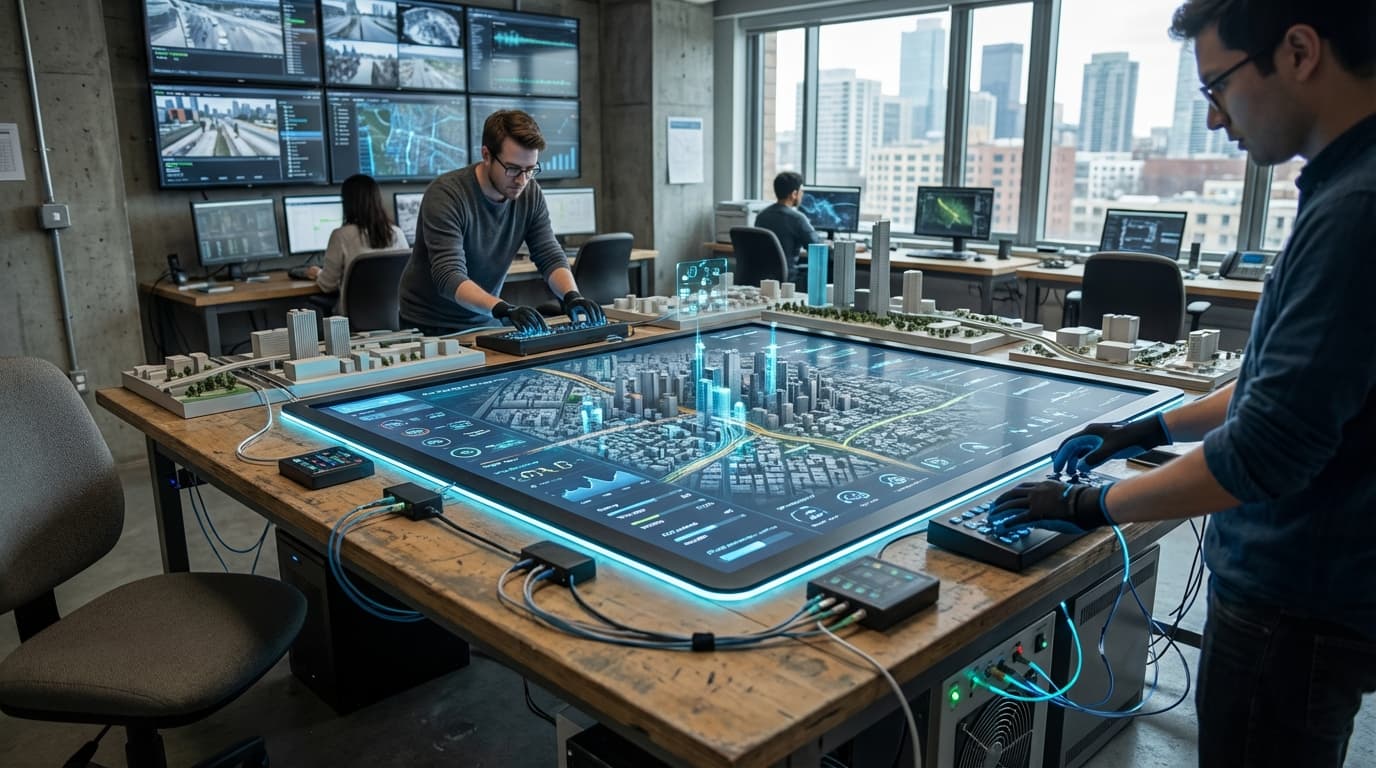
Urban planners and city administrators face an increasingly complex challenge: how to make informed decisions about infrastructure, services, and policies in environments where millions of variables interact simultaneously. Traditional planning methods, which rely on historical data, static models, and limited simulations, often fail to capture the dynamic, interconnected nature of modern cities. Digital Twin Cities & Regions address this fundamental limitation by creating comprehensive virtual replicas of entire urban areas that mirror their physical counterparts in real-time. These sophisticated digital models integrate data from diverse sources—IoT sensors embedded throughout the city, traffic cameras, geographic information systems (GIS), utility networks, weather stations, and telecommunications infrastructure. The technology works by continuously ingesting this multi-layered data stream and processing it through advanced algorithms that maintain synchronization between the physical city and its digital counterpart. This creates a living, breathing model where changes in the real world are reflected virtually within seconds or minutes, enabling planners to observe patterns, test hypotheses, and predict outcomes with unprecedented accuracy.
The transformative potential of digital twin technology lies in its ability to simulate complex urban scenarios before committing resources to physical implementation. City officials can model the impact of new transportation routes on traffic congestion, test emergency response protocols under various disaster scenarios, or evaluate how proposed building developments might affect wind patterns, sunlight exposure, and energy consumption in surrounding neighborhoods. This capability addresses a critical gap in urban planning: the inability to conduct real-world experiments without significant cost and disruption. Research suggests that cities employing digital twins can reduce infrastructure planning errors, optimize resource allocation, and respond more effectively to both routine challenges and crisis situations. The technology also enables cross-departmental collaboration, as transportation, utilities, public safety, and environmental agencies can all work within the same virtual environment, identifying conflicts and synergies that might otherwise remain hidden until implementation. Furthermore, digital twins support climate resilience planning by allowing cities to model the long-term effects of rising temperatures, changing precipitation patterns, and extreme weather events on infrastructure and populations.
Early implementations of digital twin technology are already demonstrating tangible benefits in cities worldwide, though widespread adoption faces significant technical hurdles. The system requires substantial telecommunications bandwidth to handle the constant flow of data from thousands or millions of sensors, as well as edge computing infrastructure positioned throughout the city to process information locally before transmitting it to central systems. This distributed architecture is essential for maintaining the real-time responsiveness that makes digital twins valuable—delays of even a few minutes can render simulations less useful for time-sensitive decisions like traffic management or emergency response. As 5G networks expand and edge computing becomes more prevalent, the feasibility of maintaining synchronized digital twins improves considerably. Industry analysts note that the technology is evolving beyond simple visualization tools into predictive platforms that use machine learning to anticipate future conditions based on historical patterns and current trends. This progression aligns with broader movements toward data-driven governance and smart city initiatives, positioning digital twins as a foundational technology for urban management in an era of rapid change, population growth, and environmental uncertainty.
Related Organizations


Software corporation specializing in 3D design and digital mock-ups.

A dynamic 3D city model and collaborative data platform, including the 3D maps of Singapore.

Cityzenith
United States · Startup
Develops the SmartWorldOS digital twin platform for cities and large building portfolios.

Global leader in GIS software (ArcGIS), providing the spatial analytics layer used by thousands of local governments for urban planning and policy.

Hexagon AB
Sweden · Company
A global leader in sensor, software, and autonomous solutions, providing reality capture for digital twins.

Developing foundation models for robotics (Project GR00T) and vision-language models like VILA.

Creates digital twins of civil infrastructure to help teams visualize and manage sites.

A subsidiary of Engie, providing 3D city modelling and simulation for telecommunications and smart city planning.

An interdisciplinary research institute focusing on the science of cities, simulation, and visualization.
Supporting Evidence
Research this in Signals
Signals turns a topic into a sourced research record you can inspect and rerun. Your first scan is free, and this one starts with Digital Twin Cities & Regions already loaded, so edit it or scan as is.