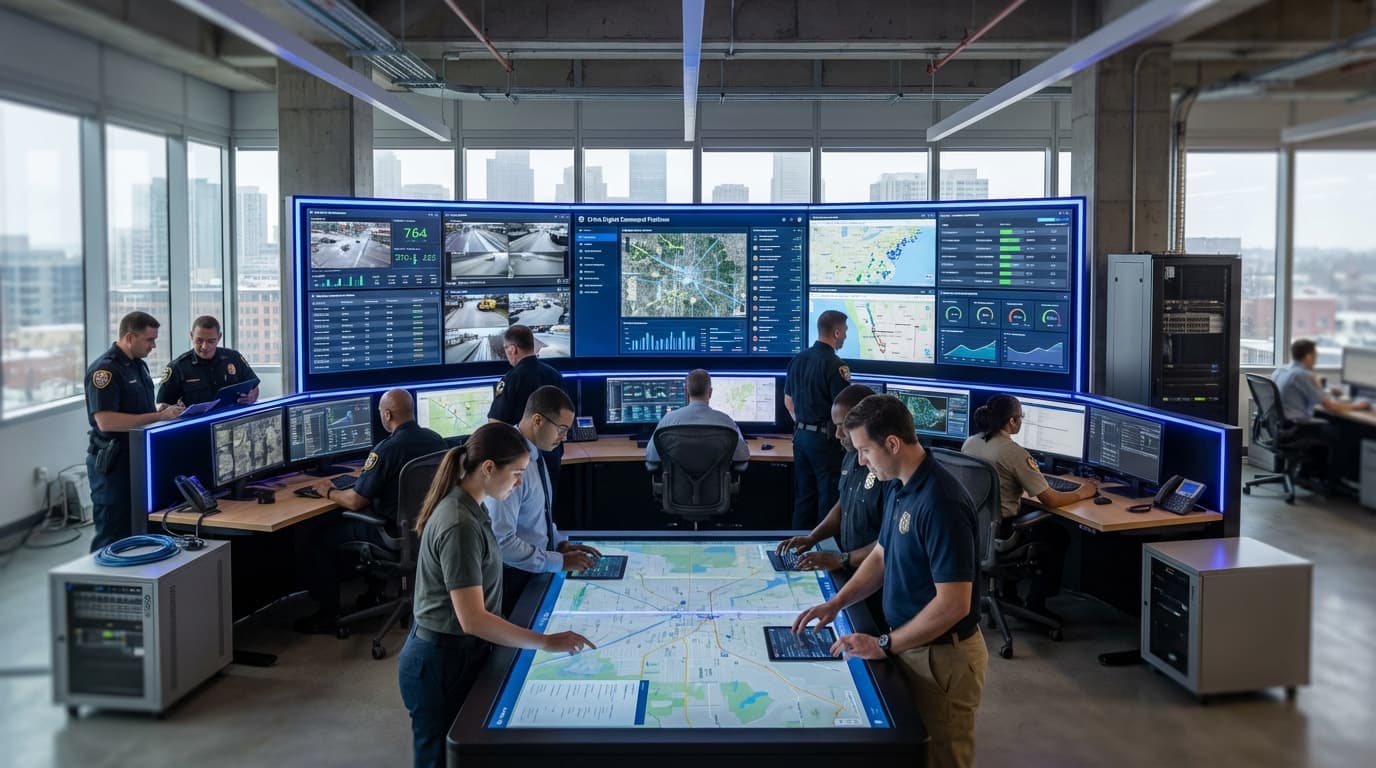
Crisis Digital Command Platforms
Crisis Digital Command Platforms represent a fundamental shift in how governments and emergency services coordinate responses to large-scale disasters and public safety incidents. These systems function as centralised digital hubs that aggregate and synthesise information from multiple sources—including IoT sensors, weather stations, social media feeds, emergency calls, satellite imagery, and field reports from first responders—into a unified operational picture. The technical architecture typically combines geographic information systems (GIS) with real-time data processing engines, machine learning algorithms for pattern recognition, and secure communication protocols that allow multiple agencies to share sensitive information while maintaining appropriate access controls. By creating a common operating picture, these platforms overcome the traditional challenge of information silos, where different emergency services operate with incomplete or conflicting data about an evolving crisis.
The fundamental problem these platforms address is the coordination breakdown that has historically plagued multi-agency emergency responses. During major incidents such as hurricanes, terrorist attacks, or industrial accidents, police, fire departments, emergency medical services, public health authorities, and utility companies must work in concert, yet they often rely on incompatible communication systems and conflicting situational assessments. Crisis Digital Command Platforms solve this by providing a shared digital workspace where all stakeholders can view the same real-time information, track resource deployment, identify capability gaps, and coordinate tactical decisions. This integration enables more efficient resource allocation—ensuring ambulances aren't dispatched to areas already saturated with medical support while other zones remain underserved—and facilitates faster decision-making by giving commanders visibility into the full scope of available assets and emerging threats. The platforms also support predictive analytics, using historical data and current conditions to forecast how a crisis might evolve, allowing agencies to position resources proactively rather than reactively.
Early deployments of these systems have demonstrated measurable improvements in response times and inter-agency coordination during both natural disasters and public health emergencies. Cities and regions are increasingly adopting these platforms as core infrastructure for resilience planning, integrating them with existing emergency operations centres and training personnel across multiple agencies in their use. The technology has proven particularly valuable during complex, multi-day incidents where sustained coordination is essential, such as wildfire evacuations or pandemic response efforts. As climate change intensifies the frequency and severity of natural disasters, and as urban populations grow more vulnerable to cascading infrastructure failures, Crisis Digital Command Platforms are becoming essential components of modern governance. The trajectory points toward increasingly sophisticated systems that incorporate artificial intelligence for automated threat detection, drone feeds for aerial reconnaissance, and citizen engagement tools that transform residents from passive recipients of emergency services into active participants in community resilience.
Related Organizations


Builds software that empowers organizations to integrate their data, decisions, and operations (Foundry and AIP).

Global leader in GIS software (ArcGIS), providing the spatial analytics layer used by thousands of local governments for urban planning and policy.

A global leader in public safety and enterprise security.

Develops Next-Generation 911 technology allowing citizens to stream live video and instant location data to emergency call centers.

Supplier of communication and information systems for control centers, actively developing UTM solutions for Austria and Norway.

Unified security platform blending IP security, video surveillance, and access control.

A cloud-native dispatch platform that democratizes access to advanced situational awareness tools for smaller agencies.

Provides an intelligent safety platform that links data from connected devices (wearables, apps) directly to 911 and first responders.

Offers the SAFE platform, a unified control room solution for mission-critical operations in public safety and security.
Supporting Evidence
Research this in Signals
Signals turns a topic into a sourced research record you can inspect and rerun. Your first scan is free, and this one starts with Crisis Digital Command Platforms already loaded, so edit it or scan as is.