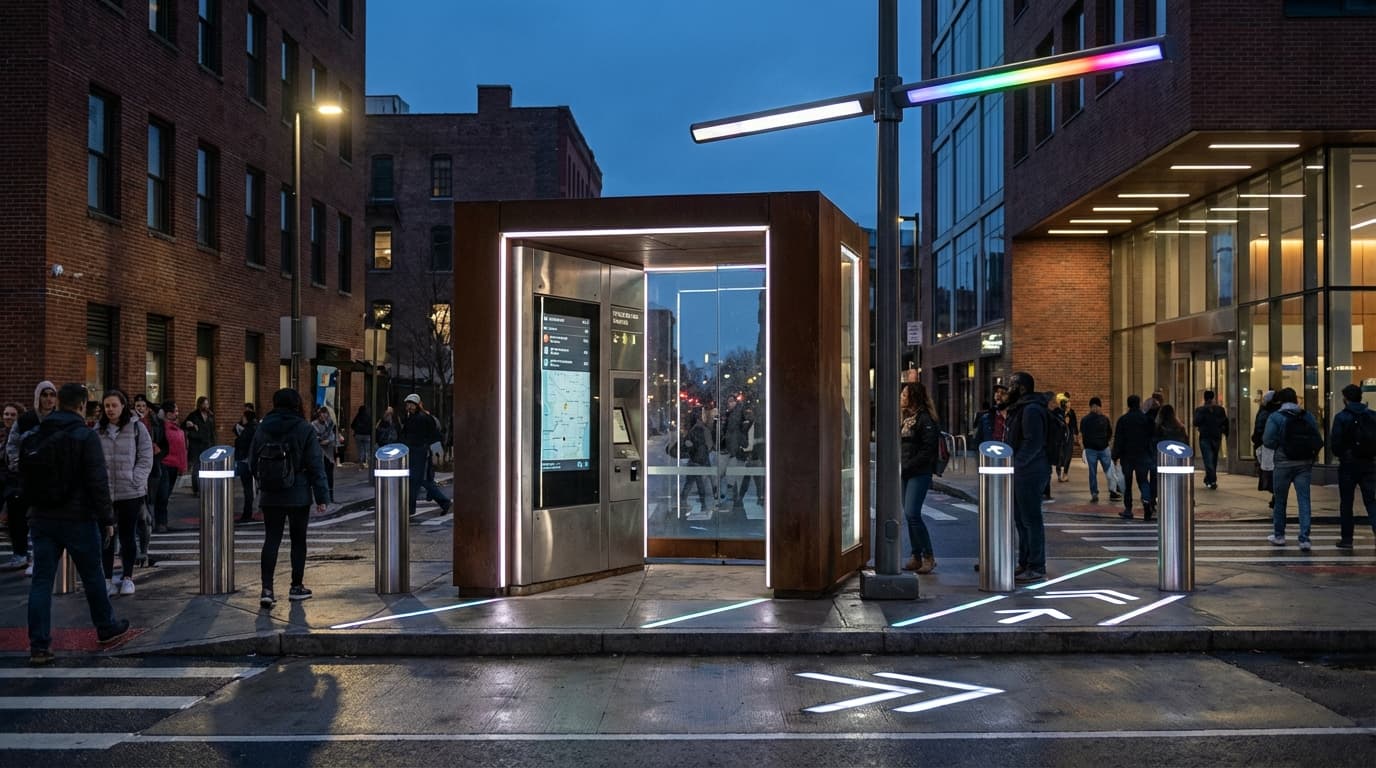
Urban Signaling & Wayfinding
Urban environments face mounting challenges in managing the movement of people, vehicles, and information through increasingly congested spaces. Traditional signage and wayfinding systems—static signs, painted road markings, and fixed traffic signals—struggle to adapt to real-time conditions or communicate nuanced information to diverse populations. The problem intensifies as cities grow denser and more complex, with multiple modes of transportation competing for limited space and attention. Urban Signaling & Wayfinding addresses these limitations by transforming light itself into a dynamic, programmable communication medium embedded directly into the urban fabric. This approach integrates LED arrays, projection systems, and responsive lighting into pavements, crosswalks, building facades, street furniture, and infrastructure surfaces. These systems employ sensors, connectivity networks, and control algorithms to detect environmental conditions—pedestrian density, traffic patterns, weather events, or emergency situations—and respond by altering color, intensity, pattern, or direction of light in real time. The technology operates on principles of visual perception and behavioral psychology, using light's immediacy and universality to convey information that transcends language barriers and captures attention more effectively than conventional signage.
The practical value of this solution lies in its ability to address multiple urban management challenges simultaneously. Cities deploying embedded pavement lighting report improvements in pedestrian safety at crossings, where illuminated pathways guide foot traffic and warn drivers of crossing activity. Dynamic light strips can redirect pedestrian flow during crowded events, manage queue formation at transit stations, or create temporary pathways during construction or emergencies. For traffic management, color-coded road surface lighting can designate lanes for different vehicle types, indicate speed limits through visual cues, or warn drivers of upcoming hazards—all adaptable to changing conditions throughout the day. Emergency response scenarios benefit particularly from this infrastructure, as coordinated lighting across multiple surfaces can guide evacuations, mark safe zones, or alert populations to dangers faster than traditional alarm systems. The technology also enables new forms of behavioral influence, with research suggesting that subtle light-based nudges can encourage desired behaviors like maintaining social distance, reducing jaywalking, or directing attention to important information without the visual clutter of additional signs.
Early implementations have appeared in transit hubs, smart city pilot districts, and high-traffic pedestrian zones across Europe and Asia, where municipalities are testing various configurations and use cases. These deployments range from simple LED-embedded crosswalks that activate when pedestrians approach to sophisticated building facade systems that display directional arrows, safety messages, or real-time transit information. The technology aligns with broader smart city initiatives that emphasize responsive infrastructure and data-driven urban management. As cities continue to densify and the Internet of Things expands, urban lighting infrastructure increasingly serves dual purposes—providing illumination while simultaneously functioning as a distributed communication network. Future developments point toward more sophisticated integration with urban data platforms, enabling coordinated responses across entire districts and personalized wayfinding delivered through the built environment itself, fundamentally reimagining how cities communicate with their inhabitants.
Related Organizations

Starling Technologies
United States · Startup
A technology company developing the Starling Crossing, an interactive LED road surface.

Transport infrastructure construction group, developer of 'Flowell' dynamic road marking.

A large traffic technology group providing intelligent traffic lights, LED signage, and detection systems for safer pedestrian crossings.

Worldwide leader in outdoor lighting solutions with a strong focus on smart city applications.


Offers a traffic management platform powered by IoT sensors installed in road studs (smart cat's eyes).

A leading provider of intelligent traffic systems, Yunex develops the camera and software infrastructure used to enforce Low Emission Zones in major cities like London.

Pioneered 'Digital Light' technology which projects guide lines and warning symbols onto the road surface.


Contracted by JAXA to develop the HTV-X cargo vehicle which will supply Gateway.