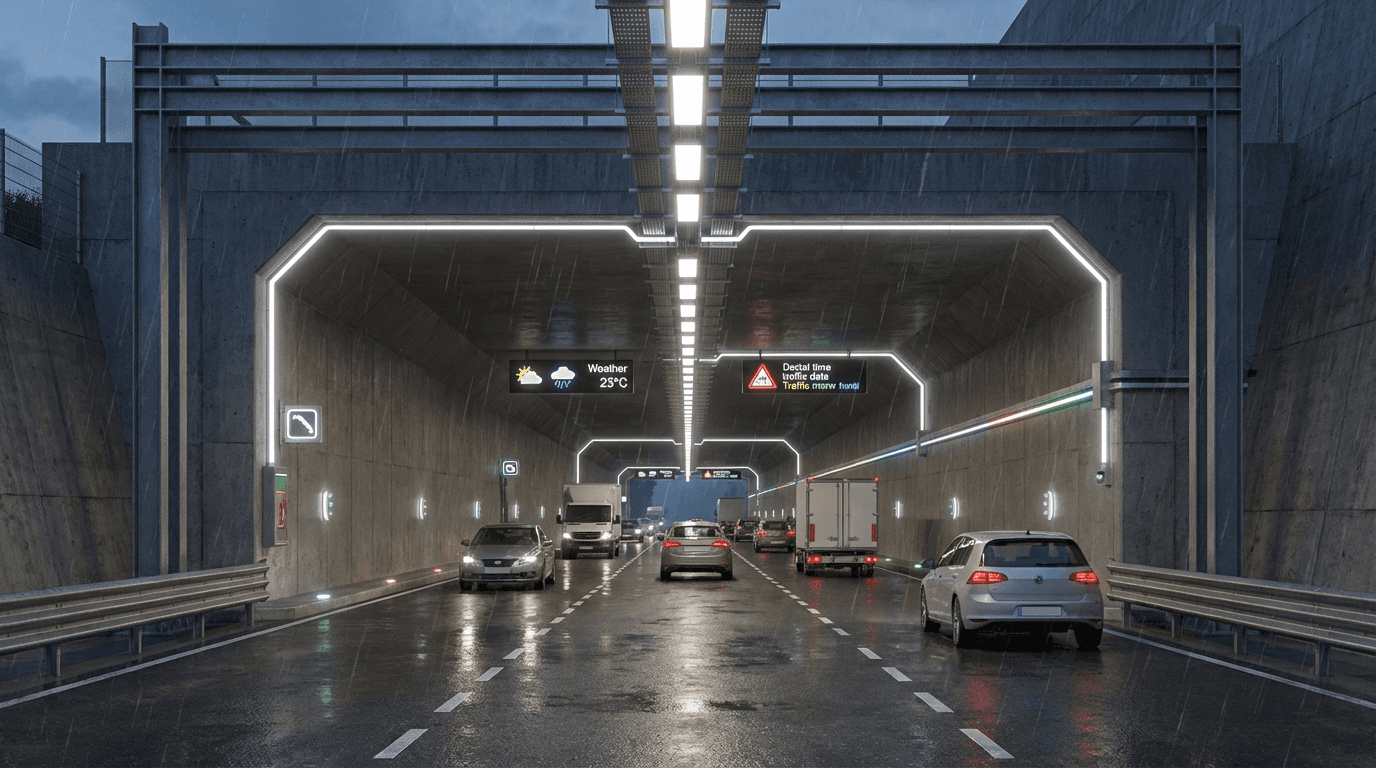
Adaptive Roadway & Tunnel Lighting
Adaptive roadway and tunnel lighting represents a significant evolution beyond static illumination systems, employing sensors, networked controls, and intelligent algorithms to modulate light output in response to real-time conditions. Unlike conventional street lighting that operates at fixed intensities regardless of actual need, adaptive systems continuously monitor factors such as traffic density, vehicle speed, weather conditions, ambient light levels, and even specific incidents like accidents or maintenance activities. The technology typically integrates photometric sensors to measure natural daylight, presence detectors to track vehicle flow, and atmospheric sensors to identify fog, rain, or snow that degrades visibility. These inputs feed into centralized or distributed control systems that adjust luminaire intensity, color temperature, and beam distribution across individual fixtures or entire corridor segments. In tunnels, where the transition from bright daylight to artificial light poses particular visual challenges, adaptive systems can create graduated lighting zones that ease driver adaptation and reduce the "black hole" effect at tunnel entrances.
The primary challenge this technology addresses is the inherent inefficiency and safety limitations of one-size-fits-all lighting schemes. Traditional roadway lighting consumes substantial energy by operating at full power throughout the night, regardless of whether roads are empty or congested, clear or fog-bound. This approach also fails to respond to dynamic safety needs—a minor fender-bender may require increased illumination for emergency responders, while dense fog demands higher light levels to penetrate reduced visibility. Adaptive systems overcome these limitations by delivering the right amount of light at the right time, potentially reducing energy consumption by thirty to fifty percent in typical deployments while simultaneously improving safety outcomes. The technology also extends infrastructure lifespan by reducing thermal stress on luminaires during low-demand periods and enables predictive maintenance through continuous monitoring of fixture performance and environmental conditions.
Current implementations of adaptive roadway lighting are expanding beyond pilot programs into mainstream infrastructure projects, particularly in Europe and parts of Asia where energy costs and sustainability mandates drive adoption. Highway authorities have deployed these systems on major motorways, using traffic-responsive dimming during low-volume nighttime hours while maintaining full illumination during peak periods or adverse weather. Tunnel installations represent some of the most sophisticated applications, with systems that adjust not only to external daylight levels but also to the specific visual adaptation needs of drivers entering and exiting these confined spaces. The technology aligns with broader smart city initiatives, often integrating with traffic management systems, emergency response networks, and municipal energy management platforms. As LED technology continues to mature and wireless control protocols become more standardized, adaptive lighting is positioned to become the default approach for new roadway infrastructure and retrofit projects, contributing to both climate goals and the evolution of responsive urban environments that prioritize both efficiency and human safety.
Related Organizations

The international authority on light, illumination, color, and color spaces, defining the standard observers and colorimetric functions used in all modeling.

Specializes in power line control systems specifically for tunnel lighting.

Worldwide leader in outdoor lighting solutions with a strong focus on smart city applications.

Dutch high-tech company specializing in motion sensors and wireless lighting controls for adaptive street lighting.

Canadian provider of IoT and smart city management platforms, specifically focusing on remote control of streetlights.

Developer of the inteliLIGHT system, a LoRaWAN/NB-IoT compatible street lighting control solution. Acquired by Lucy Group.

Illuminating Engineering Society (IES)
United States · Company
The technical society in North America that develops standards for the lighting industry.

A global leader in IoT and smart metering solutions, providing the hardware and software backbone for AMI deployments worldwide.

Phoenix Contact
Germany · Company
Major supplier of charging technology components, including High Power Charging (HPC) cables, connectors, and charge controllers.

Electric utility company serving the state of Georgia.