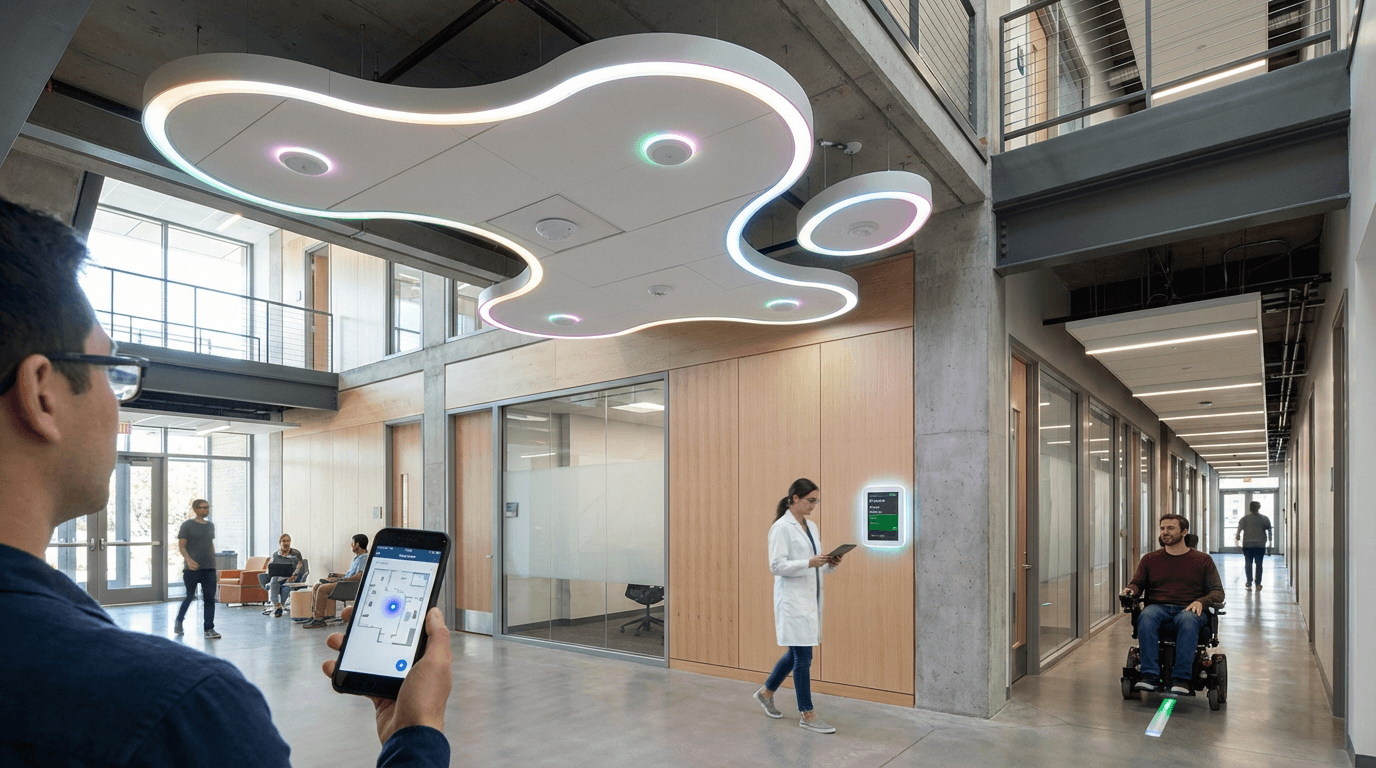
Indoor Positioning via Lighting
Indoor positioning systems have long struggled with the limitations of GPS, which performs poorly within buildings due to signal attenuation and multipath interference. Traditional solutions relying on Wi-Fi triangulation or Bluetooth beacons often face challenges with accuracy, infrastructure costs, and radio frequency congestion in densely occupied spaces. Indoor positioning via lighting addresses these constraints by repurposing existing LED luminaires as location beacons, leveraging visible light communication (VLC) technology to transmit unique identifiers through imperceptible modulation of light output. Each fixture emits a distinct signal that can be detected by smartphone cameras or specialized photodetectors, allowing devices to determine their precise location by identifying which lights are visible and analyzing signal characteristics. This approach achieves positioning accuracy ranging from meter-level to centimeter-level precision, depending on the density of fixtures and sophistication of the receiving hardware, while utilizing infrastructure that buildings already require for illumination.
The technology solves critical problems in environments where precise indoor navigation is essential but traditional methods fall short. In healthcare facilities, patients and visitors can receive turn-by-turn directions to specific departments or rooms, reducing stress and improving operational efficiency in sprawling hospital complexes. Warehouses and manufacturing facilities benefit from real-time worker and asset tracking, enabling optimized picking routes and inventory management without the electromagnetic interference concerns that plague RFID systems in metal-rich environments. For individuals with visual impairments, lighting-based positioning enables accessibility applications that provide audio guidance along predetermined safe routes, while museums and retail spaces can deliver context-aware content triggered by a visitor's exact position within a gallery or showroom. The system's reliance on existing lighting infrastructure significantly reduces deployment costs compared to installing dedicated beacon networks, while the use of visible light rather than radio frequencies eliminates concerns about spectrum licensing and interference with sensitive medical or industrial equipment.
Early commercial deployments have demonstrated the technology's viability in airports, shopping centers, and corporate campuses, where building operators appreciate the dual-purpose nature of fixtures that provide both illumination and positioning services. Research initiatives continue to refine algorithms for handling ambient light interference and improving accuracy in challenging conditions, while integration with building management systems enables analytics on space utilization and foot traffic patterns. As LED lighting adoption accelerates and smart building concepts gain traction, indoor positioning via lighting represents a convergence of illumination and digital infrastructure that aligns with broader trends toward intelligent, responsive built environments. The technology's ability to function without requiring users to install specialized apps—many implementations work with standard smartphone cameras—positions it as an increasingly practical solution for the growing demand for seamless indoor navigation and location-based services in an urbanizing world.
Related Organizations

IoT platform for commercial buildings (acquired by Siemens) with sensors for light, heat, and occupancy.

Institute of Electrical and Electronics Engineers (IEEE)
United States · Consortium
The world's largest technical professional organization dedicated to advancing technology for the benefit of humanity.

Develops LiFi components and systems, co-founded by the 'father of LiFi' Harald Haas.

The standards organization that oversees the development of Bluetooth technology, including the new Channel Sounding feature.

French company specializing in LiFi solutions for secure environments and aerospace.

Developer of a wireless lighting control platform based on Bluetooth Low Energy mesh, enabling decentralized orchestration of lighting networks.

Provides 'Deep Location' technology for high-performance indoor positioning and mapping.