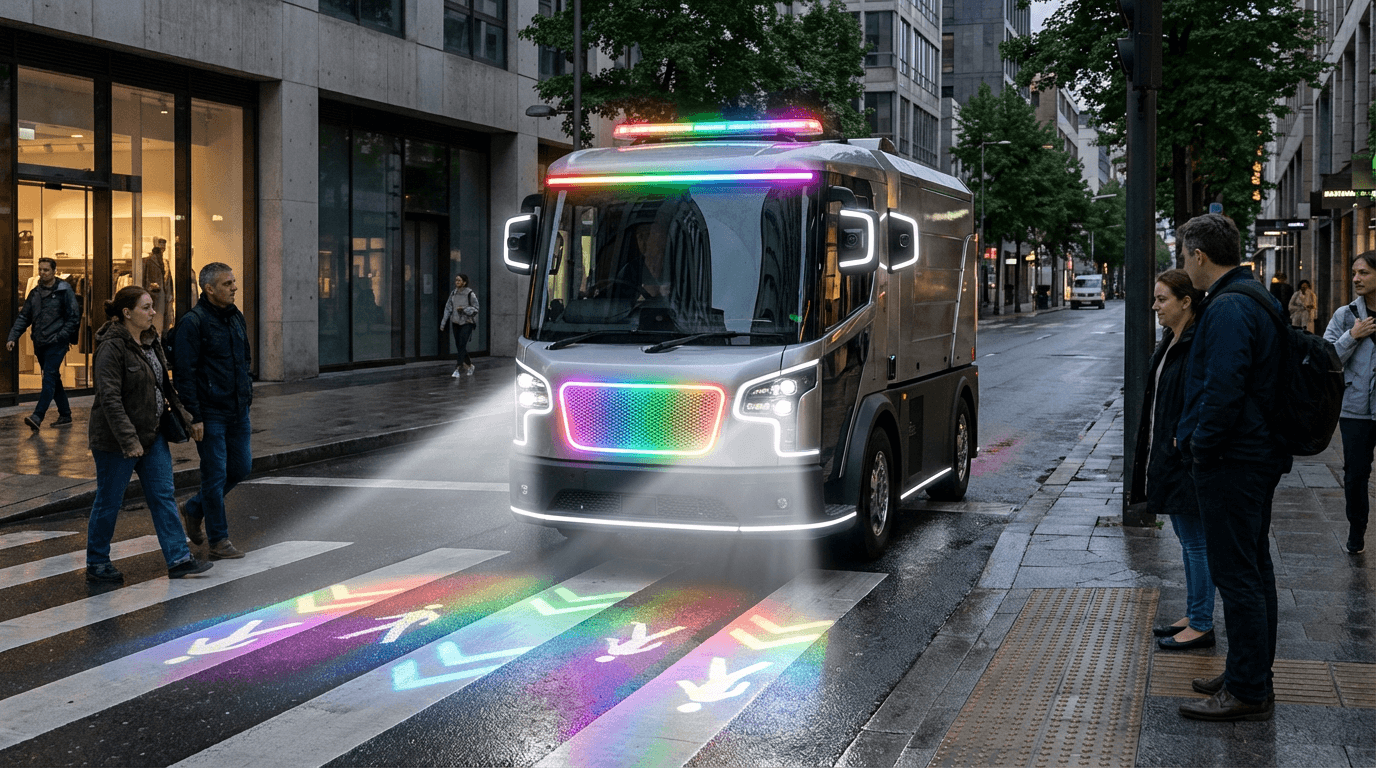
Vehicle-to-environment Illumination
Vehicle-to-environment illumination represents a fundamental shift in how autonomous vehicles communicate with the world around them. Traditional automotive lighting has primarily served functional purposes—illuminating the road ahead and signaling basic maneuvers like turns or stops. However, as vehicles transition toward full autonomy, the absence of a human driver creates a critical communication void. Pedestrians, cyclists, and other road users have historically relied on subtle cues like eye contact, hand gestures, and driver body language to navigate shared spaces safely. Vehicle-to-environment illumination addresses this gap by transforming a vehicle's external surfaces into dynamic communication interfaces. These systems employ high-resolution projection technologies, programmable LED arrays, and adaptive lighting architectures that can display symbols, patterns, text, and even animated sequences on road surfaces and nearby infrastructure. The underlying technology integrates sensor data from cameras, LIDAR, and radar systems with sophisticated algorithms that interpret the vehicle's surroundings and determine appropriate visual signals to broadcast in real-time.
The implementation of vehicle-to-environment illumination tackles several pressing challenges in the deployment of autonomous vehicles. Research suggests that public trust in self-driving technology remains a significant barrier to adoption, with pedestrians reporting uncertainty about when it is safe to cross in front of driverless vehicles. By projecting virtual crosswalks onto the pavement, displaying directional arrows indicating the vehicle's intended path, or showing status indicators that communicate whether the vehicle has detected a pedestrian, these systems create a shared visual language that transcends traditional automotive signaling. Industry analysts note that this technology also addresses regulatory concerns, as transportation authorities worldwide grapple with establishing safety standards for human-machine interaction in mixed traffic environments. Beyond safety, vehicle-to-environment illumination enables new forms of urban communication, potentially displaying warnings about road hazards to following vehicles, coordinating with smart city infrastructure, or even providing wayfinding assistance to pedestrians in complex intersections.
Early deployments of vehicle-to-environment illumination have appeared in prototype autonomous vehicles from major automotive manufacturers and technology companies, with pilot programs testing various communication protocols in controlled urban environments. Current applications range from simple status indicators—such as illuminated strips that change color to signal autonomous mode engagement—to sophisticated projection systems that can adapt messaging based on environmental conditions and the specific road users present. Some implementations project the vehicle's planned trajectory as a light path on the road surface, while others display symbolic representations like stop signs or yielding gestures. As autonomous vehicle technology matures and regulatory frameworks evolve, vehicle-to-environment illumination is expected to become a standard safety feature, potentially governed by international standards that ensure consistent communication across different manufacturers and regions. This technology represents a crucial bridge between the current transportation paradigm and a future where human and machine road users must coexist seamlessly, transforming lighting from a purely functional element into an essential component of urban communication infrastructure.
Related Organizations

Produces the Eviyos hybrid LED, a multipixel light source designed specifically for high-resolution adaptive headlights and road projection.

Develops high-resolution lighting systems (Digital FlatLight) capable of projecting symbols and warnings onto the road for communication.

Developing sensor-integrated headlamps and external communication displays for autonomous shuttles.

Pioneered 'Digital Light' technology which projects guide lines and warning symbols onto the road surface.

Major automotive supplier that produced the first automotive-grade LiDAR (SCALA).

Automotive supplier producing the h-Digi lighting module, which uses micro-mirrors to project high-resolution light patterns on the road.

Produces mmWave radar sensors (IWR series) with specific SDKs and reference designs for vital signs monitoring.

Institute for Applied Optics and Precision Engineering, conducting advanced research on micro-optics and freeform surfaces.

Specializes in premium lighting systems and high-definition projection modules for luxury automakers.