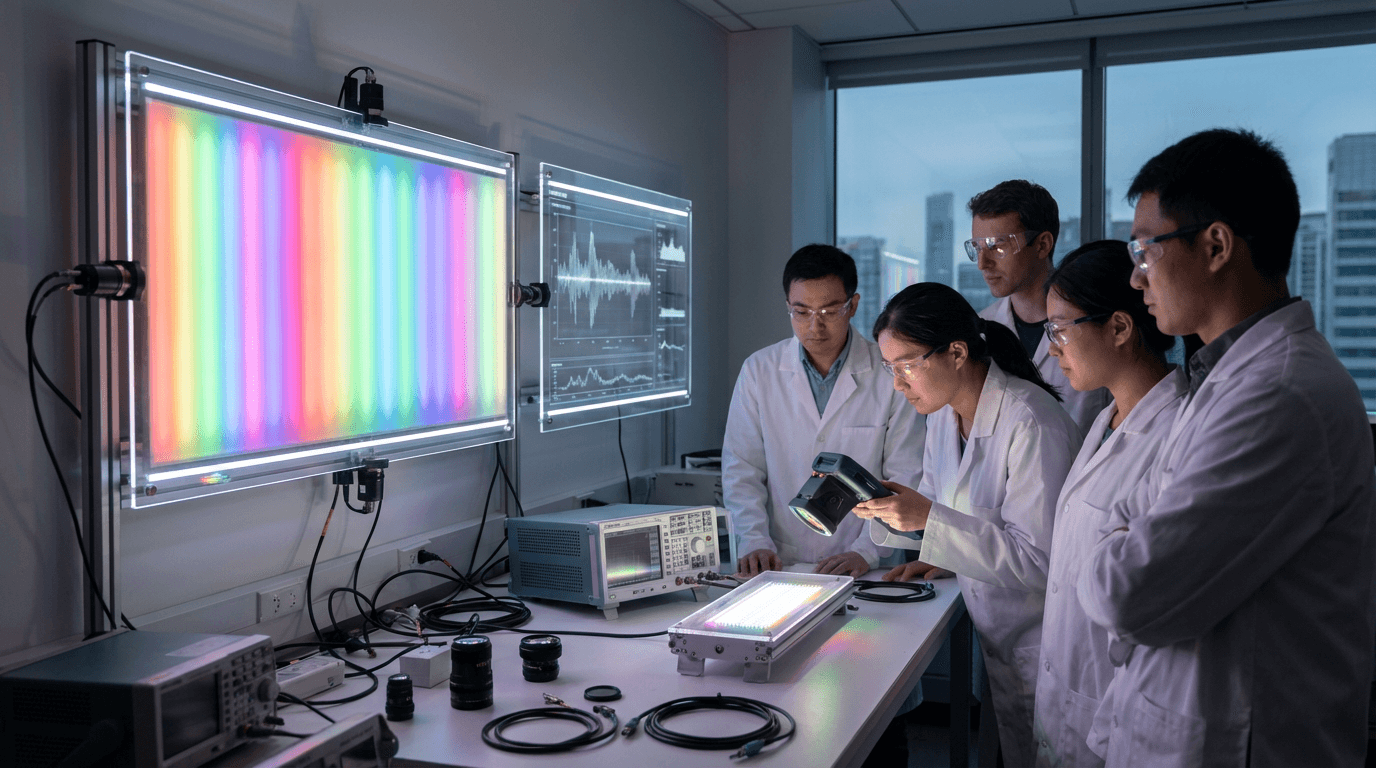
Temporal Light Artefacts (TLA) Analysis & Mitigation
Temporal Light Artefacts represent a critical challenge in modern LED lighting systems, where rapid fluctuations in light output—often imperceptible to the naked eye—can trigger discomfort, visual fatigue, headaches, and in extreme cases, photosensitive epileptic seizures. Unlike traditional incandescent sources that produce inherently stable light due to thermal inertia, LEDs respond instantaneously to changes in electrical current, making them susceptible to temporal instabilities introduced by dimming methods, driver electronics, and power supply variations. The most common culprit is pulse-width modulation (PWM) dimming, a technique that rapidly switches LEDs on and off to control brightness. While effective for maintaining color consistency, PWM can create visible flicker at low frequencies or stroboscopic effects that make moving objects appear to jump or freeze—a serious safety concern in industrial settings with rotating machinery. TLA analysis software employs sophisticated measurement protocols and metrics such as PstLM (short-term flicker perceptibility) and SVM (stroboscopic visibility measure) to quantify these temporal disturbances across the full spectrum of human visual sensitivity, accounting for both photopic and peripheral vision responses.
The lighting industry faces mounting pressure to address TLA concerns as awareness grows among building designers, occupational health specialists, and regulatory bodies. Poor temporal light quality can undermine the energy efficiency gains of LED adoption if occupants experience discomfort or reduced productivity in flickering environments. Research suggests that even subliminal flicker—fluctuations below conscious perception thresholds—may contribute to eye strain and cognitive fatigue during prolonged exposure. TLA mitigation tools enable manufacturers to optimize driver designs by identifying problematic frequency ranges, evaluating alternative dimming strategies such as amplitude modulation or hybrid approaches, and ensuring adequate power supply filtering. For lighting specifiers and facility managers, these software platforms provide objective criteria for comparing products and verifying compliance with emerging standards like IEEE 1789 and CIE technical notes on flicker. By integrating TLA analysis into the design and procurement process, stakeholders can prevent costly retrofits and protect vulnerable populations including children, individuals with autism spectrum disorders, and those prone to migraine.
Current deployment of TLA analysis tools spans research laboratories, lighting manufacturer quality control departments, and increasingly, commissioning processes for critical environments such as hospitals, schools, and precision manufacturing facilities. Early adopters in the architectural lighting community have begun incorporating temporal stability specifications into project requirements, moving beyond traditional metrics like color rendering and efficacy. The technology supports both laboratory-grade spectroradiometers for detailed characterization and portable field instruments for on-site verification, democratizing access to temporal quality assessment. As smart lighting systems proliferate, TLA software is evolving to address new challenges including flicker introduced by networked controls, interactions between multiple light sources, and dynamic tuning scenarios. Industry analysts note a convergence between TLA mitigation and broader human-centric lighting initiatives, recognizing that temporal stability is as fundamental to visual comfort as spectral quality. The trajectory points toward real-time TLA monitoring integrated into intelligent drivers and building management systems, enabling adaptive compensation that maintains flicker-free operation across all conditions while preserving the flexibility and efficiency that make LED technology indispensable to modern lighting infrastructure.
Related Organizations

The international authority on light, illumination, color, and color spaces, defining the standard observers and colorimetric functions used in all modeling.
A manufacturer of light measurement equipment and software.

eldoLED
Netherlands · Company
A developer of high-performance LED drivers, now part of Acuity Brands.

Institute of Electrical and Electronics Engineers (IEEE)
United States · Consortium
The world's largest technical professional organization dedicated to advancing technology for the benefit of humanity.

The world's leading university-based research center devoted to lighting, pioneering studies on circadian stimulus (CS).


A manufacturer of spectral light measurement technology.
A manufacturer of precision spectral light measurement instruments.

A major semiconductor manufacturer developing secure chips with hardware support for PQC algorithms.

A niche lighting company that explicitly markets 'Flicker-Free' LED products targeting health-conscious consumers and film professionals.