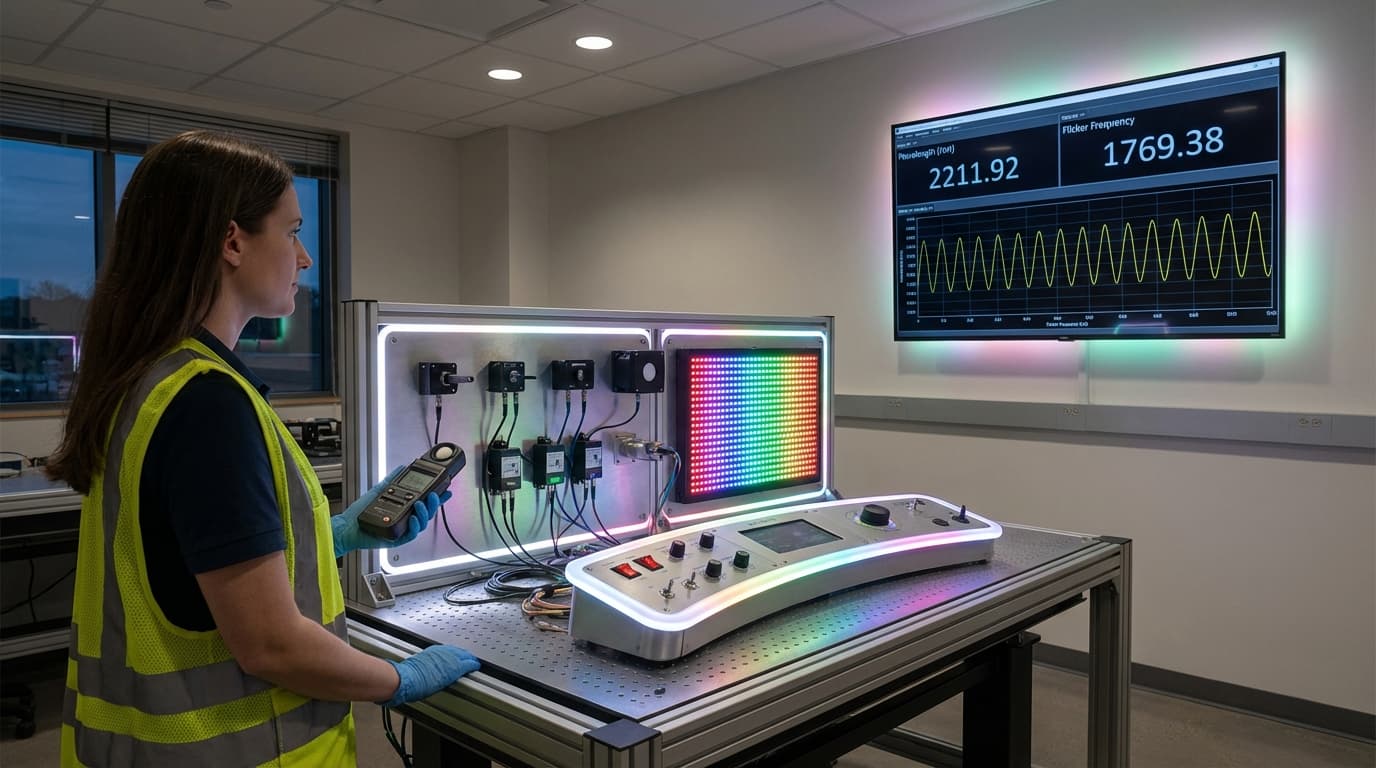
Flicker & Temporal Light Artefacts: Health and Safety
Temporal light artefacts, commonly known as flicker, represent rapid variations in light output that occur when artificial lighting systems modulate their intensity over time. While modern LED and fluorescent lighting systems offer significant energy efficiency advantages, they can produce temporal modulation at frequencies ranging from barely perceptible to completely invisible to the human eye. The technical mechanisms behind these artefacts stem from how electronic drivers regulate current to light sources, often using pulse-width modulation or other switching techniques that create periodic fluctuations in luminous output. Even when flicker occurs at frequencies above the threshold of conscious perception—typically around 70-80 Hz for most individuals—the human visual system continues to process these temporal variations at a neurological level. This phenomenon, known as the flicker fusion threshold, varies significantly among individuals and can be influenced by factors such as age, viewing angle, ambient light levels, and individual neurological sensitivity.
The health and safety implications of temporal light artefacts extend far beyond simple visual discomfort, presenting serious challenges across residential, commercial, and industrial environments. For individuals with photosensitive epilepsy, exposure to certain flicker frequencies—particularly in the 3-70 Hz range—can trigger seizures, while others may experience debilitating migraines, eye strain, headaches, and reduced cognitive performance even from imperceptible flicker. Research suggests that temporal modulation can affect circadian rhythms, visual task performance, and overall wellbeing, creating liability concerns for employers and building operators who have a duty of care toward occupants. In industrial settings, the stroboscopic effect poses particularly acute safety risks: when flickering light illuminates rotating machinery, it can create the illusion that moving parts are stationary or rotating at incorrect speeds, potentially leading to severe injuries or fatalities. This phantom array effect has been documented in manufacturing facilities, workshops, and maintenance environments where workers interact with lathes, drills, conveyor systems, and other rotating equipment.
Current industry standards and regulatory frameworks are evolving to address these risks through comprehensive measurement protocols and procurement specifications. Organizations such as the International Electrotechnical Commission and the Illuminating Engineering Society have developed metrics including the Percent Flicker and Stroboscopic Visibility Measure to quantify temporal light artefacts and establish acceptable thresholds for different applications. Forward-thinking procurement policies now specify maximum flicker levels for lighting installations, particularly in healthcare facilities, educational institutions, and workplaces where vulnerable populations may be present. Building codes in several jurisdictions are beginning to incorporate flicker requirements, while manufacturers increasingly market "flicker-free" products that maintain stable light output through improved driver design and higher modulation frequencies. As awareness grows regarding the neurological and safety impacts of temporal light artefacts, the lighting industry is moving toward a future where flicker management becomes a standard consideration in luminaire design, comparable to color rendering or energy efficiency, ensuring that the built environment supports both human health and operational safety.
Related Organizations

Institute of Electrical and Electronics Engineers (IEEE)
United States · Consortium
The world's largest technical professional organization dedicated to advancing technology for the benefit of humanity.

eldoLED
Netherlands · Company
A developer of high-performance LED drivers, now part of Acuity Brands.
A manufacturer of light measurement equipment and software.

Leader in lighting control, owner of Ketra which produces natural light simulation.

Publishes NEMA 77, a standard for Temporal Light Artifacts: Test Methods and Guidance for Classification and Limits.


A niche lighting company that explicitly markets 'Flicker-Free' LED products targeting health-conscious consumers and film professionals.

A manufacturer of spectral light measurement technology.

A major semiconductor manufacturer developing secure chips with hardware support for PQC algorithms.