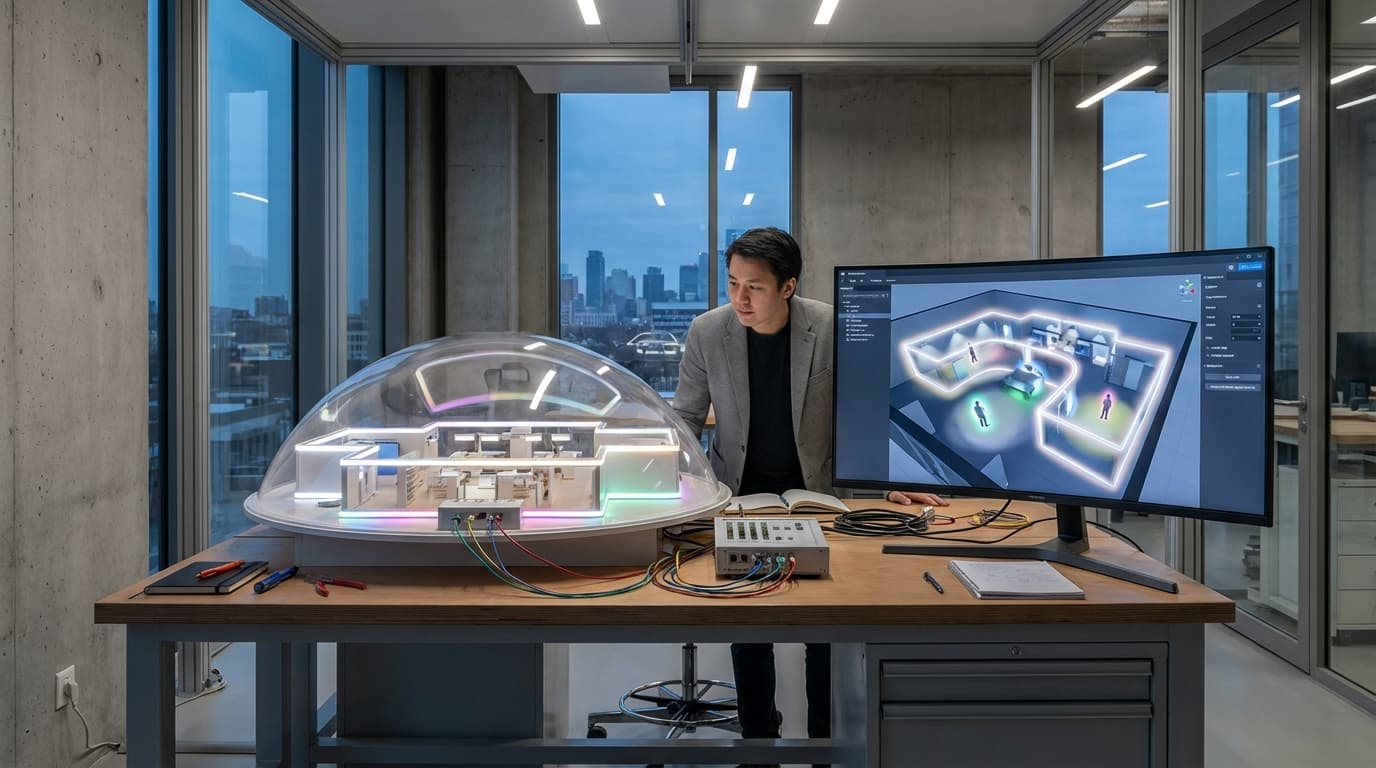
Digital Twins of Light Environments
Digital twins of light environments represent a sophisticated convergence of photometric simulation, sensor data integration, and real-time rendering technologies that create virtual replicas of physical lighting systems and their interactions with architectural spaces. At their core, these digital twins rely on advanced ray-tracing algorithms and radiometric calculations to accurately model how light behaves in three-dimensional space, accounting for variables such as surface reflectance, material properties, atmospheric conditions, and dynamic occupancy patterns. The technology integrates data from multiple sources—including building information models (BIM), photometric databases, and environmental sensors—to construct high-fidelity simulations that mirror real-world lighting conditions with remarkable precision. Unlike traditional lighting design software that produces static visualizations, digital twins operate as living models that can continuously update based on real-time sensor feedback, enabling designers to test countless scenarios ranging from emergency lighting protocols to circadian-responsive systems without physical prototyping.
The primary challenge this technology addresses is the substantial cost and risk associated with lighting infrastructure decisions in complex environments such as hospitals, industrial facilities, transportation hubs, and public spaces. Poorly designed lighting can compromise safety, reduce productivity, increase energy consumption, and fail to meet increasingly stringent regulatory standards for light pollution, glare control, and accessibility. Traditional approaches to lighting design often rely on simplified calculations and static mockups that cannot adequately predict how lighting will perform under varied conditions or how occupants will respond to different scenarios. Digital twins eliminate much of this uncertainty by allowing stakeholders to virtually experience proposed lighting schemes through immersive VR/AR interfaces, test compliance with standards such as EN 12464 or WELL Building certifications, and optimize energy efficiency by simulating annual performance across different usage patterns and daylight availability. This capability proves particularly valuable in retrofitting historic buildings where physical experimentation is impractical, or in designing adaptive lighting systems that respond to occupancy, time of day, and specific tasks.
Early implementations of digital twin technology for lighting have emerged in sectors where precision and safety are paramount. Research facilities and pharmaceutical manufacturers use these virtual environments to validate cleanroom lighting that meets contamination control requirements while supporting detailed visual tasks. Transportation authorities employ digital twins to test platform and tunnel lighting configurations that enhance passenger safety and wayfinding without costly physical trials. The technology also supports the growing field of human-centric lighting by enabling researchers to simulate and measure physiological responses to different spectral compositions and intensity patterns before deployment. As cities pursue smart infrastructure initiatives and buildings become increasingly sensor-rich, digital twins of light environments are positioned to become standard practice in lighting design workflows. The integration of artificial intelligence and machine learning into these platforms promises to further enhance their predictive capabilities, automatically suggesting optimizations based on occupancy patterns, energy costs, and user feedback, ultimately transforming lighting from a static design decision into a continuously optimized system that adapts to the evolving needs of its environment.