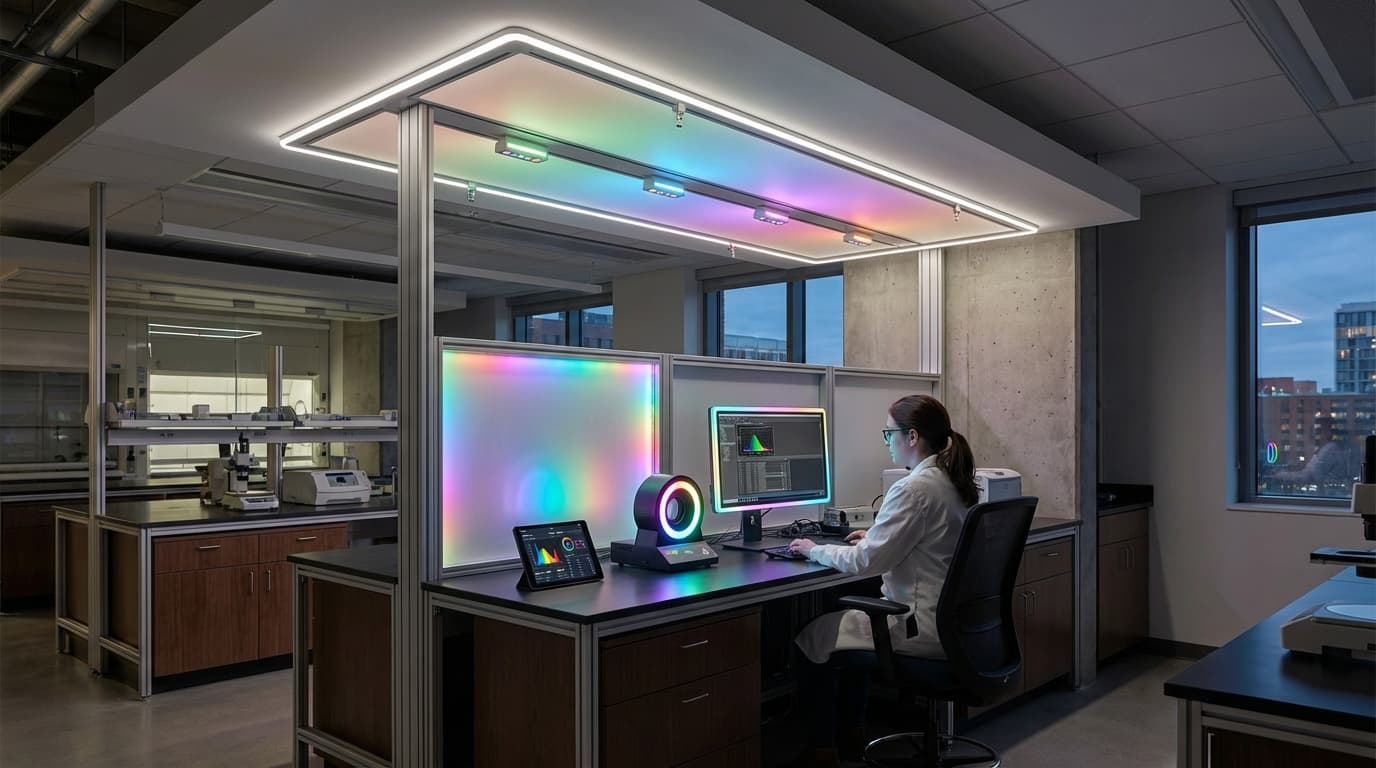
Health Externalities of Spectral Exposure
The investigation into health externalities of spectral exposure addresses a growing public health concern rooted in the widespread adoption of artificial lighting technologies. At its core, this field examines how prolonged exposure to artificial light at night (ALAN), particularly light rich in short-wavelength blue spectrum emissions, disrupts fundamental biological processes in humans. The mechanism centers on the suppression of melatonin production in the pineal gland, triggered when photosensitive retinal ganglion cells detect blue light wavelengths between 460-480 nanometers. This suppression cascades through the body's circadian timing system, affecting not only sleep-wake cycles but also hormone regulation, cellular repair processes, and metabolic function. Research suggests that chronic circadian misalignment from evening light exposure may contribute to a range of adverse health outcomes, from impaired cognitive performance and mood disorders to increased risk of obesity and cardiovascular disease. The concern extends beyond sleep disruption to include potential retinal photochemical damage from cumulative high-energy visible light exposure, particularly as LED lighting becomes ubiquitous in homes, workplaces, and urban environments.
The lighting industry faces mounting pressure to reconcile energy efficiency gains with emerging evidence of photobiological risks. While LED technology has revolutionized lighting through dramatic improvements in energy consumption and longevity, many early LED products were optimized for luminous efficiency rather than spectral quality, resulting in high blue content that maximizes circadian disruption potential. This challenge is particularly acute in urban settings where outdoor lighting, digital displays, and indoor environments create layered exposure scenarios that extend well beyond natural daylight hours. The problem is compounded by the fact that vulnerable populations—including children whose eyes transmit more blue light to the retina, shift workers exposed to bright light during biological night, and aging adults with altered circadian sensitivity—face disproportionate risks. Industry stakeholders are now grappling with the need to develop lighting solutions that balance energy performance, visual quality, and biological safety, while regulatory bodies work to establish exposure limits and testing protocols that reflect long-term health considerations rather than solely acute safety thresholds.
Current efforts to address spectral exposure risks are driving innovation in tunable lighting systems, circadian-aware design standards, and new metrics for evaluating light's biological impact beyond traditional photometric measures. Several lighting manufacturers have introduced products with adjustable color temperature that automatically reduce blue content in evening hours, while building codes in some jurisdictions are beginning to incorporate circadian lighting principles. Early deployments in healthcare facilities, schools, and residential settings indicate that spectrally optimized lighting can improve sleep quality and daytime alertness, though large-scale longitudinal studies are still needed to quantify long-term health benefits. The field is also spurring development of protective technologies, from screen filters and eyewear designed to selectively block blue wavelengths to architectural strategies that manage artificial light intrusion in bedrooms. As awareness grows among both professionals and the public, health externalities of spectral exposure are becoming a critical consideration in lighting design, urban planning, and public health policy. This trajectory suggests a future where lighting systems are evaluated not merely on their ability to illuminate spaces efficiently, but on their capacity to support human health and biological rhythms across the full spectrum of daily and seasonal cycles.
Related Organizations
The international authority on light, illumination, color, and color spaces, defining the standard observers and colorimetric functions used in all modeling.

A leading academic research center (formerly at RPI) studying the impact of light on human health and defining metrics like Circadian Stimulus (CS).

A company founded by former NASA researchers developing 'SkyBlue' technology to provide high melanopic lux for circadian regulation without compromising visual color.

Home to the lab of Juan Carlos Izpisua Belmonte (prior to Altos), a pioneer in in-vivo partial reprogramming.

A Swedish health-tech company pioneering 'BioCentric Lighting', a system that uses sensors and algorithms to deliver personalized light environments.

A nonprofit organization dedicated to education and research on environmental therapies, specifically bright light therapy and circadian rhythm regulation.

Developers of 'SunLike' LED technology, which reproduces the spectrum of natural sunlight more closely than conventional LEDs to support circadian health.

Develops software that adjusts the color temperature of computer displays according to time of day to reduce melanopic input at night.
Human Centric Lighting Society
United States · Nonprofit
An information hub and advocacy group promoting the benefits of lighting that supports human health and well-being.

TÜV SÜD
Germany · Company
International testing and certification service that offers specific testing for 'Circadian Lighting' and photobiological safety.