Lighting Orchestration Engines
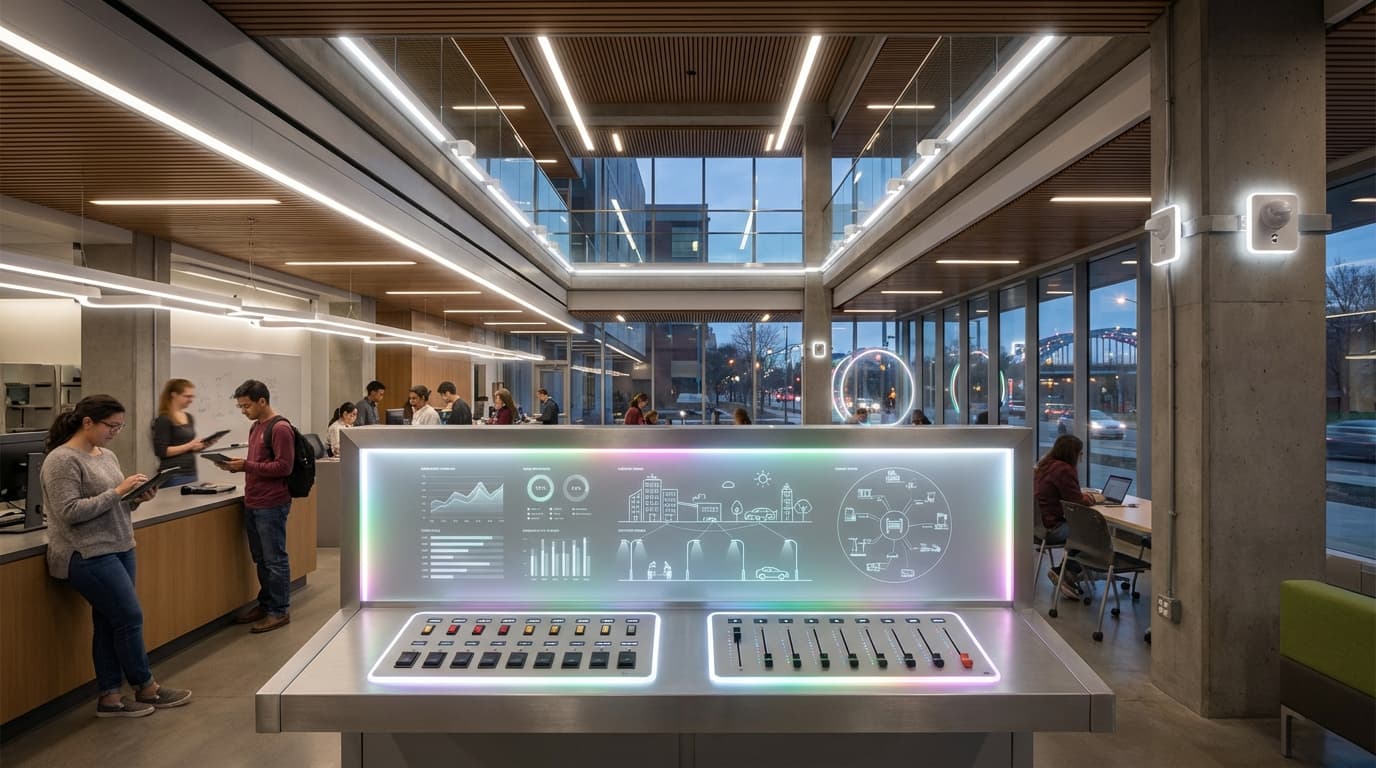
Lighting orchestration engines represent a fundamental shift from isolated lighting control to integrated, intelligent systems that manage illumination as a unified network resource. These centralized software platforms coordinate thousands or even millions of individual lighting endpoints across diverse environments—from streetlights and building facades to vehicle headlamps and event venues. At their technical core, these engines function as middleware layers that translate between disparate lighting protocols such as DALI (Digital Addressable Lighting Interface), DMX512 (the entertainment industry standard), and various IoT communication frameworks including MQTT and BACnet. The systems employ sophisticated scheduling algorithms, real-time sensor integration, and rule-based logic to orchestrate lighting behaviors that respond dynamically to environmental conditions, human activity patterns, and programmatic requirements. Unlike traditional building management systems that treat lighting as a simple on-off utility, orchestration engines enable granular control over intensity, color temperature, timing, and spatial distribution across entire networks, creating what industry specialists describe as "programmable luminous environments."
The emergence of these platforms addresses critical challenges in urban infrastructure management and large-scale facility operations. Cities struggle with the complexity of managing heterogeneous lighting assets installed over decades, each potentially using different control systems and communication protocols. Orchestration engines solve this fragmentation by providing a unified interface that can simultaneously manage legacy systems and cutting-edge smart fixtures. For entertainment and architectural lighting designers, these platforms eliminate the need for manual programming of individual fixtures, instead allowing designers to define high-level intentions that the engine translates into thousands of coordinated commands. Energy management represents another significant application domain, as these systems can implement sophisticated demand-response strategies, automatically dimming or adjusting color temperature across entire districts during peak load periods while maintaining safety and visibility standards. The technology also enables new business models around "lighting as a service," where building owners or municipalities can outsource the complexity of lighting management to specialized operators who use orchestration platforms to deliver guaranteed performance outcomes.
Current deployments span multiple sectors, with smart city initiatives in Europe and Asia implementing orchestration engines to manage municipal lighting networks that adapt to pedestrian density, weather conditions, and special events. Major sports venues and entertainment complexes increasingly rely on these platforms to create synchronized lighting spectacles that would be impossible to program manually. Research institutions and corporate campuses use orchestration engines to implement circadian lighting programs that adjust color temperature throughout the day to support human biological rhythms while optimizing energy consumption. As lighting infrastructure becomes increasingly networked and intelligent, these orchestration platforms are evolving to incorporate machine learning capabilities that can predict optimal lighting configurations based on historical patterns and real-time conditions. The trajectory points toward lighting systems that function less as static infrastructure and more as responsive, adaptive networks that continuously optimize for multiple objectives—human comfort, energy efficiency, safety, and aesthetic experience—positioning orchestration engines as essential infrastructure for the next generation of smart environments.
Related Organizations

Parent company of Philips Hue, which offers the 'Hue Sync' protocol to align smart lighting with HDMI video signals.

Leader in lighting control, owner of Ketra which produces natural light simulation.

Developer of a wireless lighting control platform based on Bluetooth Low Energy mesh, enabling decentralized orchestration of lighting networks.

Industrial giant offering the 'Senseye Predictive Maintenance' suite and MindSphere IoT platform.

Worldwide leader in outdoor lighting solutions with a strong focus on smart city applications.

Provider of connected street lighting and smart city data applications.

A global leader in IoT and smart metering solutions, providing the hardware and software backbone for AMI deployments worldwide.

Offers smart city platforms that plug into existing streetlights to monitor traffic, air quality, and safety.

Developer of the inteliLIGHT system, a LoRaWAN/NB-IoT compatible street lighting control solution. Acquired by Lucy Group.

Multinational conglomerate operating in aerospace and building technologies.