Holographic & Light Field Illumination
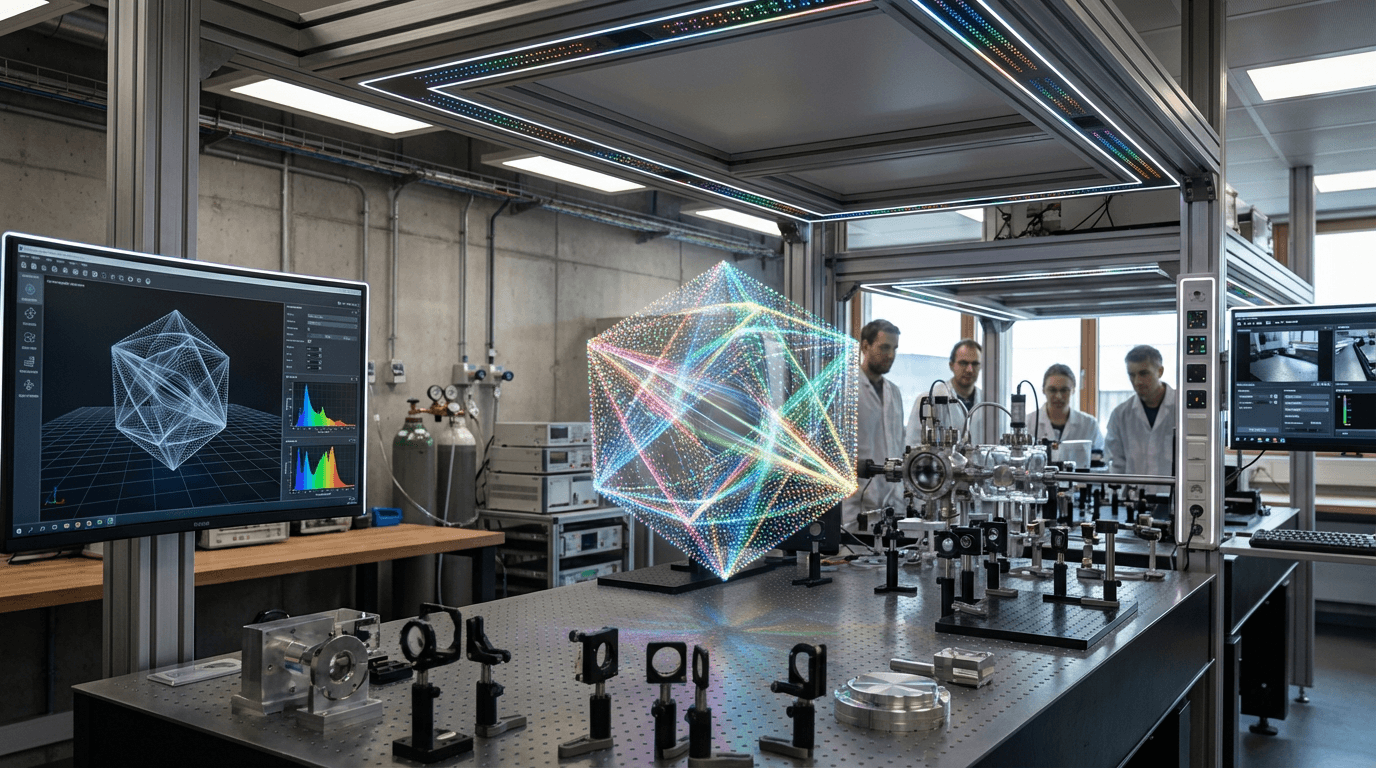
Holographic and light field illumination represents a fundamental departure from conventional lighting by employing phase-modulating arrays—such as spatial light modulators (SLMs) and metasurface optics—to dynamically sculpt the wavefront of light itself. Unlike traditional fixtures that emit light in fixed patterns, this technology manipulates the phase and amplitude of individual light rays, enabling precise control over where and how illumination appears in three-dimensional space. The core mechanism relies on diffractive optics and computational algorithms that calculate the interference patterns needed to steer light beams, focus them on arbitrary points, or create the illusion of volumetric luminous structures suspended in mid-air. By encoding spatial information directly into the light field, these systems can generate illumination that adapts in real-time to changing environments, tracking moving subjects or reconfiguring entire lighting schemes without any mechanical actuators or repositioning of physical hardware.
This approach addresses several persistent challenges in architectural and industrial lighting, particularly the inflexibility and energy waste inherent in static fixture arrays. Traditional lighting systems require extensive infrastructure—mounting points, conduits, and often redundant fixtures to cover different use cases—resulting in both capital expense and ongoing maintenance burdens. Holographic illumination eliminates much of this complexity by consolidating multiple lighting functions into a single programmable source. In manufacturing environments, for instance, the technology enables "spotlight-on-demand" that follows workers or highlights specific assembly points without the glare and shadows cast by overhead banks of lights. For museums and galleries, it offers the ability to illuminate artifacts with pinpoint accuracy while leaving surrounding areas in controlled darkness, enhancing visual drama while reducing light exposure damage. The fixture-free nature also opens new architectural possibilities, allowing designers to create spaces unencumbered by visible lighting infrastructure, where illumination seems to emerge organically from the environment itself.
Early commercial deployments have appeared in high-value applications such as automotive showrooms, where steerable light fields dynamically highlight vehicle features as customers move around displays, and in surgical suites, where shadowless, repositionable illumination follows instruments without requiring nurses to adjust overhead lamps. Research institutions are exploring integration with computer vision systems to create responsive environments that anticipate occupant needs, automatically adjusting task lighting as people shift positions or change activities. As the cost of spatial light modulators continues to decline and computational power becomes more accessible, industry analysts note growing interest from the smart building sector, where holographic illumination aligns with broader trends toward adaptive, sensor-driven environments. The technology's ability to merge illumination with spatial information display suggests a future where lighting systems serve dual roles—not merely revealing spaces but actively communicating within them, projecting wayfinding cues, safety warnings, or contextual information directly into the visual field without additional screens or signage.
Related Organizations

Provider of Spatial Light Modulators (SLMs) and diffractive optical elements used to phase-modulate light for holographic applications.

Produces Holographic Optical Elements (HOEs) for automotive transparent displays and lighting applications.

Fabless semiconductor company developing 'Holographic eXtended Reality' (HXR) chips based on proprietary Phase Change Material (PCM) technology with pixel pitches under 300nm.

Software and IP licensing company specializing in computer-generated holography (CGH) for displays and AR.

Institute for Applied Optics and Precision Engineering, conducting advanced research on micro-optics and freeform surfaces.

Developer of optical semiconductor solutions enabling solid-state LiDAR using Light Control Metasurfaces (LCM).

Develops functional materials and nanocomposites, including holographic films and optical filters for light management.

Produces mmWave radar sensors (IWR series) with specific SDKs and reference designs for vital signs monitoring.

Automotive supplier producing the h-Digi lighting module, which uses micro-mirrors to project high-resolution light patterns on the road.