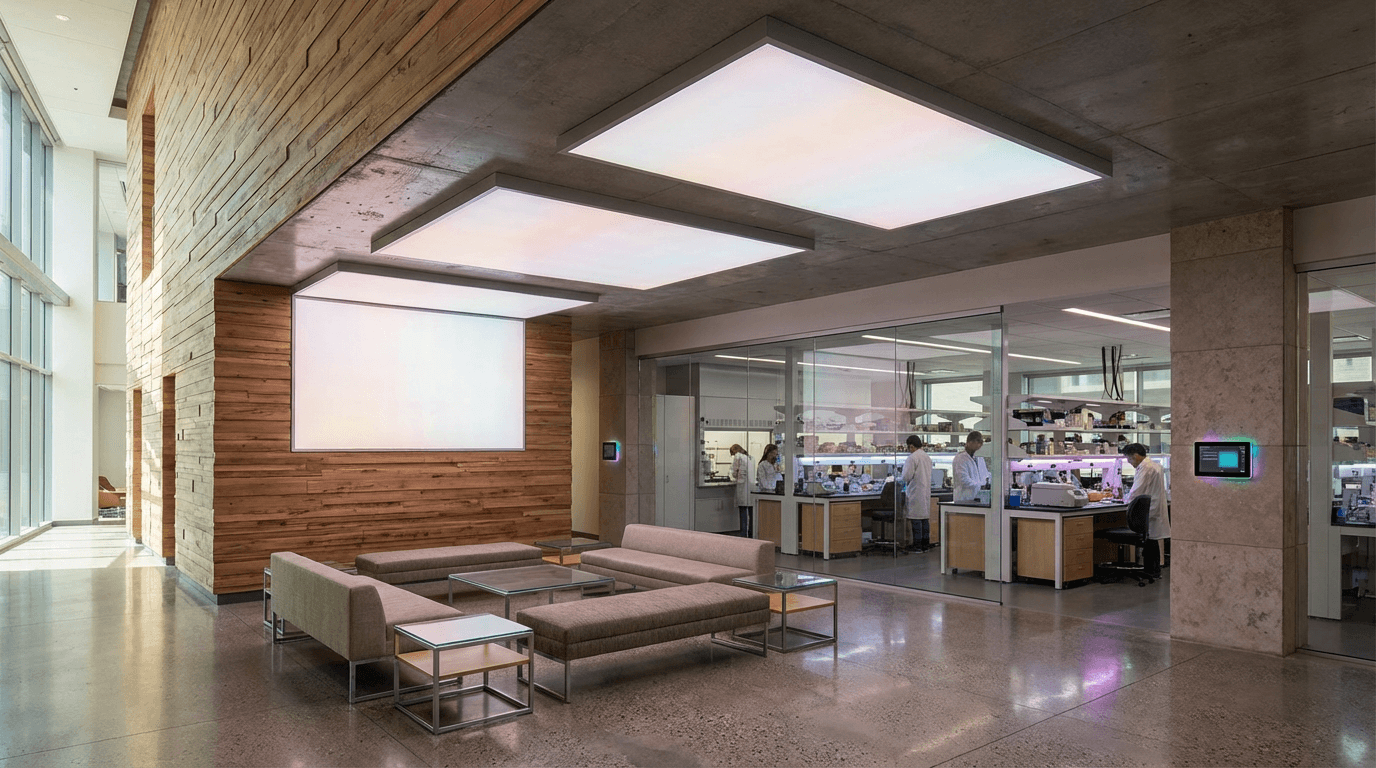
OLED Lighting Panels
Organic Light Emitting Diode (OLED) lighting panels represent a fundamental departure from conventional point-source illumination, offering large-area diffuse light emission through thin layers of organic compounds sandwiched between conductive substrates. Unlike traditional LEDs that concentrate light from small semiconductor chips, OLEDs generate illumination across their entire surface when an electric current passes through the organic material, creating a uniform glow without hotspots or harsh shadows. The technology operates through electroluminescence, where organic molecules emit photons as electrons and holes recombine within the emissive layer. This architecture enables panels as thin as 2 millimeters that can be manufactured on glass or flexible substrates, opening possibilities for curved, transparent, or even rollable lighting surfaces. The inherent low luminance of OLED panels—typically ranging from 1,000 to 3,000 candelas per square meter—produces a quality of light that more closely mimics natural diffuse illumination than the intense beams of conventional fixtures.
The architectural and design industries face persistent challenges with glare, visual comfort, and the integration of lighting into built environments without compromising aesthetics or spatial flow. Traditional lighting solutions often require bulky fixtures, visible heat sinks, and complex optical systems to distribute light evenly, creating visual clutter and limiting design freedom. OLED lighting panels address these limitations by functioning as both light source and architectural surface, eliminating the distinction between fixture and finish. Their low-glare characteristics make them particularly valuable in environments where visual comfort is paramount—hospitals, museums, offices, and residential spaces—where harsh lighting can cause eye strain, headaches, and reduced productivity. The technology also solves thermal management challenges inherent in high-intensity LED systems, as OLEDs generate significantly less heat per unit area, reducing cooling requirements and enabling installation in heat-sensitive contexts. Furthermore, the ability to produce transparent panels when switched off allows designers to create dynamic surfaces that transform from windows or mirrors into light sources, fundamentally reimagining how illumination integrates with architecture.
Current commercial deployments remain concentrated in premium architectural projects and specialty applications, with manufacturers like LG Display and OSRAM offering modular panel systems for ceiling integration and decorative installations. Early adopters include high-end hospitality projects, automotive interior lighting, and museum exhibitions where the unique aesthetic qualities justify the technology's higher cost compared to conventional LED systems. Flexible OLED panels are beginning to appear in concept vehicles and experimental architecture, demonstrating potential for curved luminous surfaces that follow organic building forms. However, the technology faces ongoing challenges in manufacturing scale, lifetime performance—current panels typically offer 30,000 to 50,000 hours compared to 50,000-plus for quality LEDs—and cost competitiveness, which currently limits widespread adoption beyond niche applications. As production techniques mature and economies of scale develop, industry analysts anticipate broader integration into standard architectural lighting systems, particularly as building codes increasingly emphasize human-centric lighting and circadian rhythm support. The trajectory points toward OLED panels becoming a standard option in the lighting designer's palette, especially for applications where the quality of light and spatial integration outweigh pure efficiency metrics, contributing to built environments that prioritize occupant well-being alongside energy performance.
Related Organizations

The leading pure-play manufacturer of OLED lighting panels for architectural and automotive applications.

Chemical and material manufacturer producing high-efficiency heterojunction solar cells for automotive applications.

Develops and licenses phosphorescent OLED technologies and materials essential for efficient lighting panels.

Specializes in organic electronics research, developing flexible OLED lighting and roll-to-roll manufacturing processes.

Open innovation center by imec and TNO specializing in flexible electronics.

Develops TADF (Thermally Activated Delayed Fluorescence) technology to create cost-effective, rare-metal-free OLED materials.

Hosts a renowned Research Center for Organic Electronics and Systems dedicated to OLED lighting advancements.

A decorative lighting manufacturer that was an early adopter of OLED panels in high-end residential fixtures.