Micro-LED Arrays
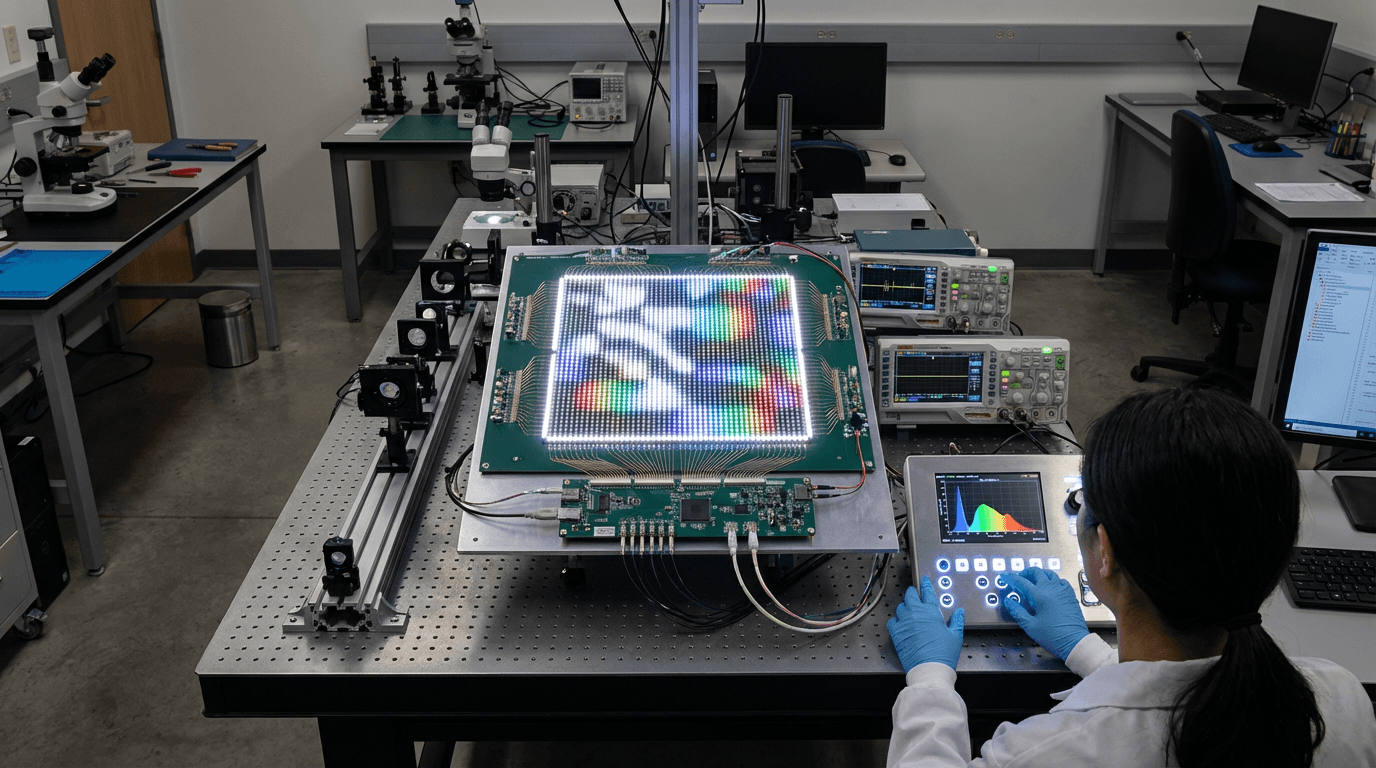
Micro-LED arrays represent a fundamental shift in solid-state lighting, built from millions of microscopic inorganic gallium nitride (GaN) light-emitting diodes, each measuring less than 100 micrometers across. Unlike conventional LEDs that function as single light sources or organic light-emitting diodes (OLEDs) that rely on carbon-based compounds, Micro-LEDs are individually addressable semiconductor chips arranged in dense matrices. This architecture enables pixel-level control over intensity, color, and directionality of light emission. The inorganic nature of these emitters delivers exceptional luminous efficacy—often exceeding 200 lumens per watt—while maintaining stability across temperature extremes and eliminating the degradation pathways that plague organic alternatives. Each microscopic element can be independently modulated at high frequencies, allowing for dynamic beam shaping and adaptive illumination patterns that respond to environmental conditions in real time.
The lighting industry has long struggled with the trade-off between energy efficiency and precise control. Traditional lighting systems require bulky optics, diffusers, and mechanical actuators to shape light output, adding cost, weight, and failure points. Micro-LED arrays dissolve this constraint by embedding spatial control directly into the emitter itself. In automotive applications, this enables adaptive driving beam systems that selectively dim individual pixels to prevent glare for oncoming drivers while maintaining full illumination elsewhere—a capability that mechanical systems cannot match in speed or granularity. For architectural and retail environments, Micro-LED surfaces can create dynamic lighting scenes without gels, gobos, or moving fixtures, reducing installation complexity and maintenance overhead. The technology also addresses the chronic issue of light pollution in urban settings, as pixelated control allows illumination to be directed precisely where needed, minimizing sky glow and trespass into adjacent spaces.
Early commercial deployments have focused on premium automotive headlamps and specialty architectural installations, where the performance advantages justify current manufacturing costs. Research initiatives are exploring transfer printing and monolithic integration techniques to scale production and reduce price points, with industry analysts noting steady progress toward broader market viability. Beyond static illumination, Micro-LED arrays are finding applications in spatial light modulators for augmented reality displays and LiDAR systems, where their microsecond switching speeds and high brightness enable new sensing modalities. As manufacturing processes mature and economies of scale emerge, this technology is positioned to redefine expectations for what lighting systems can achieve—transforming illumination from a passive utility into an active, intelligent interface between built environments and their occupants. The trajectory points toward a future where every surface capable of emitting light can also shape, direct, and adapt that light with unprecedented precision.
Related Organizations

Produces the Eviyos hybrid LED, a multipixel light source designed specifically for high-resolution adaptive headlights and road projection.

Global LED market leader developing high-density micro-LED light sources for adaptive automotive lighting.

Pure-play micro-LED company developing chips and transfer technologies for transparent displays and automotive lighting.

Specializes in GaN-on-Silicon micro-LED technology for AR displays and high-density projection.

A leading UV LED manufacturer known for its Violeds technology used in sterilization and purification.

Develops 3D WireLED technology (nanowires) on large-area silicon wafers for cost-effective micro-LEDs.

Manufacturer of ultra-high brightness micro-LED micro-displays, often used in AR but relevant to compact projection lighting.

University of Cambridge spin-out developing porous GaN micro-LED materials for higher efficiency and color control.

Develops micro-printing transfer technology to place millions of micro-LEDs efficiently onto substrates.

Develops high-speed placement technology for mini and micro-LEDs, focusing on keyboard backlights and automotive applications.

Yale spin-off developing NPQD (Nanopore Quantum Dot) technology to create high-efficiency micro-LEDs.