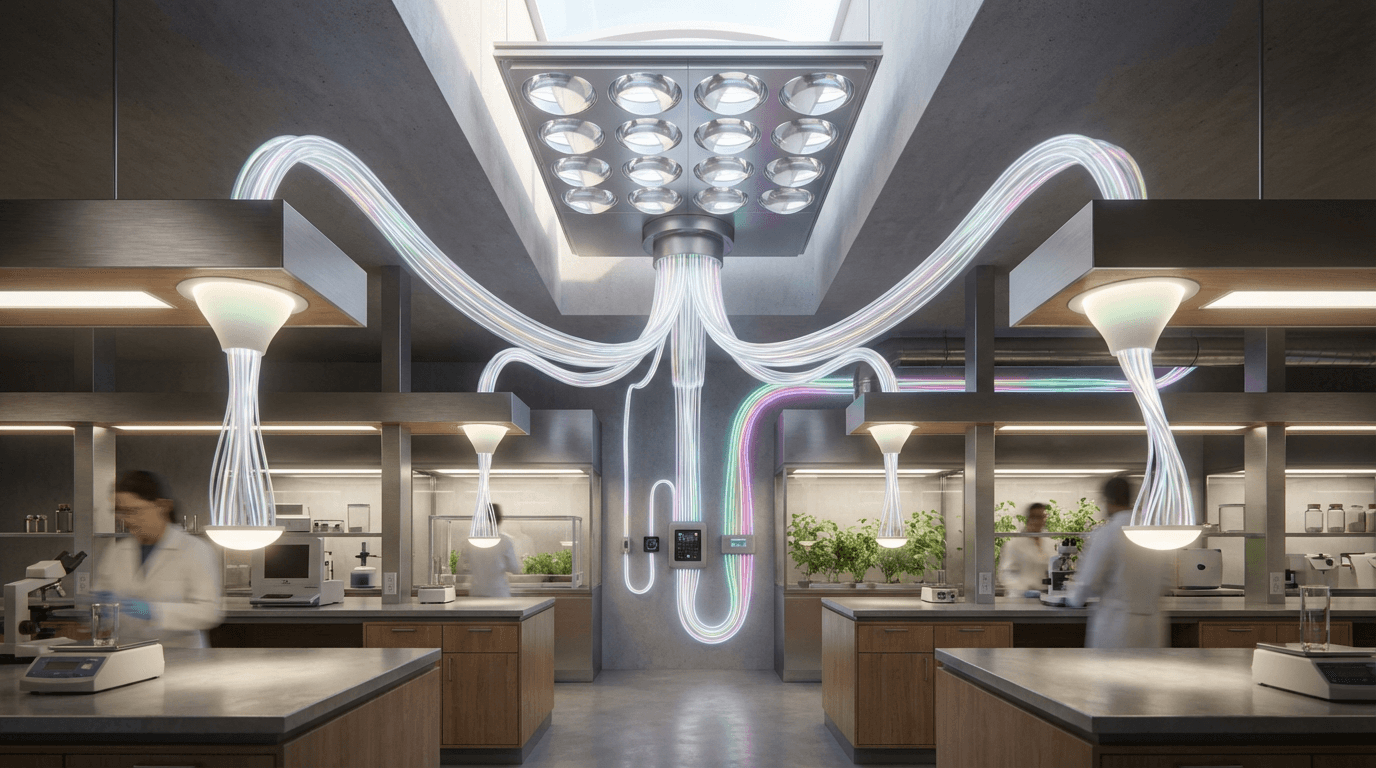
Active Fiber-Optic Daylighting
Active fiber-optic daylighting represents a sophisticated approach to bringing natural sunlight into spaces that conventional windows or skylights cannot reach. The technology employs sun-tracking collectors mounted on building exteriors or rooftops that follow the sun's path throughout the day, maximizing light capture from dawn to dusk. These collectors concentrate incoming sunlight and couple it into bundles of specialized optical fibers designed for minimal light loss over extended distances. The fibers themselves are engineered with high-purity cores and protective cladding that can transport photons hundreds of meters while preserving the full spectrum of natural daylight, including beneficial wavelengths that support circadian rhythm regulation and vitamin D synthesis. Unlike passive light tubes or traditional skylights that rely on direct overhead positioning, active systems can navigate around structural obstacles, bend through building cores, and deliver concentrated natural illumination to multiple distribution points from a single collector array.
The primary challenge this technology addresses is the growing prevalence of deep-plan buildings, underground facilities, and interior spaces where occupants spend extended periods without access to natural light. Research suggests that prolonged exposure to artificial lighting alone can disrupt circadian cycles, reduce productivity, and negatively impact mental well-being. Active fiber-optic daylighting overcomes the fundamental limitation of passive systems by actively pursuing optimal sun angles and routing light through complex architectural geometries. This capability proves particularly valuable in retrofitting existing structures where adding conventional windows would be structurally impractical or prohibitively expensive. The technology also enables new architectural possibilities, allowing designers to create habitable spaces in locations previously considered unsuitable for regular human occupancy, such as basement offices, underground transit stations, or the cores of large commercial buildings. By reducing dependence on electric lighting during daylight hours, these systems also contribute to energy efficiency goals while maintaining the psychological and physiological benefits that natural light provides.
Early deployments of active fiber-optic daylighting have appeared in commercial buildings, museums, and underground facilities where preserving occupant well-being justifies the initial investment. Transit authorities in several cities have explored the technology for subway platforms and underground pedestrian passages, where natural light can improve wayfinding and reduce the psychological stress associated with subterranean environments. Healthcare facilities represent another promising application area, as natural light exposure has been linked to improved patient recovery outcomes and reduced staff fatigue. As fiber-optic technology continues to advance and manufacturing costs decline, industry analysts note growing interest from developers of high-density urban projects where maximizing usable floor area often means creating spaces far from building perimeters. The technology aligns with broader trends toward biophilic design and human-centric architecture, suggesting that active daylighting systems may become increasingly common as the built environment evolves to better support human health and performance in spaces where natural light was once considered an impossible luxury.
Related Organizations

Japanese pioneer of the 'Himawari' system, which uses automatic sun-tracking Fresnel lenses and fiber optics to transport sunlight.

Swedish technology company that develops systems using sun-tracking collectors and fiber optic cables to channel sunlight deep into buildings.
Developer of the SunTracker, an active skylight system that uses a GPS-driven mirror array to track the sun and direct light indoors.
SunPortal
South Korea · Company
South Korean company specializing in active daylighting systems using parabolic mirrors and optical pipes to transport light long distances.

Swiss company specializing in daylight engineering for basements and underground spaces using mirror shafts and light guides.

Home to 'FLEXLAB', the world's most advanced building efficiency simulator for grid interaction research.

Austrian lighting design and research firm known for developing complex daylight redirection and optical systems for architecture.

Institute for Building Physics conducting applied research on visual comfort, daylighting, and the psychophysical effects of lighting.

Major manufacturer of tubular daylighting devices (TDDs) that include optical technologies to capture low-angle sunlight.

A multinational construction and development company with aggressive climate targets and a portfolio of Deep Green projects.