Luminescent Solar Concentrators (LSC)
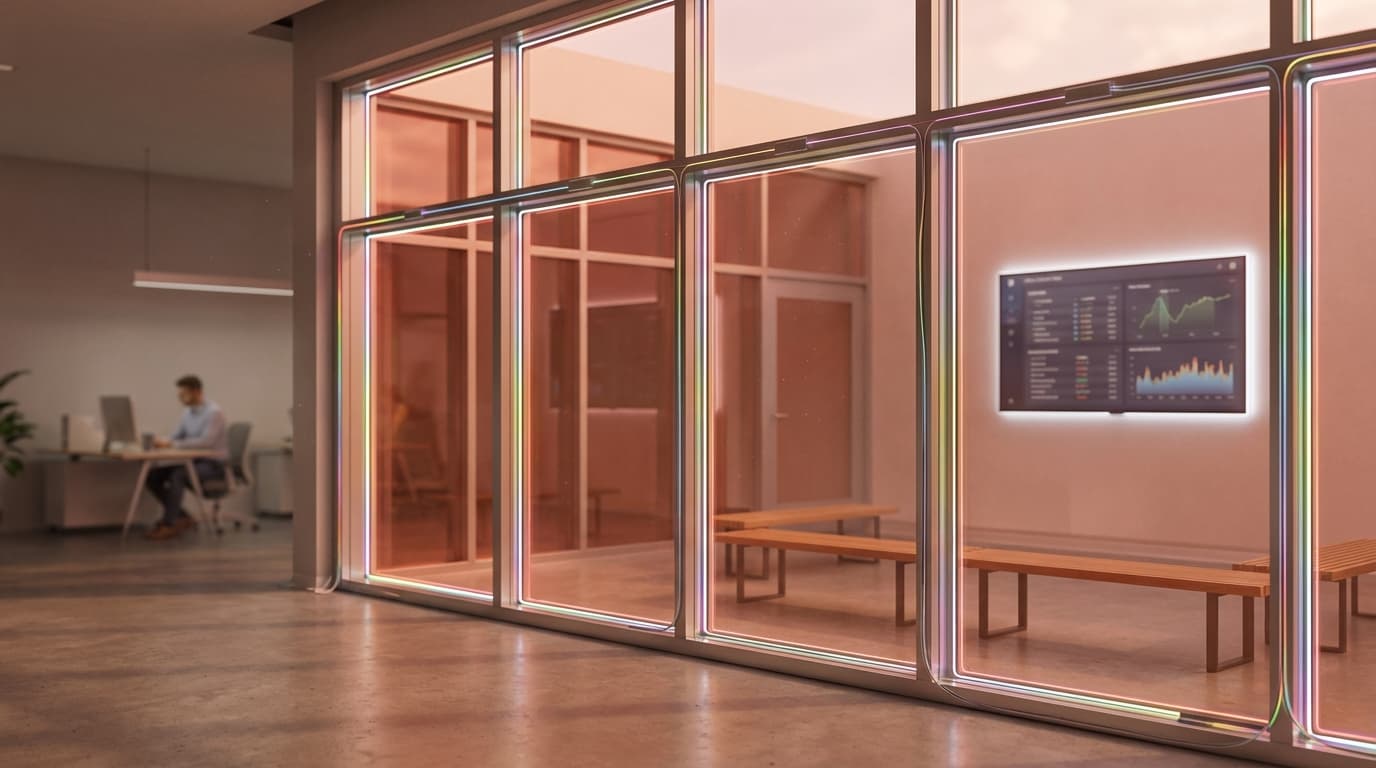
Luminescent Solar Concentrators represent a convergence of photovoltaic technology and architectural glazing, transforming conventional windows into dual-function building elements that simultaneously harvest solar energy and manage interior lighting conditions. The technology operates through luminescent materials—typically organic dyes, quantum dots, or rare-earth complexes—embedded within transparent polymer or glass waveguides. When sunlight strikes these materials, they absorb photons across a broad spectrum and re-emit them at longer, specific wavelengths through a process called photoluminescence. Due to total internal reflection, these re-emitted photons travel through the waveguide to its edges, where narrow strips of photovoltaic cells convert the concentrated light into electricity. This edge-mounted configuration allows the majority of the window surface to remain transparent or lightly tinted, preserving views and natural illumination while generating power from what would otherwise be passive building envelope.
The architectural and energy sectors face a fundamental tension between maximizing natural daylight for occupant wellbeing and minimizing solar heat gain and glare. Traditional building-integrated photovoltaics often sacrifice transparency entirely, while conventional windows contribute to cooling loads without offsetting energy consumption. LSC technology addresses this challenge by enabling windows to function as semi-transparent power generators that also modulate the spectral quality of transmitted light. By selecting luminescent materials that absorb primarily in the ultraviolet and infrared ranges, LSCs can reduce heat gain while maintaining visible light transmission. Furthermore, the technology allows architects to tune the colour and intensity of transmitted light by adjusting the concentration and type of luminescent materials, creating opportunities for dynamic facade design that responds to both aesthetic and energy performance requirements. This capability is particularly valuable in commercial buildings where facade area far exceeds roof space, unlocking vast untapped surfaces for distributed energy generation.
Current LSC implementations demonstrate power conversion efficiencies ranging from 2-7%, significantly lower than conventional solar panels but sufficient to offset a meaningful portion of building energy consumption when deployed across large facade areas. Research institutions and building technology companies have installed pilot LSC windows in office buildings and research facilities, where they serve as proof-of-concept for integration with building management systems. The technology shows particular promise in retrofit applications for existing glass curtain-wall buildings, where traditional solar installations are impractical. Ongoing materials research focuses on developing more efficient luminescent compounds with reduced self-absorption losses and improved photostability under prolonged UV exposure. As urban density increases and net-zero building codes become more prevalent, LSCs represent a pathway toward transforming the vast glazed surfaces of modern architecture from passive thermal liabilities into active energy assets, while maintaining the transparency and natural lighting that define contemporary building design.
Related Organizations
Spin-off from the University of Milano-Bicocca developing transparent photovoltaic windows using LSC nanoparticles.

Advanced materials company using quantum dots to create luminescent solar concentrator windows (WENDOW).
Australian company developing solar glass that uses nano-particles to redirect UV and IR light to the edges of the glass for collection.

Dutch technology company producing 'SmartSkin' and 'PowerWindow' products that generate power and sense environmental data.

Produces wavelength-selective greenhouse panels that generate power and optimize the light spectrum for plant growth.

Develops transparent solar glass for greenhouses (Agri-PV) using nanomaterials to harvest energy and optimize light.

A US Department of Energy national laboratory that partnered with Parting Stone to develop the material science behind the solidification process.
The European Union Agency for Cybersecurity, responsible for cloud certification schemes (EUCS).

Developing organic photovoltaic (OPV) coatings that can be applied to commercial windows to generate power.

Develops custom coatings and masterbatches, including those for solar energy harvesting and light management.