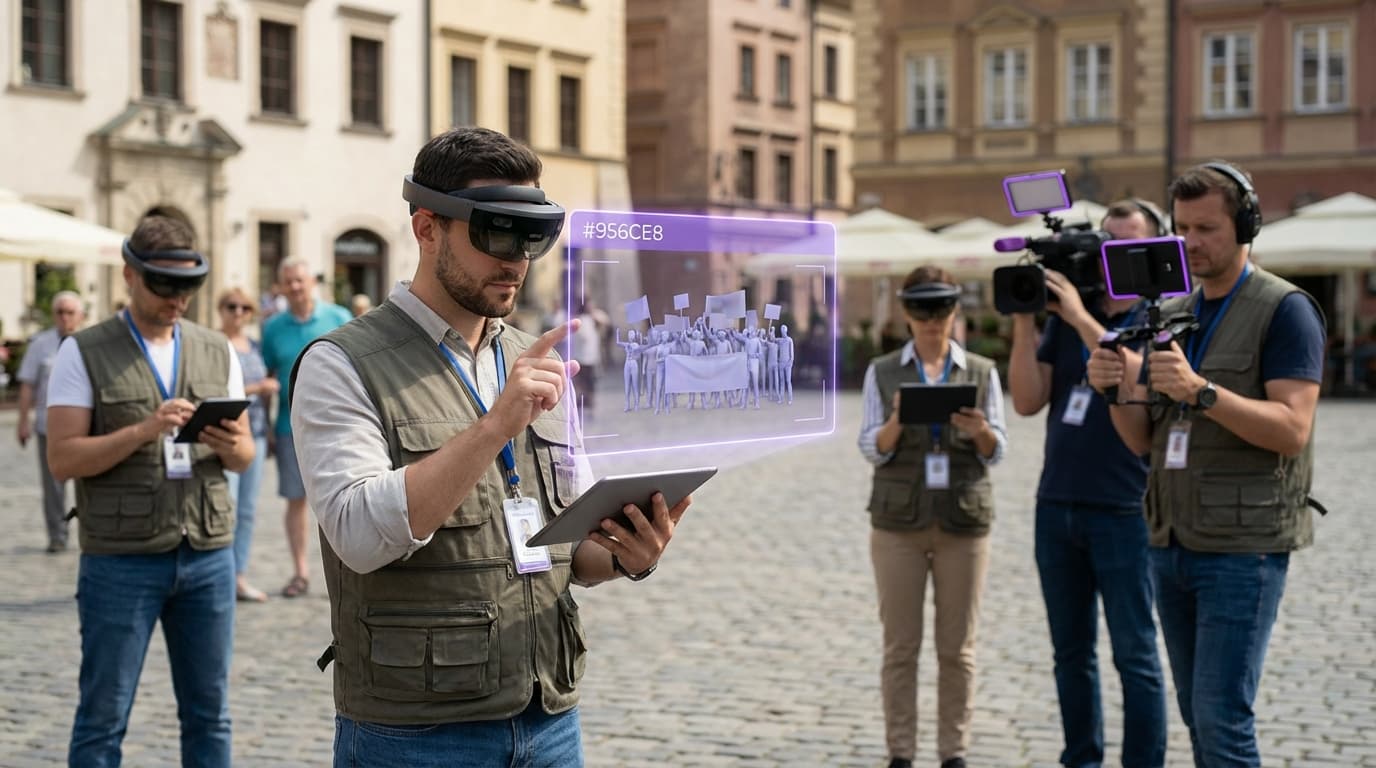
Spatial Journalism
Spatial journalism represents a fundamental shift in how news and documentary content can be experienced, moving beyond traditional two-dimensional screens to create fully immersive environments that place audiences directly within the events being reported. This approach combines volumetric video capture—which records subjects and environments in three dimensions rather than flat images—with spatial audio technologies that recreate the acoustic properties of real locations. The technical foundation relies on arrays of cameras and microphones that capture multiple perspectives simultaneously, generating point cloud data or photogrammetric models that can be rendered in virtual or augmented reality environments. Unlike conventional video journalism, which frames reality through a single lens, spatial journalism preserves the geometric relationships between objects, people, and spaces, allowing viewers to move through and explore documented scenes with six degrees of freedom.
The journalism industry has long grappled with the challenge of conveying the visceral reality of distant events to audiences who consume news primarily through screens and text. Traditional reporting methods, while informative, often struggle to bridge the empathy gap between viewers in comfortable settings and subjects experiencing conflict, displacement, environmental catastrophe, or social injustice. Spatial journalism addresses this limitation by creating what researchers describe as embodied presence—the sensation of actually being in a location rather than merely observing it. This technology proves particularly valuable for covering underreported stories from regions with limited media access, where the physical and emotional distance between global audiences and affected communities can lead to disengagement. By enabling viewers to stand in a refugee camp, walk through a climate-affected village, or witness social movements from within the crowd, spatial journalism transforms abstract statistics into human experiences, potentially driving greater awareness and response to global issues.
Early implementations of spatial journalism have emerged from partnerships between news organisations and immersive technology studios, with pilot projects documenting everything from humanitarian crises to environmental degradation. These experiences are currently distributed through VR headsets, web-based platforms supporting WebXR standards, and increasingly through location-based installations in museums and cultural centres. The approach aligns with broader industry trends toward experiential storytelling and audience engagement, as media organisations seek new formats that can compete for attention in an oversaturated information landscape. As capture technologies become more portable and affordable, and as distribution platforms expand beyond specialised hardware to mainstream devices, spatial journalism is positioned to become a standard tool in the documentary filmmaker's toolkit. The technology's ability to preserve historical moments in three-dimensional form also creates valuable archives for future generations, offering unprecedented documentation of our current era's most significant events and transformations.
Related Organizations

Pioneering immersive journalism studio founded by Nonny de la Peña, creating VR documentaries that place viewers inside news events.

Al Jazeera's immersive media studio focusing on 360-degree video and VR documentaries about the Global South.

The technical research arm of the BBC, developing tools like 'StoryKit' for object-based media and interactive narratives.

Major news publisher that launched NYT VR and continues to integrate photogrammetry and AR journalism into their core reporting app.

Investigative journalism series that actively commissions and distributes VR and interactive documentaries.

Creators of Depthkit, a software tool allowing volumetric capture using accessible depth sensors.

British news organization that established an in-house VR team to produce pieces like '6x9' (solitary confinement experience).

Academic institution with dedicated labs exploring the ethics and practice of immersive journalism.

A major philanthropic funder of journalism innovation, including significant grants for immersive technology in newsrooms.

A premier volumetric capture stage in Los Angeles, utilizing Microsoft Mixed Reality Capture technology.
Supporting Evidence
Research this in Signals
Signals turns a topic into a sourced research record you can inspect and rerun. Your first scan is free, and this one starts with Spatial Journalism already loaded, so edit it or scan as is.