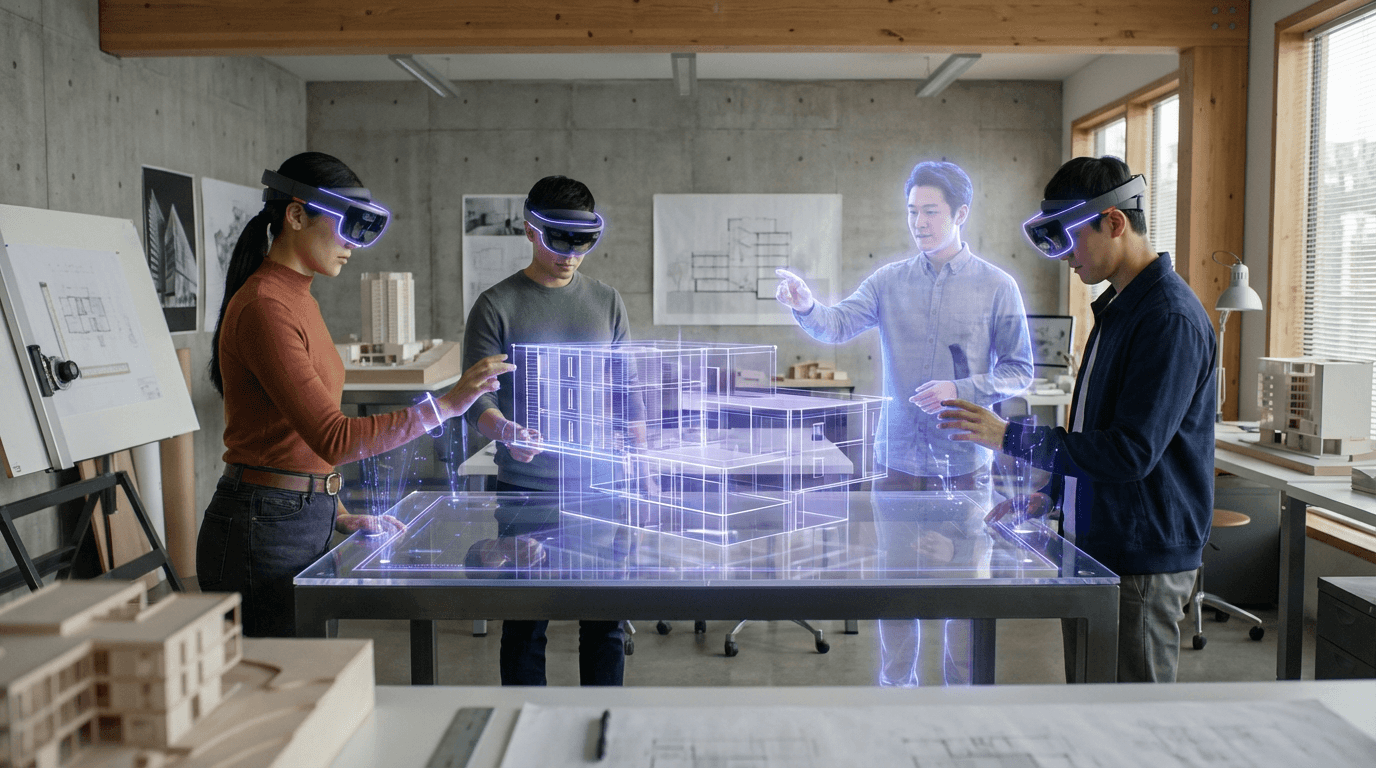
Spatial Design Collaboration
Spatial Design Collaboration represents a fundamental shift in how design professionals conceptualise and refine three-dimensional environments. This approach combines mixed reality technologies—including augmented reality headsets, spatial tracking systems, and real-time rendering engines—to create shared virtual workspaces where multiple participants can simultaneously interact with full-scale design models. Unlike traditional CAD software or physical mockups, these systems allow designers to overlay digital prototypes directly onto physical spaces or inhabit entirely virtual environments at 1:1 scale. The underlying architecture relies on spatial anchors that maintain consistent positioning of virtual objects across multiple users' viewpoints, while cloud-based synchronisation ensures that changes made by one participant are instantly reflected for all collaborators, whether they're standing in the same room or connecting from different continents.
The design and construction industries have long struggled with the gap between two-dimensional plans and three-dimensional reality, a disconnect that often leads to costly revisions, miscommunication among stakeholders, and designs that fail to account for human-scale experience. Spatial Design Collaboration addresses these challenges by enabling architects to evaluate ceiling heights, sightlines, and spatial relationships in context rather than through abstraction. Urban planners can assess how proposed structures interact with existing streetscapes, while product designers can test ergonomics and user flows in realistic settings. This technology fundamentally changes the review and approval process, allowing clients and community members to experience proposed designs viscerally rather than interpreting technical drawings. The ability to rapidly iterate at full scale—adjusting wall positions, testing furniture arrangements, or experimenting with material finishes in real-time—compresses design cycles and reduces the risk of expensive post-construction modifications.
Early adoption has been strongest among large architecture firms and automotive design studios, where the technology supports both internal design reviews and client presentations. Research institutions and forward-thinking municipalities are beginning to deploy these tools for participatory planning exercises, enabling community members to walk through proposed developments and provide feedback based on embodied experience rather than rendered images. The integration of environmental simulation capabilities—such as accurate daylighting analysis, acoustic modeling, and pedestrian flow prediction—is expanding the technology's utility beyond aesthetic considerations into performance-driven design. As hardware becomes more accessible and interoperability standards mature, industry observers note a trajectory toward spatial collaboration becoming standard practice rather than experimental novelty. This evolution aligns with broader trends toward distributed work, stakeholder engagement, and evidence-based design, positioning mixed reality collaboration as an essential component of the spatial design toolkit for creating environments that better serve human needs and urban contexts.
Related Organizations

A collaborative design tool for architecture and urban planning that works across VR, AR, tablets, and phones.

A 3D design platform enabling cross-disciplinary teams to create, collaborate, and review models in virtual reality.

Owner of the Arnold renderer, which integrates AI denoising to optimize high-end VFX workflows for film and TV.

Holographic collaboration system for professional 3D workflows.

A collaborative design tool for spatial computing, allowing teams to prototype cross-reality interfaces.

Developing foundation models for robotics (Project GR00T) and vision-language models like VILA.

A solution for reviewing massive BIM files (building information models) in VR on standalone headsets like Quest.

Develops Tekla Structures, a leading BIM software for structural engineering and steel detailing, along with hardware for connecting BIM to the field.

Creators of the Unity Engine and the ML-Agents toolkit, which allows researchers to train intelligent agents within game environments.

Developed 'Project Ghost', a telepresence booth that uses glass reflection and screen technology to create eye-contact enabled realistic calls.
Supporting Evidence
Research this in Signals
Signals turns a topic into a sourced research record you can inspect and rerun. Your first scan is free, and this one starts with Spatial Design Collaboration already loaded, so edit it or scan as is.