Haptic Epidermal Skins
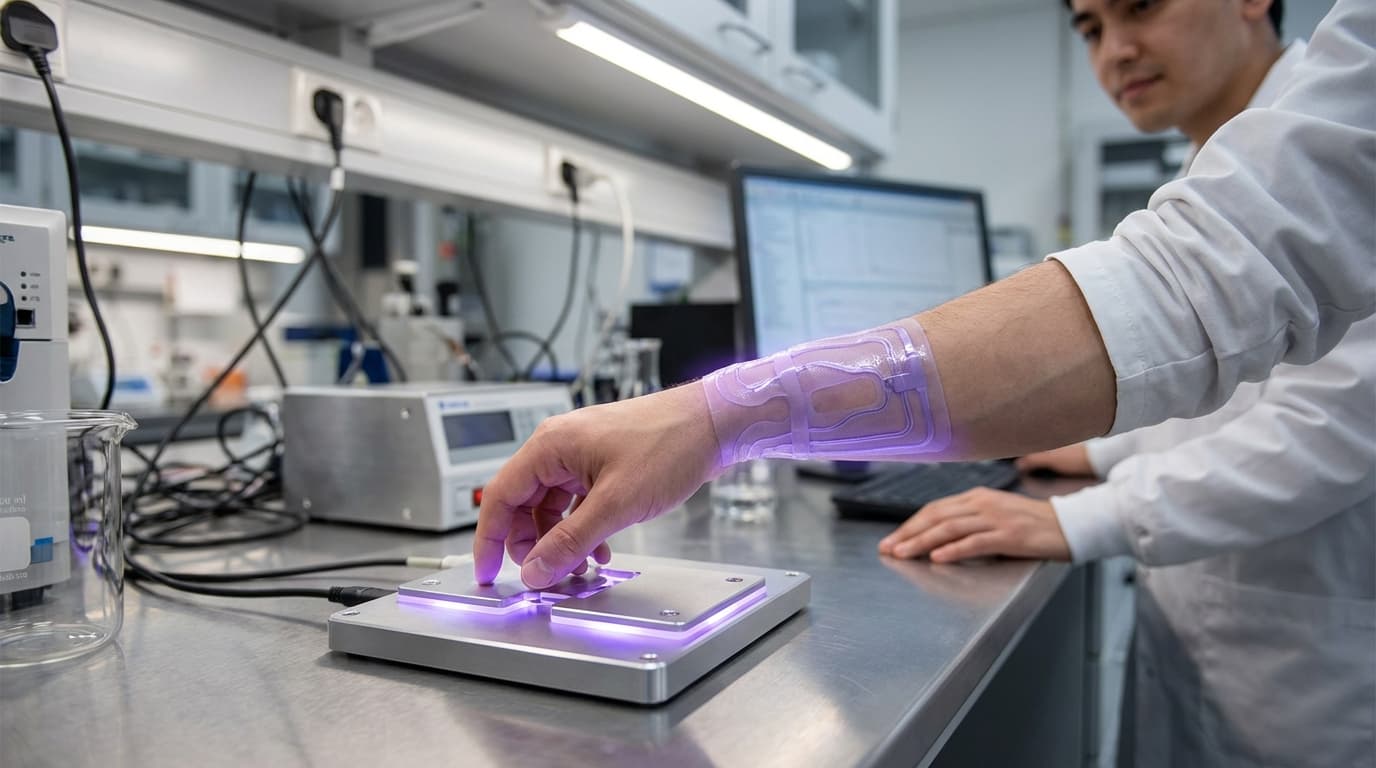
Haptic epidermal skins represent a breakthrough in wearable interface technology, consisting of ultra-thin, flexible electronic membranes that adhere directly to human skin like temporary tattoos. These devices integrate dense arrays of micro-actuators, sensors, and wireless communication components into substrates typically less than 50 micrometers thick—thinner than a human hair. The core mechanism relies on miniaturised piezoelectric, electrostatic, or thermal actuators that can generate localised sensations of pressure, vibration, texture, and temperature. Unlike traditional haptic devices that rely on bulky motors or rigid frames, epidermal skins conform to the body's natural contours and movements, maintaining consistent contact with mechanoreceptors in the skin. Advanced versions incorporate stretchable electronics and biocompatible materials that allow the devices to flex, bend, and move naturally with the wearer's body, while sophisticated control algorithms can modulate individual actuators to create complex tactile patterns that simulate everything from the roughness of sandpaper to the warmth of a handshake.
The technology addresses a critical limitation in virtual and augmented reality systems: the absence of convincing tactile feedback. While visual and auditory immersion have advanced dramatically, the lack of realistic touch sensations has remained a persistent barrier to truly convincing digital experiences. Haptic epidermal skins enable new forms of remote collaboration where surgeons could feel tissue resistance during teleoperated procedures, or engineers could sense the texture of virtual prototypes during design reviews. In gaming and entertainment, these interfaces allow users to feel impacts, environmental conditions, and object interactions that were previously only visual. The technology also opens possibilities for enhanced accessibility, providing tactile navigation cues for visually impaired users or translating audio information into touch patterns. For training applications, epidermal skins can simulate the physical sensations of complex tasks—from surgical procedures to equipment operation—without requiring physical props or expensive simulators.
Research prototypes have demonstrated the viability of this approach in laboratory settings, with early implementations showing the ability to render distinct textures and thermal sensations across small skin patches. Industry analysts note growing interest from sectors ranging from healthcare to entertainment, though commercial availability remains limited to specialised applications. Current deployments indicate particular promise in rehabilitation contexts, where haptic feedback can enhance motor learning and sensory retraining. The technology aligns with broader trends toward more natural, body-integrated interfaces that reduce the barrier between users and digital information. As manufacturing techniques for flexible electronics mature and wireless power delivery improves, haptic epidermal skins are positioned to become a standard component of immersive computing systems, fundamentally changing how we perceive and interact with digital content by adding the missing dimension of touch to our virtual experiences.
Related Organizations

Led by John Rogers, this lab pioneered 'epidermal VR'—wireless, battery-free haptic skin patches.

Research group led by Zhenan Bao focusing on stretchable electronics and electronic skin.

Research group led by Takao Someya, famous for 'electronic skin'.

Research group specializing in skin-integrated electronics and wireless haptic interfaces, often publishing breakthroughs in thin, flexible VR skins.

Researches soft actuators and flexible sensors for wearable haptics.

Lab led by Chris Harrison exploring on-skin interfaces and novel haptic feedback mechanisms.

Develops the Quest Pro and research prototypes (Butterscotch, Starburst) focusing on foveated systems.

Develops high-precision stretchable sensors for motion capture gloves.

A major supplier of system-critical elastomer components, developing soft dry electrodes and conductive materials for smart wearables and e-skin.
Supporting Evidence
Research this in Signals
Signals turns a topic into a sourced research record you can inspect and rerun. Your first scan is free, and this one starts with Haptic Epidermal Skins already loaded, so edit it or scan as is.