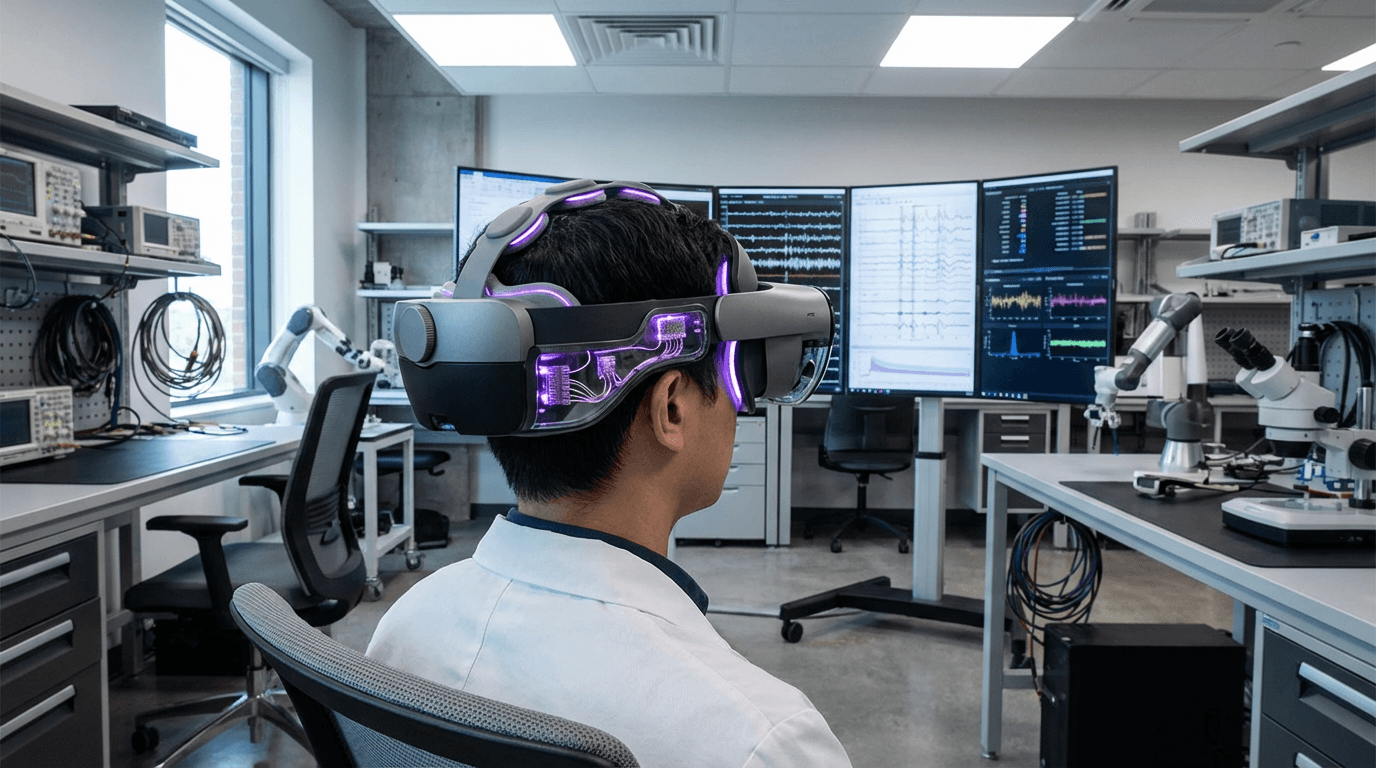
Neural Interface Headsets
Neural interface headsets represent a convergence of extended reality (XR) display technology and non-invasive brain-computer interface (BCI) systems, fundamentally reimagining how humans interact with digital environments. These devices integrate electroencephalography (EEG) sensors or functional near-infrared spectroscopy (fNIRS) modules directly into head-mounted displays, creating a unified platform that can simultaneously render immersive virtual content and capture neural signals. The technical foundation relies on detecting patterns in brain activity—whether electrical signals measured through scalp electrodes or blood oxygenation changes in the prefrontal cortex—and translating these patterns into actionable commands within virtual or augmented spaces. Advanced signal processing algorithms filter out noise and artifacts, while machine learning models trained on individual users' neural signatures enable increasingly accurate interpretation of cognitive states and intentions. Unlike invasive BCIs that require surgical implantation, these headsets maintain the accessibility and safety profile of consumer electronics while introducing a direct neural pathway between thought and digital action.
The integration of BCI capabilities into XR headsets addresses a persistent challenge in immersive computing: the inherent awkwardness and cognitive overhead of traditional input methods. Hand controllers, gesture recognition, and voice commands all require deliberate physical actions that can break immersion and create barriers for users with motor impairments. Neural interfaces enable what researchers describe as "intention-based interaction," where the mere thought of selecting an object, navigating a menu, or executing a command can trigger the corresponding action in virtual space. This capability proves particularly valuable in professional contexts where hands-free operation is essential—surgeons reviewing medical imaging during procedures, pilots accessing flight data without diverting attention from instruments, or industrial workers manipulating digital twins of machinery while performing maintenance. Early enterprise deployments suggest that neural interfaces can reduce task completion times and cognitive load in complex workflows, while also opening new possibilities for accessibility in immersive environments. The technology also enables passive monitoring of cognitive states such as attention, fatigue, or stress, allowing adaptive systems to modify content difficulty or suggest breaks based on the user's mental state.
Several research institutions and technology companies have demonstrated prototype neural interface headsets in controlled settings, with some systems achieving reliable detection of basic mental commands after brief calibration periods. Current applications focus primarily on supplementing rather than replacing traditional inputs—using neural signals to enhance gaze-based selection, adjust interface complexity based on cognitive load, or provide subtle navigation cues through thought alone. The technology faces practical challenges including sensor reliability across diverse users, the need for individualized calibration, and the computational demands of real-time neural signal processing. However, as machine learning techniques improve and sensor miniaturization advances, neural interface headsets are positioned to become a standard feature in professional-grade XR systems within the next decade. This trajectory aligns with broader industry movements toward more intuitive human-computer interaction paradigms, where the boundary between thought and action in digital spaces continues to dissolve. The long-term vision extends beyond mere command input to encompass bidirectional communication, where headsets might eventually provide subtle neural feedback to enhance learning, guide attention, or create entirely new forms of sensory experience within immersive environments.
Related Organizations
Creates open-source brain-computer interface tools and the Galea headset (integrating with VR) for researching physiological responses.

Builds AI-powered BCI headsets with AR displays for accessibility and communication.

Develops VR-compatible brain sensor modules to analyze user emotion and stress levels during immersive experiences.

Develops BCI-enabled headphones that detect focus and intent to control digital experiences.

Produces EEG headsets and the BCI-OS platform, allowing developers to build applications that respond to cognitive stress and facial expressions.

Develops gamified neurorehabilitation platforms for stroke and brain injury recovery.

Social media and camera company developing AR spectacles.

Develops high-performance BCI hardware, including the 'Unicorn' hybrid black interface for developers.

Develops the Muse EEG headband and software platform that adapts audio soundscapes in real-time based on the user's brain state (meditation/focus).

Develops the Neurotwin technology, a computational model of a patient's brain used to optimize non-invasive brain stimulation protocols.
Supporting Evidence
Research this in Signals
Signals turns a topic into a sourced research record you can inspect and rerun. Your first scan is free, and this one starts with Neural Interface Headsets already loaded, so edit it or scan as is.