









Digital Twin Testing for Preparedness
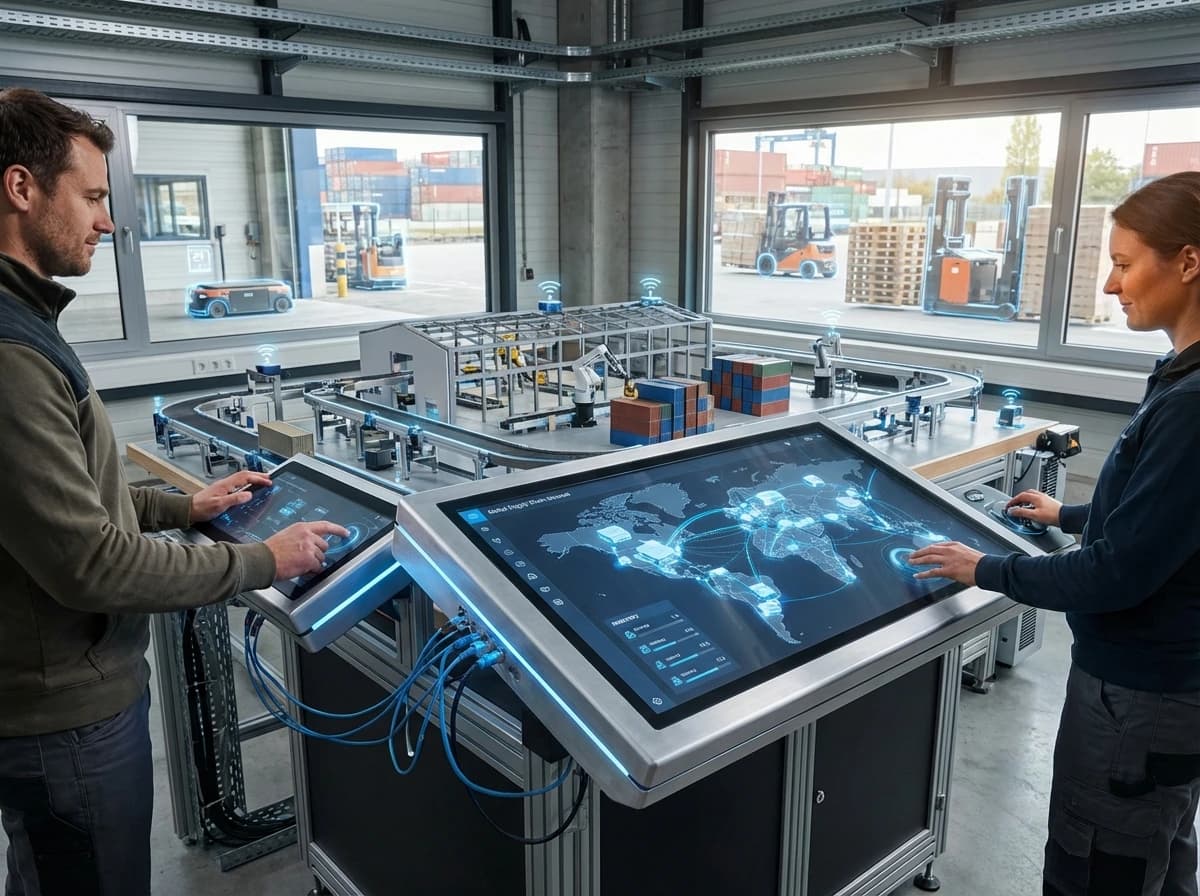
Supply Chain Digital Twins
Virtual replicas of the entire supply chain network for simulation and optimization.
Supply chain digital twins represent a sophisticated convergence of real-time data integration, advanced simulation, and predictive analytics to create dynamic virtual replicas of physical logistics networks. These digital models synthesize information streams from Internet of Things sensors, enterprise resource planning systems, transportation management platforms, and external data sources such as weather forecasts, geopolitical events, and market demand signals. The underlying architecture typically employs cloud computing infrastructure to process massive data volumes, machine learning algorithms to identify patterns and anomalies, and visualization tools that render complex supply chain operations into comprehensible interfaces. Unlike static planning models, these twins continuously update themselves as conditions change, maintaining a near-real-time mirror of inventory positions, shipment locations, warehouse capacities, and supplier performance across global networks. The technology builds upon decades of supply chain modeling but achieves unprecedented fidelity by incorporating granular operational data that was previously siloed or unavailable.
The fundamental challenge these systems address is the growing complexity and fragility of modern supply chains, which often span dozens of countries, hundreds of suppliers, and thousands of potential failure points. Traditional planning approaches struggle to account for the cascading effects of disruptions or to evaluate the trade-offs between efficiency and resilience before committing resources. Supply chain digital twins enable logistics managers to conduct sophisticated scenario planning, testing how their networks would respond to port closures, supplier bankruptcies, demand surges, or transportation delays without risking actual operations. This capability proves particularly valuable for optimizing inventory positioning, identifying single points of failure, and evaluating alternative sourcing strategies. Organizations can quantify the financial and operational impacts of different network configurations, supporting decisions about warehouse locations, transportation modes, and supplier diversification. The technology also facilitates collaboration across organizational boundaries, as partners can share relevant portions of their digital twins to coordinate planning and response strategies more effectively.
Early implementations have emerged primarily among large manufacturers and retailers with complex global operations, though cloud-based platforms are beginning to make the technology accessible to mid-sized enterprises. Automotive companies have deployed digital twins to manage semiconductor shortages and evaluate regional production strategies, while consumer goods firms use them to balance inventory costs against service levels across distribution networks. The technology shows particular promise in industries facing regulatory pressures for supply chain transparency, as the comprehensive data integration required for digital twins naturally supports traceability and compliance reporting. Looking forward, the convergence of digital twin technology with autonomous decision-making systems suggests a trajectory toward self-optimizing supply chains that can automatically reroute shipments, adjust production schedules, and rebalance inventory in response to detected anomalies. As climate-related disruptions and geopolitical uncertainties continue to challenge global logistics, the ability to simulate and stress-test supply chain strategies before implementation will likely become a competitive necessity rather than a technological advantage.
TRL
7/9Operational
Impact
5/5
Investment
5/5
Category
Software
Related Organizations
A leading provider of multimethod simulation modeling software.
Developer
Provides simulation digital twin software for enterprise decision making.
Developer
Owned by Panasonic, their Luminate platform offers a digital twin of the supply chain for real-time visibility and prediction.
Developer
Supply chain planning software (RapidResponse) that provides concurrent planning via the cloud.
Developer
Provides an AI-powered 'Digital Brain' platform that creates digital twins of enterprise supply chains, heavily utilized by major fashion and apparel retailers.
Developer
Provides simulation and scheduling software used to create digital twins of hospital emergency departments and surgical suites.
Developer
Software corporation specializing in 3D design and digital mock-ups.
Developer
Developing foundation models for robotics (Project GR00T) and vision-language models like VILA.
Developer
Offers a Digital Planning Twin that uses optimization modeling to represent the end-to-end value chain.
Developer
Offers the Xcelerator portfolio, enabling comprehensive digital twins for spacecraft design, manufacturing, and operations.
Developer
Creates a digital twin of the warehouse to optimize labor and inventory movement in real-time.
Developer
What was expected
Published forecasts about this technology, graded against what happened in Hindsight.
Digital Twin
This page is a narrower case of it.
Supporting Evidence
Evidence data is not available for this technology yet.
Research this in Signals
Scan Supply Chain Digital Twins for yourself.
Signals turns a topic into a sourced research record you can inspect and rerun. Your first scan is free, and this one starts with Supply Chain Digital Twins already loaded, so edit it or scan as is.