






AI Agents
This page is a narrower case of it.
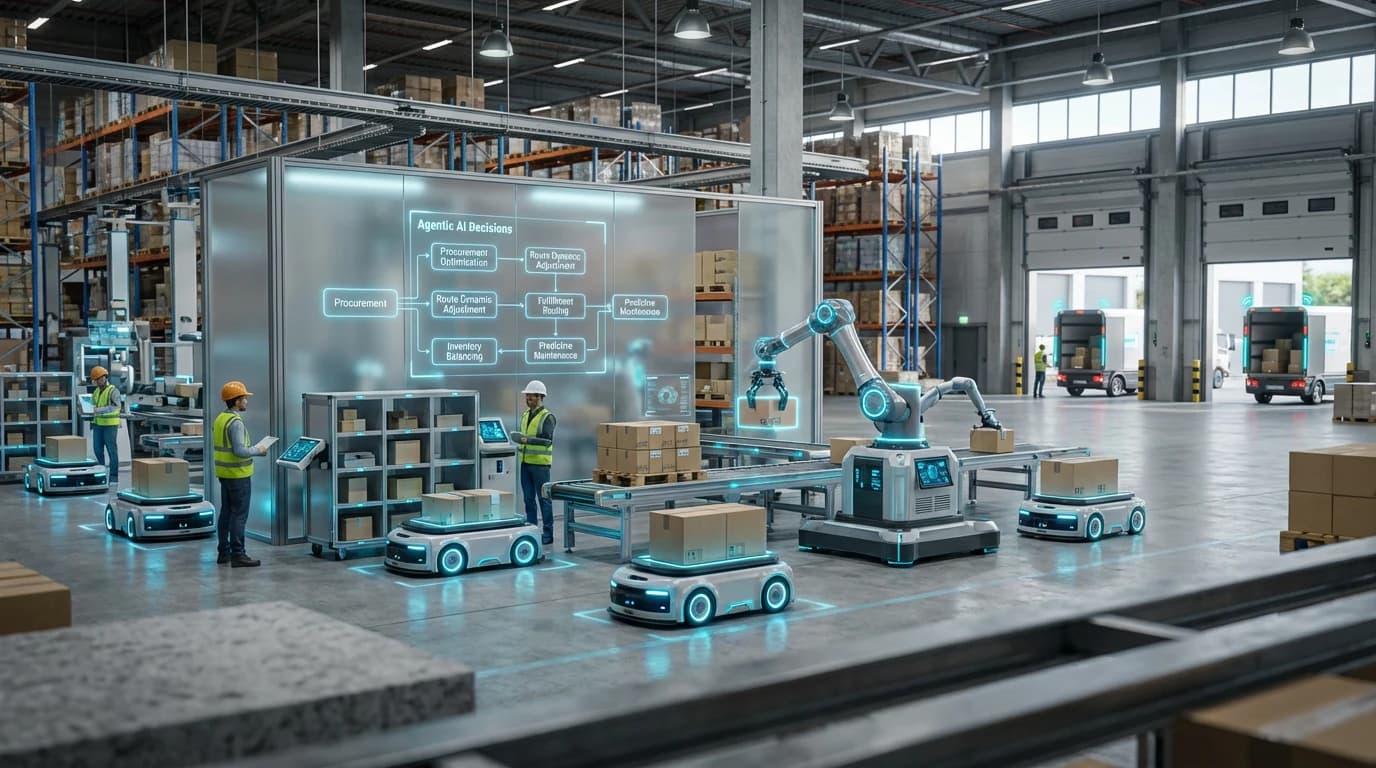
Agentic AI for autonomous supply chain operations represents a fundamental shift from traditional decision-support systems to truly autonomous agents capable of independent action across the entire logistics ecosystem. Unlike conventional AI systems that merely provide recommendations or predictions, these agents possess the authority and capability to execute decisions in real-time, from procurement negotiations to last-mile delivery adjustments. The technology builds upon advances in reinforcement learning, multi-agent systems, and large language models to create digital entities that can perceive their environment through data streams, reason about complex trade-offs, and take actions that optimize for multiple objectives simultaneously. These agents operate within defined guardrails and governance frameworks, but within those boundaries, they function with remarkable autonomy—analyzing market conditions, evaluating supplier performance, forecasting demand fluctuations, and orchestrating responses without waiting for human approval. The underlying architecture typically involves distributed agent networks that communicate and coordinate with one another, sharing information and negotiating resource allocation in ways that mirror human collaboration but at machine speed and scale.
The supply chain industry faces mounting pressures that strain traditional management approaches: volatile demand patterns, geopolitical disruptions, labor shortages, and the expectation of ever-faster delivery times. Human planners, no matter how skilled, struggle to process the volume and velocity of information required to optimize modern supply networks that span continents and involve thousands of variables. Agentic AI addresses this fundamental limitation by enabling continuous, autonomous optimization across the entire value chain. When a port closure threatens to delay shipments, these agents can instantly evaluate alternative routes, renegotiate carrier contracts, adjust production schedules at affected facilities, and communicate revised delivery expectations to customers—all within minutes rather than the hours or days human coordination would require. This capability transforms supply chains from reactive systems that respond to disruptions into proactive, self-healing networks that anticipate and mitigate problems before they cascade. The technology also enables new forms of inter-organizational collaboration, as agents from different companies can negotiate and coordinate directly, establishing dynamic partnerships and resource-sharing arrangements that would be impractical through traditional business development channels.
Early implementations of agentic AI in supply chain operations are emerging across industries, particularly in sectors where speed and complexity create the strongest business case for automation. Logistics providers are deploying agents that autonomously manage fleet routing and warehouse operations, while manufacturers experiment with agents that coordinate procurement across global supplier networks. These initial deployments suggest significant potential for reducing costs, improving service levels, and building resilience against disruptions. However, widespread adoption requires addressing important questions around accountability, transparency, and the appropriate balance between machine autonomy and human oversight. As the technology matures, industry observers anticipate a gradual expansion from tactical applications—such as automated reordering or route optimization—toward more strategic functions like supplier relationship management and network design. This evolution aligns with broader trends toward autonomous systems in logistics, from self-driving delivery vehicles to robotic warehouses, creating an integrated vision of supply chains where intelligent agents orchestrate physical and digital operations with minimal human intervention, fundamentally redefining how goods move through the global economy.
Develops the 'Decision Cloud' to digitize, augment, and automate supply chain and operational decisions.
Provides an AI-powered 'Digital Brain' platform that creates digital twins of enterprise supply chains, heavily utilized by major fashion and apparel retailers.
Develops autonomous negotiation AI that handles supplier contracts and procurement negotiations independently.
Creates a digital twin of the warehouse to optimize labor and inventory movement in real-time.
Supply chain planning software (RapidResponse) that provides concurrent planning via the cloud.
Owned by Panasonic, their Luminate platform offers a digital twin of the supply chain for real-time visibility and prediction.
An autonomous sourcing platform that uses AI to match buyers with service providers and manage the RFP process.
A platform that coordinates transportation networks, moving freight contracting from reactive to predictive/planned.
Published forecasts about this technology, graded against what happened in Hindsight.
AI Agents
This page is a narrower case of it.
AI Augmented Process Decisions
This page is a narrower case of it.
Augmented & Automated Processes
This page is a narrower case of it.
Signals turns a topic into a sourced research record you can inspect and rerun. Your first scan is free, and this one starts with Agentic AI for Autonomous Supply Chain Operations already loaded, so edit it or scan as is.