

















Digital Twin Testing for Preparedness
Supply Chain Digital Twins
Virtual replicas of supply networks that simulate logistics scenarios in real time
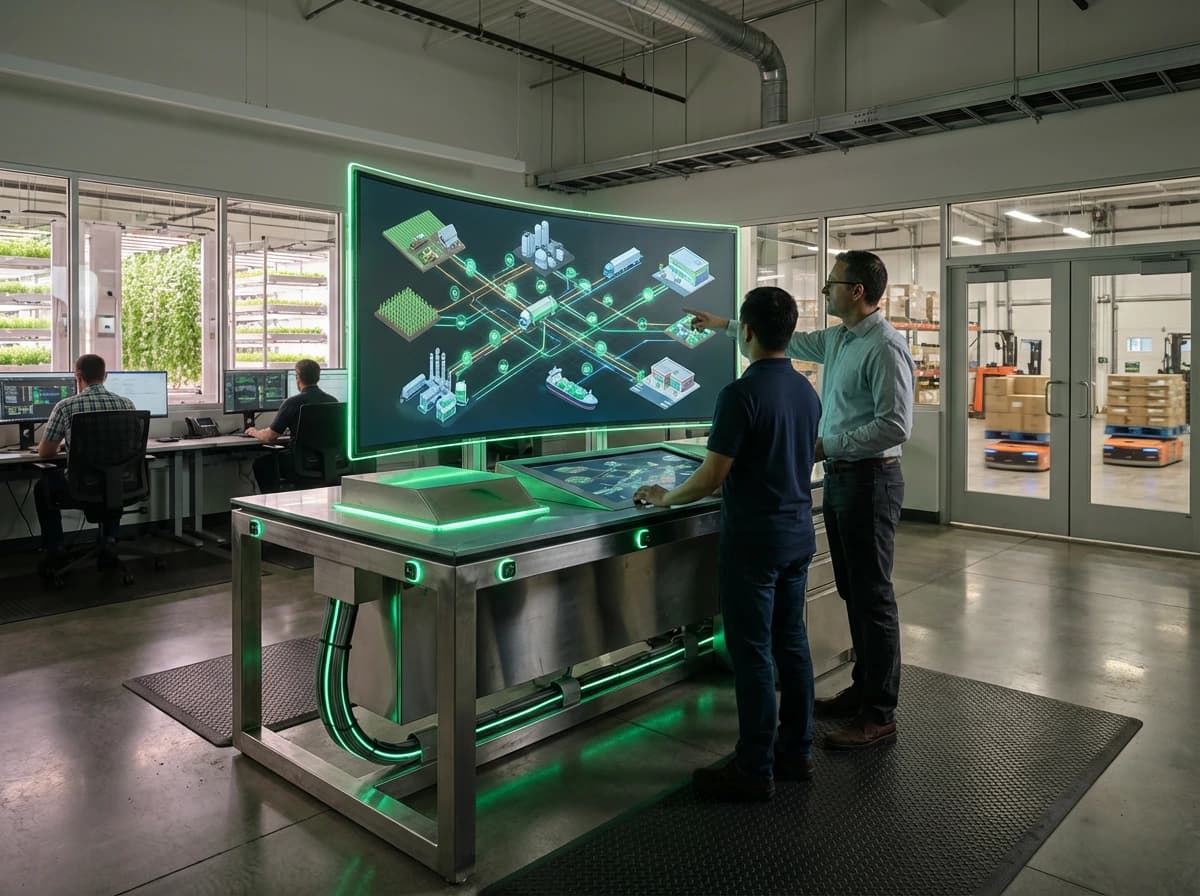
Supply chain digital twins represent a sophisticated convergence of real-time data integration, advanced analytics, and simulation technology that creates dynamic virtual replicas of physical supply chain networks. These systems continuously ingest data from multiple sources—including IoT sensors on shipping containers, warehouse management systems, point-of-sale terminals, weather services, and transportation tracking platforms—to construct and maintain an accurate digital representation of the entire supply chain ecosystem. The technology employs machine learning algorithms to process this constant stream of information, enabling the virtual model to mirror the current state of physical operations while simultaneously running predictive simulations. By combining historical patterns with real-time inputs, these digital twins can model countless scenarios, from routine demand fluctuations to extreme disruption events, providing supply chain managers with a powerful tool for understanding complex interdependencies across their networks.
The agricultural and food retail sectors face particularly acute supply chain challenges due to the perishable nature of products, seasonal variability, and the complexity of coordinating between farms, processing facilities, distribution centers, and retail outlets. Traditional supply chain management often relies on reactive approaches that struggle to prevent waste or respond quickly to disruptions. Digital twin technology addresses these limitations by enabling proactive decision-making through continuous scenario testing. For instance, when a digital twin detects early indicators of potential delays—such as adverse weather affecting harvest schedules or transportation routes—it can immediately simulate alternative routing options, adjusted inventory positioning, or modified production schedules. This capability is transformative for reducing food waste, as the system can optimize the flow of perishable goods to ensure products reach consumers before spoilage occurs. Additionally, these virtual models help retailers balance inventory levels more precisely, avoiding both stockouts that disappoint customers and overstocking that leads to markdowns or disposal.
Early implementations in food supply chains have demonstrated the technology's potential to fundamentally reshape how agricultural products move from farm to table. Distribution companies are deploying digital twins to coordinate complex networks involving hundreds of suppliers and thousands of delivery points, using the technology to reduce spoilage rates and improve delivery reliability. The systems prove particularly valuable during harvest seasons when supply surges require rapid coordination across the entire chain. Looking forward, the integration of digital twins with emerging technologies such as blockchain for traceability and autonomous vehicles for logistics promises even greater optimization potential. As climate variability increases and consumer expectations for freshness and sustainability intensify, digital twin technology is becoming essential infrastructure for building resilient, efficient food supply chains capable of feeding growing urban populations while minimizing environmental impact.
TRL
7/9Operational
Impact
5/5
Investment
5/5
Category
Software
Related Organizations
Provides simulation digital twin software for enterprise decision making.
Developer
Offers Vertex AI NAS, a managed service for automating the design of neural network architectures.
Developer
Supply chain planning software (RapidResponse) that provides concurrent planning via the cloud.
Developer
Provides an AI-powered 'Digital Brain' platform that creates digital twins of enterprise supply chains, heavily utilized by major fashion and apparel retailers.
Developer
Software specifically designed for supply chain design, optimization, and simulation using digital twin technology.
Developer

Coupa Software (Llamasoft)
United States · Company
Through its acquisition of Llamasoft, Coupa offers advanced supply chain design and digital twin capabilities to model complex logistics networks.
Developer
Software corporation specializing in 3D design and digital mock-ups.
Developer
Provides watsonx.governance for managing AI risk and compliance.
Developer
Offers a Digital Planning Twin that uses optimization modeling to represent the end-to-end value chain.
Developer
Enterprise software giant providing data analytics solutions to esports teams like Team Liquid.
Developer
Offers the Xcelerator portfolio, enabling comprehensive digital twins for spacecraft design, manufacturing, and operations.
Developer
Provides supply chain network design and planning software that allows users to create digital representations of their logistics for optimization.
Developer
Owned by Panasonic, their Luminate platform offers a digital twin of the supply chain for real-time visibility and prediction.
Developer
Global logistics company heavily deploying analytics for warehouse optimization and transport planning.
Deployer
Provides a digital supply chain platform that leverages AI and digital twins for planning and traceability.
Developer
Noodle.ai
United States · Startup
Provides 'Flow Operations' software that creates a probabilistic digital twin of the supply chain to predict and prevent waste.
Developer
Developing foundation models for robotics (Project GR00T) and vision-language models like VILA.
Developer
Offers Oracle Cloud for Government with isolated regions and high-security accreditation.
Developer
Provides an advanced visibility platform for shippers and logistics service providers, connecting data across the supply chain.
Developer
Provides simulation and scheduling software used to create digital twins of hospital emergency departments and surgical suites.
Developer
Develops the Gurobi Optimizer, a mathematical solver used by many logistics platforms to calculate optimal routes.
Developer
An operational resilience company that maps supply chains to the Nth tier.
Developer
Major supply chain technology provider that acquired Enspire Commerce and partners with robotics firms.
Developer
Provides cloud-native supply chain commerce solutions, specifically Warehouse Management Systems (WMS).
Developer
Through Copilot and the 'Recall' feature in Windows, Microsoft is integrating persistent memory and agentic capabilities directly into the operating system.
Developer
What was expected
Published forecasts about this technology, graded against what happened in Hindsight.
Industrial True-to-Reality Simulations and Digital Twins
This page is a narrower case of it.
Supporting Evidence
Evidence data is not available for this technology yet.
Research this in Signals
Scan Supply Chain Digital Twins for yourself.
Signals turns a topic into a sourced research record you can inspect and rerun. Your first scan is free, and this one starts with Supply Chain Digital Twins already loaded, so edit it or scan as is.