























Agricultural robots
Autonomous Field Robots
Mobile robots that navigate fields to harvest crops, remove weeds, and monitor plant health
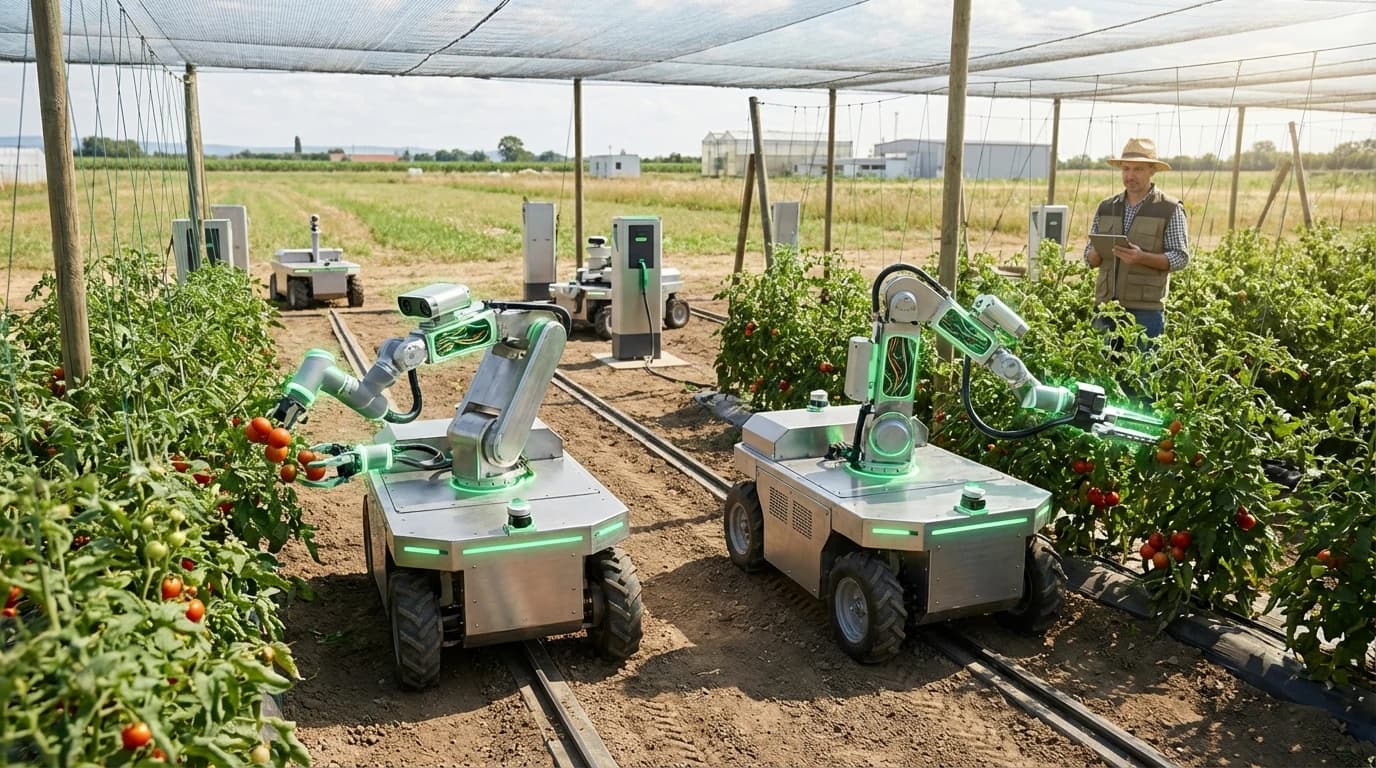
Autonomous field robots represent a convergence of robotics, computer vision, GPS navigation, and artificial intelligence designed to perform labor-intensive agricultural tasks with minimal human intervention. These mobile platforms navigate crop rows using a combination of satellite positioning and onboard cameras that continuously map their surroundings, identifying individual plants, weeds, and ripe produce. Advanced sensor arrays—including multispectral cameras, LiDAR, and depth sensors—enable the robots to distinguish between crop species and unwanted vegetation, assess plant health, and determine harvest readiness at the individual fruit or vegetable level. Machine learning algorithms process this visual data in real-time, allowing the robots to make autonomous decisions about which actions to take, whether applying targeted herbicide droplets to specific weeds, gently grasping ripe strawberries, or pruning diseased leaves. The mechanical systems vary by application, from precision spray nozzles that deliver chemicals only where needed to soft robotic grippers designed to handle delicate produce without bruising.
The agricultural sector faces mounting pressure from labor shortages, rising input costs, and increasing demand for sustainable farming practices. Traditional mechanized harvesting often requires crops bred for uniformity and simultaneous ripening, limiting variety and quality, while broadcast spraying of herbicides and pesticides contributes to environmental concerns and regulatory scrutiny. Autonomous field robots address these challenges by enabling precision agriculture at scale—they can work continuously through day and night, operate in weather conditions uncomfortable for human workers, and perform repetitive tasks with consistent accuracy. By targeting interventions at the plant or even leaf level, these systems dramatically reduce chemical inputs, sometimes by 90% or more compared to conventional spraying methods. This capability is particularly valuable for organic and specialty crop producers who face strict limitations on chemical use and rely heavily on manual labor for tasks like hand-weeding and selective harvesting. The technology also opens new possibilities for data collection, as robots continuously gather information about crop health, growth patterns, and yield predictions that inform broader farm management decisions.
Early commercial deployments have focused on high-value crops where labor costs represent a significant portion of production expenses, including strawberries, lettuce, grapes, and asparagus. Several agricultural technology companies have introduced robotic weeders now operating on thousands of acres across North America and Europe, with farmers reporting substantial reductions in herbicide use and labor requirements. Harvesting robots, while more technically challenging due to the delicate nature of produce handling, have progressed from research prototypes to field trials and limited commercial availability. Industry analysts note that as sensor costs decline and machine learning models improve through exposure to diverse field conditions, these systems are becoming economically viable for a broader range of crops and farm sizes. The technology aligns with larger agricultural trends toward precision farming, data-driven decision-making, and sustainable intensification—producing more food on existing farmland while reducing environmental impact. As climate variability increases and rural labor markets tighten, autonomous field robots are positioned to become essential infrastructure for resilient food production systems.
TRL
6/9Demonstrated
Impact
5/5
Investment
5/5
Category
Hardware
Related Organizations
Develops the AgBot ecosystem, a series of autonomous diesel-electric tractors for soil cultivation and seeding.
Developer
Produces the Autonomous LaserWeeder, which uses AI and lasers to eliminate weeds without chemicals.
Developer
Manufactures Global Unmanned Spray System (GUSS) autonomous sprayers for orchards and vineyards.
Developer
Develops robotic strawberry and apple harvesters that work alongside human crews.
Developer
Builds autonomous mechanical weeders (Vulcan) powered by AI and computer vision.
Developer
Develops flexible robotic arms for harvesting soft fruits like raspberries.
Developer
Developing a large-scale automated strawberry picking machine to address labor shortages.
Developer
Manufacturer of smart, electric, driver-optional tractors.
Developer
Develops and markets autonomous electric robots for weeding and hoeing in vegetable farming.
Developer
Provides autonomy retrofit kits for standard tractors and operates Farming-as-a-Service with autonomous fleets.
Developer
Develops autonomous agricultural robots that work in swarms to apply crop protection products and manage farmland efficiently.
Developer
Operates 'Community Notes' (formerly Birdwatch), the most prominent collaborative verification system at scale.
Developer
Builds autonomous collaborative robots that follow pickers and carry produce in vineyards and nurseries.
Developer
Muddy Machines
United Kingdom · Startup
Develops the 'Sprout' robot for autonomous asparagus harvesting.
Developer
Manufacturer of ROBOTTI, an autonomous tool carrier for arable farming.
Developer
Provides a platform to retrofit existing tractors into autonomous vehicles.
Developer
Produces ultra-high precision sprayers (ARA) that use AI to target individual weeds.
Developer
Specialist university for the agri-food sector.
Researcher
A global machinery giant that operates the Operations Center, one of the largest repositories of agronomic and machine data in the world.
Developer

Nexus Robotics
Canada · Startup
Develops 'La Chèvre', an autonomous weeding robot that uses robotic arms to pull weeds.
Developer
Robotics company offering 'Sharpshooter' technology for farming.
Developer
Produces robot tractors capable of unmanned operation and coordinated multi-vehicle tasks.
Developer
Builds autonomous harvesting robots for table-top strawberry production in controlled environments.
Developer
AutoNxt Automation
India · Startup
Developing India's first electric autonomous tractor tailored for the specific needs of Indian agriculture.
Developer
Parent of Case IH and New Holland, developing autonomous technology stacks (via Raven Industries acquisition).
Acquirer
What was expected
Published forecasts about this technology, graded against what happened in Hindsight.
Robotic farm swarms
This page is broader than it.
Supporting Evidence
Evidence data is not available for this technology yet.
Research this in Signals
Scan Autonomous Field Robots for yourself.
Signals turns a topic into a sourced research record you can inspect and rerun. Your first scan is free, and this one starts with Autonomous Field Robots already loaded, so edit it or scan as is.