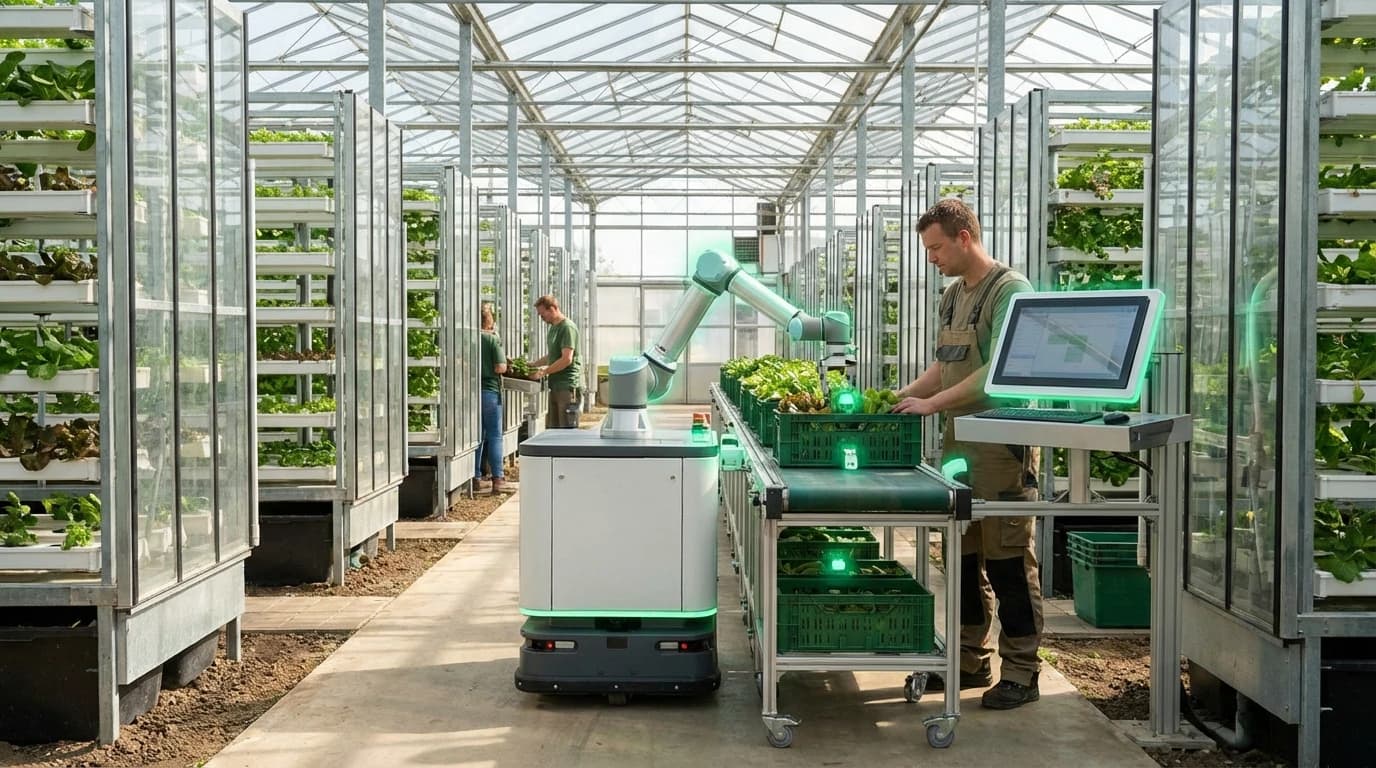
Responsible Automation Transition
The agricultural and food supply sectors stand at a critical juncture as automation technologies rapidly transform traditional labor models. Responsible Automation Transition represents a comprehensive socio-technical framework designed to address the complex challenges that arise when farms, food processing facilities, warehouses, and retail operations introduce robotic systems, AI-driven logistics, and automated handling equipment. Unlike conventional automation deployments that focus solely on technological efficiency, this approach recognizes that the introduction of machines into labor-intensive environments creates profound social, economic, and ethical implications. The framework integrates multiple components: structured reskilling programs that prepare workers for new roles alongside automated systems, formal social dialogue mechanisms that give workers and communities a voice in transition planning, and continuous impact monitoring systems that track employment patterns, wage effects, and community wellbeing. These elements work in concert to ensure that productivity gains from automation do not come at the expense of worker livelihoods or community stability.
The agri-food value chain faces unique labor challenges that make responsible transition frameworks particularly urgent. Seasonal agricultural work, warehouse logistics, and retail operations have historically provided employment for millions of workers, many from vulnerable populations including migrant laborers and rural communities with limited alternative employment options. As robotic harvesters, automated sorting systems, and autonomous delivery vehicles become increasingly viable, industry analysts note the risk of rapid displacement without adequate support structures. Responsible Automation Transition addresses this by creating structured pathways that allow workers to evolve alongside technology rather than being replaced by it. For instance, a farm implementing robotic berry pickers might simultaneously establish training programs for equipment maintenance, data analysis roles for crop monitoring systems, or supervisory positions overseeing automated operations. The social dialogue component ensures that workers, unions, and community representatives participate in planning these transitions, helping to identify local needs and concerns that purely technical assessments might overlook.
Early implementations of responsible transition frameworks are emerging across various segments of the food supply chain. Some agricultural cooperatives have begun piloting programs that combine gradual automation introduction with guaranteed retraining opportunities and temporary income support during skill development periods. In warehouse and distribution contexts, several operators are experimenting with hybrid models where human workers and robots collaborate, with workers receiving training to manage and optimize automated systems rather than being displaced entirely. These approaches align with broader industry trends toward stakeholder capitalism and ESG (environmental, social, governance) considerations, as food companies face increasing pressure from consumers, investors, and regulators to demonstrate social responsibility. Looking forward, responsible automation transition frameworks may become essential components of technology procurement decisions, with companies evaluating automation investments not just on productivity metrics but on their ability to support workforce development and community resilience. As the pace of agricultural and food system automation accelerates, these frameworks offer a pathway toward technological advancement that preserves human dignity and economic opportunity alongside efficiency gains.
Related Organizations

Builds autonomous collaborative robots that follow pickers and carry produce in vineyards and nurseries.

A specialized agency of the United Nations that leads international efforts to defeat hunger.

The nation's first enduring and largest farm workers union, actively negotiating labor protections regarding mechanization.

The French association representing the agricultural robotics ecosystem.
Agri-EPI Centre
United Kingdom · Consortium
One of the four UK Agri-Tech Innovation Centres, focused on precision agriculture and engineering.

An interdisciplinary research initiative exploring the social, economic, and technical impacts of digital ag and automation.

European Federation of Food, Agriculture and Tourism Trade Unions.

A certification program that trains farmworkers and management in collaborative problem-solving, including adapting to new technologies.

A nonprofit organization that seeks to empower migrant and seasonal farmworkers.
Western Growers Center for Innovation & Technology
United States · Consortium
An incubator and trade association hub focused on accelerating agricultural technology to address labor shortages while managing industry transition.

Manufacturer of smart, electric, driver-optional tractors.

Develops and markets autonomous electric robots for weeding and hoeing in vegetable farming.

A top agricultural research university conducting extensive studies on the labor impacts of ag-tech and developing human-collaborative robotics.

Produces the Autonomous LaserWeeder, which uses AI and lasers to eliminate weeds without chemicals.

Manufactures the Smart Cultivator, a software-defined implement that uses vision to mechanically remove weeds in row crops.

Builds autonomous harvesting robots for table-top strawberry production in controlled environments.

Robotics company offering 'Sharpshooter' technology for farming.

International organization for public-private cooperation.

The leading certifier of Fair Trade products in North America.
Global Association for the Tech in Agriculture (GOFAR)
France · Consortium
Organizers of the FIRA (International Forum of Agricultural Robotics) events, which include dedicated tracks on legal, social, and ethical aspects of ag robotics.

A UN agency that sets international labor standards and produces the 'Guidelines for a just transition towards environmentally sustainable economies'.
Muddy Machines
United Kingdom · Startup
Develops the 'Sprout' robot for autonomous asparagus harvesting.

A leading think tank focused on land policy, taxation, and urban development.
Supporting Evidence
Research this in Signals
Signals turns a topic into a sourced research record you can inspect and rerun. Your first scan is free, and this one starts with Responsible Automation Transition already loaded, so edit it or scan as is.