




















Indoor Plant Factories
Vertical Farming Systems
Stacked indoor crop production with controlled climate and soilless growing methods
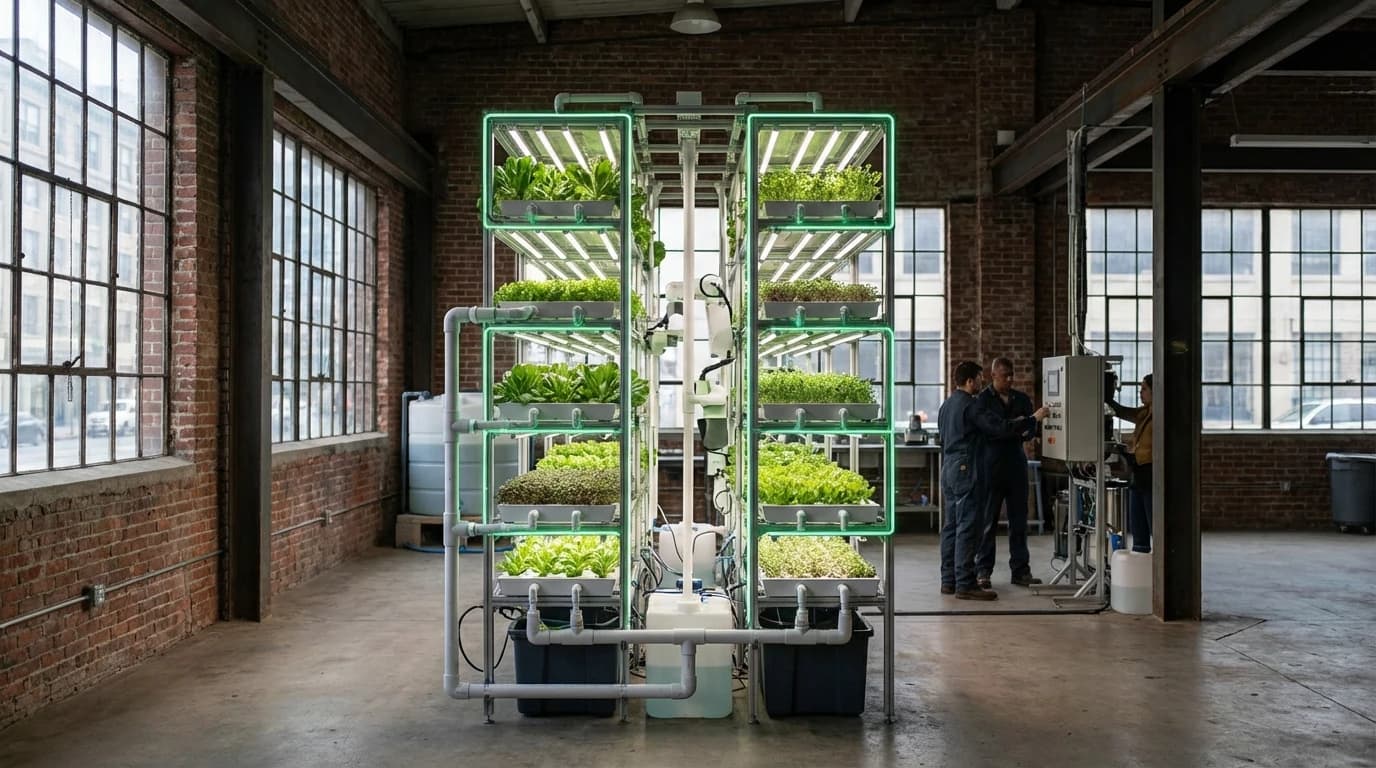
Vertical farming systems represent a paradigm shift in agricultural production, utilizing stacked layers of crops grown in controlled indoor environments. These systems typically employ soilless cultivation methods such as hydroponics, where plant roots are submerged in nutrient-rich water solutions, or aeroponics, where roots are suspended in air and periodically misted with nutrients. The controlled environment allows precise regulation of temperature, humidity, light spectrum, and CO2 levels, creating optimal growing conditions year-round regardless of external weather patterns. LED lighting systems are carefully calibrated to provide specific wavelengths that maximize photosynthesis and plant growth, while automated sensors continuously monitor and adjust environmental parameters. By growing crops in vertical stacks within warehouses, shipping containers, or purpose-built facilities, these systems can produce significantly more food per square meter than traditional field agriculture, making them particularly valuable in land-scarce urban environments.
The agricultural sector faces mounting pressure from climate change, water scarcity, and the need to feed growing urban populations while reducing the environmental footprint of food production. Vertical farming addresses these challenges by using up to 95% less water than conventional agriculture through closed-loop recirculation systems, eliminating pesticide use through environmental isolation, and dramatically reducing transportation distances by locating production facilities near or within cities. This proximity to consumers—often called "zero-mile" agriculture—reduces food waste from spoilage during transport and enables harvest-to-shelf times measured in hours rather than days, preserving nutritional value and freshness. The technology also enables year-round production of crops regardless of season, insulating food supplies from weather disruptions and providing consistent quality and pricing. For retailers and food service operators, vertical farms offer reliable local sourcing that can strengthen supply chain resilience while appealing to consumers increasingly concerned with food provenance and sustainability.
Commercial vertical farming operations have expanded significantly in recent years, with facilities producing leafy greens, herbs, and increasingly diverse crops including strawberries and tomatoes in urban centers worldwide. Major grocery chains and restaurants have begun partnering with vertical farm operators to secure consistent supplies of ultra-fresh produce, while some retailers have even installed small-scale systems within stores themselves. Research continues into expanding the range of viable crops, improving energy efficiency of LED systems, and developing automation technologies to reduce labor costs, which remain a significant operational challenge. As urban populations continue to concentrate and climate impacts on traditional agriculture intensify, vertical farming is positioned to become an increasingly important component of resilient urban food systems, complementing rather than replacing conventional agriculture by focusing on high-value, perishable crops where proximity and consistency provide clear advantages.
TRL
9/9Established
Impact
4/5
Investment
5/5
Category
Applications
Related Organizations
An indoor farming company that operates fully automated vertical farms.
Developer
A vertical farming company using proprietary software (BoweryOS) to monitor plants and optimize resources.
Developer
A Swedish company specializing in intelligent lighting technology for greenhouse and controlled plant growth environments.
Developer
iFarm
Finland · Startup
Provides turnkey vertical farming technologies and software to grow crops indoors.
Developer
A vertical farming technology company that uses vertical planes to grow leafy greens with high resource efficiency.
Developer
Develops hardware and software for building automation and climate control.
Developer
A Japanese vertical farming pioneer known for its 'Techno Farm' automated production system.
Developer
Global market leader in energy storage products and services, and digital applications for renewables and storage.
Developer
A technology company providing vertical farming infrastructure (Growth Towers) to other growers.
Developer
Develops the 'Cube', a modular container vertical farm system.
Developer
Provides end-to-end indoor farming solutions and biological research.
Developer
Operates vertical farms and joint ventures, including the world's largest vertical farm in Dubai with Emirates Flight Catering.
Developer
Europe's largest application-oriented research organization.
Researcher
Manufactures the 'Greenery', a self-contained hydroponic farm inside a shipping container, enabling farming anywhere in a city.
Developer
Operates a network of high-tech hydroponic greenhouses located on rooftops in urban centers across America.
Deployer
Jones Food Company
United Kingdom · Company
Operates Europe's largest vertical farms, backed by Ocado, focusing on high-density production.
Developer
Develops the Vera vertical farming system, a proprietary technology for industrial-scale indoor growing.
Developer
Vertical farming company famous for pollinating strawberries indoors using bees and AI-driven climate control.
Deployer
A diverse technology company providing vertical farming hardware, including the RADIX module system and specialized lighting.
Developer
Builds and operates vertical hydroponic farms integrated into urban infrastructure, such as parking garages.
Deployer
A vertical farming company aiming to grow protein-rich crops (soy/wheat) indoors.
Deployer
Home to the Japan Plant Factory Association and a leading research center for controlled environment agriculture.
Researcher
A technology provider developing aeroponic irrigation systems for indoor farming.
Developer
Parent company of Philips Hue, which offers the 'Hue Sync' protocol to align smart lighting with HDMI video signals.
Developer
A top-tier university for agricultural research, specifically in greenhouse and vertical farming innovation.
Researcher
What was expected
Published forecasts about this technology, graded against what happened in Hindsight.
Vertical farming
Vertical Farming Grows Up
Indoor Farms
This page is a narrower case of it.
Supporting Evidence
Paper
Vertical farming: productivity, environmental impact, and resource use. A reviewAgronomy for Sustainable Development · Sep 23, 2025
A comprehensive review analyzing the productivity and environmental performance of vertical farming, reporting lettuce yields of 60–105 kg FW m−2 year−1 and water use efficiency of approximately 140 g FW L−1 H2O.
Support 95%Confidence 98%
Paper
Toward Sustainable Agriculture: The Design of Environmentally Friendly, Economical, and Modular Vertical Farming SystemsEngineering · Dec 26, 2025
Presents a design for modular vertical farming systems that balances environmental impact with economic feasibility, addressing the need for sustainable urban agriculture infrastructure.
Support 90%Confidence 95%
Paper
A novel multilayer cultivation strategy improves light utilization and fruit quality in plant factories for tomato productionFrontiers in Horticulture · Jul 30, 2025
Investigates a multilayer cultivation system for mini tomatoes using white LEDs, aiming to solve light demand and height challenges in fruit-bearing crop production.
Support 89%Confidence 96%
Paper
Sustainable Edamame production in an artificial light plant factory with improved yield and qualityScientific Reports · Sep 12, 2025
Demonstrates the successful cultivation of Edamame in a plant factory with artificial lighting, overcoming seasonal limitations and quality deterioration issues.
Support 88%Confidence 95%
Research this in Signals
Scan Vertical Farming Systems for yourself.
Signals turns a topic into a sourced research record you can inspect and rerun. Your first scan is free, and this one starts with Vertical Farming Systems already loaded, so edit it or scan as is.