Field IoT Sensor Networks
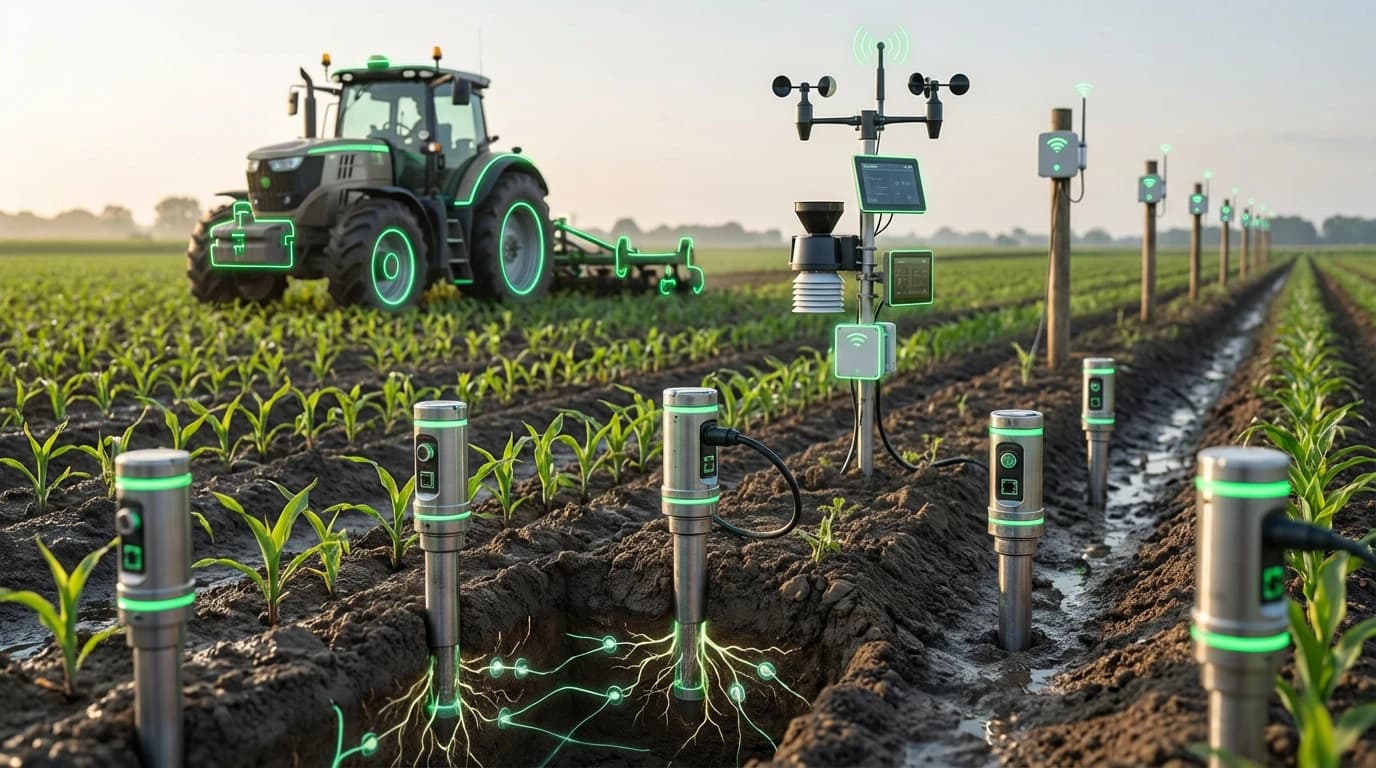
Field IoT sensor networks represent a fundamental shift in agricultural data collection, replacing periodic manual sampling with continuous, automated monitoring across entire farming operations. These systems consist of networks of low-power wireless sensors strategically distributed throughout fields, orchards, greenhouses, and storage facilities. Each node typically integrates multiple sensing capabilities—soil moisture probes, temperature and humidity sensors, light meters, and equipment vibration monitors—transmitting data via protocols like LoRaWAN, NB-IoT, or mesh networks to central gateways. The sensors operate on minimal power, often harvesting energy from solar panels or lasting years on battery power, making them practical for deployment in remote locations without electrical infrastructure. Advanced implementations incorporate edge computing capabilities, allowing nodes to perform preliminary data processing and trigger immediate alerts when conditions exceed predetermined thresholds.
The agricultural sector has long struggled with the challenge of managing variability across large production areas, where soil composition, drainage patterns, and microclimatic conditions can differ dramatically within a single field. Traditional approaches to irrigation, fertilisation, and pest management apply uniform treatments based on limited sampling points or visual inspection, often resulting in overuse of water and inputs in some areas while others receive insufficient resources. Field IoT sensor networks address this fundamental inefficiency by providing granular, real-time visibility into conditions at a spatial resolution that matches actual field variability. This enables precision agriculture practices where interventions are tailored to specific zones or even individual plants, reducing input costs while improving yields and environmental outcomes. For equipment-intensive operations, continuous vibration and temperature monitoring of machinery enables predictive maintenance strategies that prevent costly breakdowns during critical planting or harvest windows.
Commercial deployments of field sensor networks have expanded rapidly across high-value crops and large-scale operations, with early adopters reporting water savings of twenty to forty percent and significant reductions in fertiliser use. Vineyard operators use dense sensor arrays to map microclimates and optimise irrigation scheduling for different grape varieties, while row crop farmers deploy networks that inform variable-rate application of inputs through integration with precision equipment. In controlled environment agriculture, sensor networks monitor conditions across greenhouse zones to maintain optimal growing parameters and detect disease pressure early. The technology is increasingly accessible to mid-sized operations as sensor costs decline and cloud-based analytics platforms eliminate the need for on-farm data infrastructure. Looking forward, field IoT networks are evolving toward integration with satellite imagery, weather forecasting services, and artificial intelligence systems that can autonomously adjust irrigation systems and alert farmers to emerging issues, positioning these networks as the foundational data layer for increasingly automated and climate-resilient agricultural systems.
Related Organizations
Provides vertical soil moisture probes and 'Crophesy' software to analyze root activity and soil water balance.

Creator of the Arable Mark, an in-field device that collects weather, plant health, and soil moisture data simultaneously.

Produces affordable, high-density soil sensors and a data platform to enable fine-grained field monitoring.
METER Group
United States · Company
Scientific instrument company producing research-grade soil moisture sensors (TEROS series) and data loggers.
Austrian developer of the METOS brand of weather stations and wireless field sensors for soil moisture, insect monitoring, and crop health.

Provides direct plant sensing (dendrometers) and fruit growth sensors connected via IoT for irrigation optimization.

Combines plant sensing hardware with AI to provide autonomous irrigation commands.

Latin America's leading digital agriculture platform, integrating field sensors for climate and irrigation monitoring.

Provides precision irrigation management systems using proprietary soil tension sensors and wireless networks.

A precision agriculture platform for permanent crops that deploys sensor networks (including camera/trap modules) to monitor pests.

Manufacturer of data loggers and data acquisition systems used extensively in geotechnical and structural monitoring.

Provides a farm management system integrated with proprietary soil sensors for moisture, temperature, and EC.

Manufacturer of weather stations and the EnviroMonitor system, a field IoT gateway that connects various soil and environmental sensors.

Manufacturer of high-quality instruments for plant science and soil moisture measurement, including the ThetaProbe.

Sencrop
France · Startup
European ag-tech startup building a collaborative network of connected weather stations and sensors for farmers.

Develops wireless, low-power LoRaWAN soil moisture probes designed for easy integration into existing IoT networks.

Manufacturer of high-precision multi-depth soil moisture and salinity probes used in research and commercial agriculture.

Solinftec
Brazil · Company
Ag-tech company providing solar-powered on-board computers and field sensors connected to an AI platform (Alice) for real-time operations monitoring.

A top-tier university for agricultural research, specifically in greenhouse and vertical farming innovation.

Hardware enabler producing the SenseCAP LoRaWAN industrial sensor series widely used in smart agriculture.

Produces wireless soil probes that measure NPK, pH, and moisture at multiple depths in real-time.

Designs and manufactures wireless sensor network hardware for IoT applications.

Developed the FarmLab, a handheld sensor for real-time soil analysis without lab wait times.

Home to the 'Smart Farm' initiative and extensive agricultural engineering research on sensor networks and water management.

Offers affordable, open-source based soil moisture sensor solutions tailored for vineyards and orchards.


Non-profit association supporting the LoRaWAN standard, a key connectivity protocol for low-power agricultural sensors.
Supporting Evidence
Research this in Signals
Signals turns a topic into a sourced research record you can inspect and rerun. Your first scan is free, and this one starts with Field IoT Sensor Networks already loaded, so edit it or scan as is.