






















Getting a Grip
Soft Robotic Grippers
Flexible grippers that handle delicate produce without bruising or damage
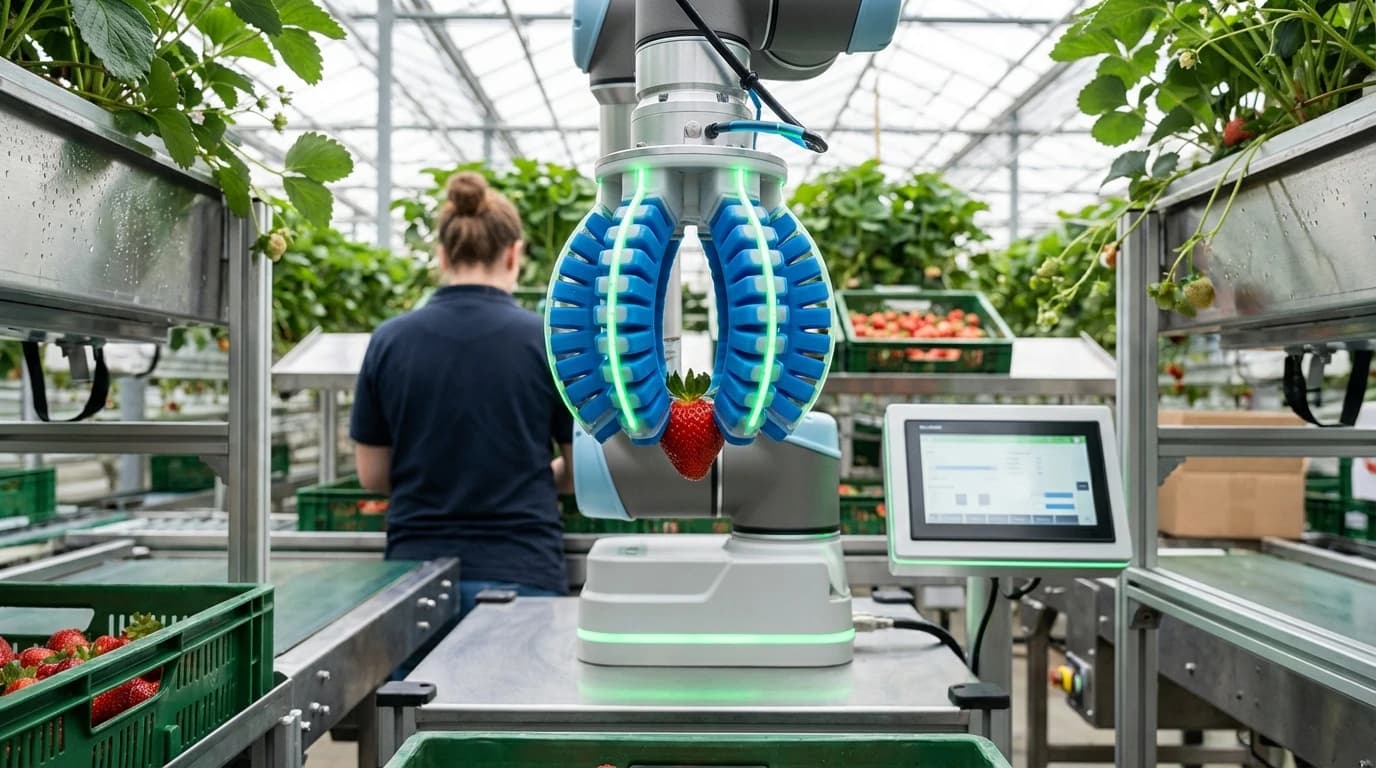
Soft robotic grippers represent a significant advancement in agricultural automation, addressing one of the industry's most persistent challenges: handling delicate produce without causing damage. Unlike traditional rigid robotic grippers that rely on hard metal or plastic components, these systems employ flexible, compliant materials such as silicone elastomers, thermoplastic polyurethanes, and other polymer-based structures that can conform to irregular shapes. The grippers typically operate through pneumatic actuation, where compressed air inflates internal chambers within the soft material, causing controlled bending and grasping motions that mimic the gentle touch of human hands. Some designs incorporate fluidic elastomer actuators or cable-driven mechanisms, while others use shape-memory alloys or electroactive polymers to achieve the necessary flexibility and responsiveness. This biomimetic approach allows the grippers to adapt to the natural variation in size, shape, and ripeness found in fruits and vegetables, applying just enough pressure to secure the item without bruising or puncturing delicate skin.
The agricultural sector has long struggled with the challenge of automating harvest and packing operations for soft produce such as strawberries, tomatoes, peaches, and leafy greens. Traditional mechanical systems often prove too rigid and forceful, resulting in unacceptable levels of product damage and waste. Labor shortages in many agricultural regions have intensified the need for reliable automation solutions that can match human dexterity and judgment. Soft robotic grippers address these challenges by enabling robots to perform tasks that previously required human workers, such as selectively harvesting ripe fruit while leaving unripe specimens on the plant, or carefully transferring delicate items between containers during packing operations. Research suggests that these systems can significantly reduce bruising and mechanical damage compared to conventional handling methods, potentially decreasing post-harvest losses and extending shelf life. This capability opens new possibilities for automated vertical farms, greenhouse operations, and field robotics, where consistent, gentle handling is essential for maintaining product quality and economic viability.
Early deployments of soft robotic grippers in commercial agriculture have shown promising results, with pilot programs appearing in berry harvesting operations, greenhouse tomato production, and automated packing facilities. Industry analysts note growing interest from large-scale growers seeking to address labor challenges while maintaining the quality standards demanded by retail markets. The technology aligns with broader trends toward precision agriculture and supply chain optimization, where minimizing waste and ensuring consistent product quality can provide competitive advantages. As sensor integration improves, these grippers are increasingly paired with computer vision systems that assess ripeness and quality, enabling fully autonomous harvesting decisions. The continued development of more durable materials, faster actuation cycles, and lower-cost manufacturing methods suggests that soft robotic grippers will become increasingly prevalent across the agricultural value chain, potentially transforming how fresh produce moves from field to consumer while reducing dependency on seasonal labor and improving overall supply chain efficiency.
TRL
7/9Operational
Impact
4/5
Investment
4/5
Category
Hardware
Related Organizations
Specializes in custom soft gripping solutions (SoftPick) for food automation, handling meat, poultry, and produce.
Developer
Research lab hosting Josh Tenenbaum's Computational Cognitive Science group, a leader in probabilistic programming and neuro-symbolic models.
Researcher
Global leader in gripping systems and clamping technology, offering FT sensors for their grippers.
Developer
Develops soft compliant grippers for industrial food handling and logistics.
Developer
Operates under the brand 'SoftGripping', manufacturing modular, pneumatic soft fingers for food handling.
Developer
Develops the 'Avarai' robotic system featuring electronic skin and soft grippers for handling delicate fruit like grapes and tomatoes.
Developer
Home to the Organic Robotics Lab, focusing on soft robots that can heal and adapt.
Researcher
Industrial automation company known for its Bionic Learning Network, creating pneumatic artificial muscles and soft-robotic animals.
Developer
Operates 'The Hive', a massive grid-based swarm of washing-machine-sized robots that collaborate to pack groceries.
Researcher
A VR/AR hardware subsidiary of ByteDance producing the Pico 4 Enterprise with color passthrough capabilities.
Developer
SRT (Soft Robot Tech)
China · Company
A leading Chinese manufacturer of flexible grippers and soft exoskeleton technologies for industrial and agricultural applications.
Developer
Swiss Federal Institute of Technology, a global leader in privacy technologies and decentralized AI research.
Researcher
Develops adaptive robots with fine force control, enabling them to handle irregular and delicate objects like fruit.
Developer

Lyro Robotics
Australia · Startup
Builds picking robots for agriculture and logistics using proprietary soft gripping technology.
Developer
Manufacturer of end-of-arm tooling for collaborative applications, including the HEX 6-axis force/torque sensors.
Developer
Develops piece-picking solutions (RightPick) that combine suction and grippers to handle a vast range of items.
Developer
Provides plug-and-play components for collaborative robots, including the FT 300 Force Torque Sensor.
Developer
A Chinese manufacturer specializing in soft robotic grippers for the food, 3C, and auto parts industries.
Developer
R&D arm of Toyota Motor Corporation.
Researcher
Develops electrically actuated soft grippers (Gentle) for handling fragile items without compressed air.
Developer
Provider of end-of-arm tooling, including flexible and soft-touch grippers for the food packaging industry.
Developer
Global tire manufacturer developing 'Bridgestone Mobility Solutions' and Webfleet for connected tire management.
Developer
Developed 'Hank', a soft robotic system with pneumatic fingers designed specifically for picking fruit.
Developer
Builders of the Shadow Dexterous Hand, a modular end-effector used for advanced manipulation research.
Developer
A research institute that pioneered many foundational soft robotics technologies, including the initial research that spun out into commercial soft grippers.
Researcher
What was expected
Published forecasts about this technology, graded against what happened in Hindsight.
Soft Robotics Get a Grip
Soft Robotics/Getting a Grip
Supporting Evidence
Evidence data is not available for this technology yet.
Research this in Signals
Scan Soft Robotic Grippers for yourself.
Signals turns a topic into a sourced research record you can inspect and rerun. Your first scan is free, and this one starts with Soft Robotic Grippers already loaded, so edit it or scan as is.