










Autonomous Last Mile Delivery
Autonomous Last-Mile Delivery
Self-driving robots and drones delivering food and groceries directly to consumers
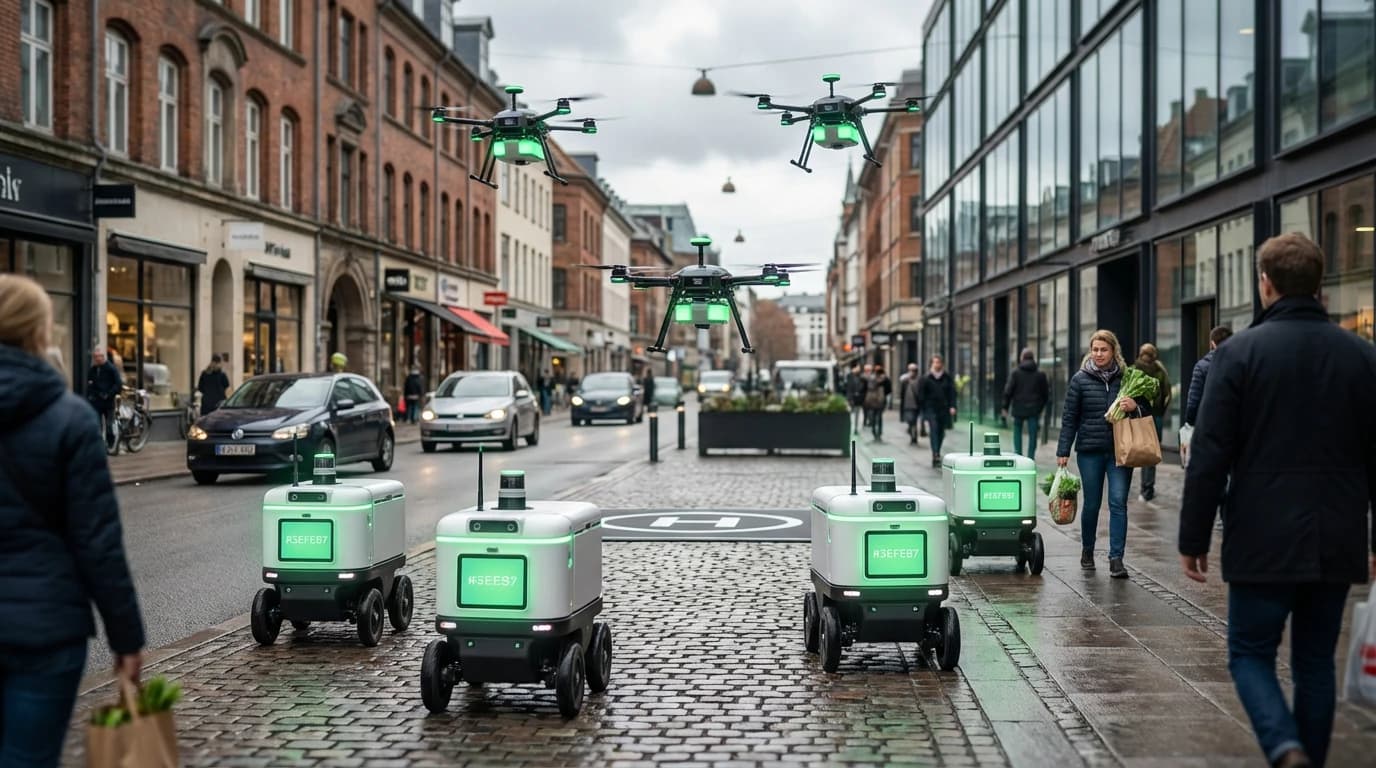
Autonomous last-mile delivery represents a fundamental shift in how food and groceries reach consumers, employing unmanned ground vehicles and aerial drones to navigate the final leg of the supply chain. These systems integrate advanced sensor arrays, including LiDAR, cameras, and GPS, with sophisticated path-planning algorithms to traverse sidewalks, bike lanes, and airspace while avoiding obstacles and adapting to dynamic urban conditions. Ground-based delivery robots typically operate at pedestrian speeds, using wheeled platforms equipped with secure compartment systems to maintain temperature control for perishable goods. Aerial drones, meanwhile, leverage vertical take-off and landing capabilities to bypass ground-level congestion entirely, though they face stricter regulatory constraints and payload limitations. Both approaches rely on real-time mapping, computer vision for obstacle detection, and increasingly sophisticated decision-making systems that can handle unpredictable scenarios like construction zones, weather changes, or unexpected pedestrian movements.
The food retail and restaurant industries face mounting pressure from rising labour costs, driver shortages, and consumer expectations for faster, more convenient delivery options. Traditional delivery models struggle with the economics of dispersed residential drop-offs, where human drivers spend significant time navigating traffic, searching for parking, and walking to doorsteps. Autonomous systems address these challenges by operating continuously without fatigue, optimising routes across multiple deliveries simultaneously, and reducing the per-delivery cost structure that has long plagued food logistics. For grocery retailers managing cold chain requirements, these technologies offer consistent temperature maintenance and reduced handling, potentially decreasing food spoilage during transit. The technology also enables new service models, such as hyper-local micro-fulfillment centres that can serve dense urban areas with delivery times measured in minutes rather than hours, fundamentally reshaping consumer expectations around food accessibility and freshness.
Several major food retailers and technology companies have launched pilot programs in select cities, with some achieving limited commercial deployment in controlled environments like university campuses, planned communities, and designated urban zones. Early implementations indicate particular promise for standardised routes with predictable conditions, such as regular grocery deliveries to residential buildings or meal kit distribution in suburban neighbourhoods. Regulatory frameworks continue to evolve, with various municipalities establishing guidelines for sidewalk robots and drone corridors, though widespread adoption remains constrained by safety certification requirements and public acceptance concerns. Industry analysts note that autonomous delivery aligns with broader trends toward contactless commerce, sustainability goals through reduced vehicle emissions, and the decentralisation of food distribution networks. As sensor costs decline and machine learning systems improve their ability to handle edge cases, these technologies are positioned to become integral components of urban food systems, potentially transforming not just how food is delivered but also how retailers design their distribution networks and fulfillment strategies for an increasingly on-demand consumer landscape.
TRL
7/9Operational
Impact
3/5
Investment
5/5
Category
Applications
Related Organizations
China's leading e-commerce platform for services, deploying autonomous delivery vehicles and drones at scale in urban environments.
Developer
Develops custom electric autonomous vehicles designed specifically for transporting goods, not passengers.
Developer
The market leader in autonomous sidewalk delivery robots, with millions of commercial deliveries completed.
Developer
Alphabet subsidiary developing an autonomous delivery drone service and an unmanned traffic management (UTM) platform.
Developer
Operates a drone delivery fleet in Ireland and expanding to the US, delivering food and pharmacy items.
Developer
Specializes in direct-to-backyard food and retail delivery via drone.
Developer
Provides robotic delivery services primarily for university campuses.
Developer
An Uber spin-out developing Level 4 autonomous sidewalk delivery robots for food delivery.
Developer
Uber Eats
United States · Company
A major food delivery platform actively deploying autonomous delivery via partnerships with Cartken, Nuro, and Serve Robotics.
Deployer
Operates the world's largest autonomous drone delivery network, specializing in medical supplies and e-commerce delivery.
Developer
Develops AI-powered autonomous delivery robots for indoor and outdoor environments.
Developer
Last-mile delivery service using remotely piloted and semi-autonomous sidewalk robots.
Developer
Chinese developer of autonomous delivery vehicles for retail and logistics.
Developer
Developer of autonomous delivery robots capable of navigating indoor and outdoor environments, piloting in airports and retail.
Developer
What was expected
Published forecasts about this technology, graded against what happened in Hindsight.
Autonomous Last Mile Logistics
Last-Mile Delivery
Everywhere Order and Delivery
This page is a narrower case of it.
Supporting Evidence
Evidence data is not available for this technology yet.
Research this in Signals
Scan Autonomous Last-Mile Delivery for yourself.
Signals turns a topic into a sourced research record you can inspect and rerun. Your first scan is free, and this one starts with Autonomous Last-Mile Delivery already loaded, so edit it or scan as is.