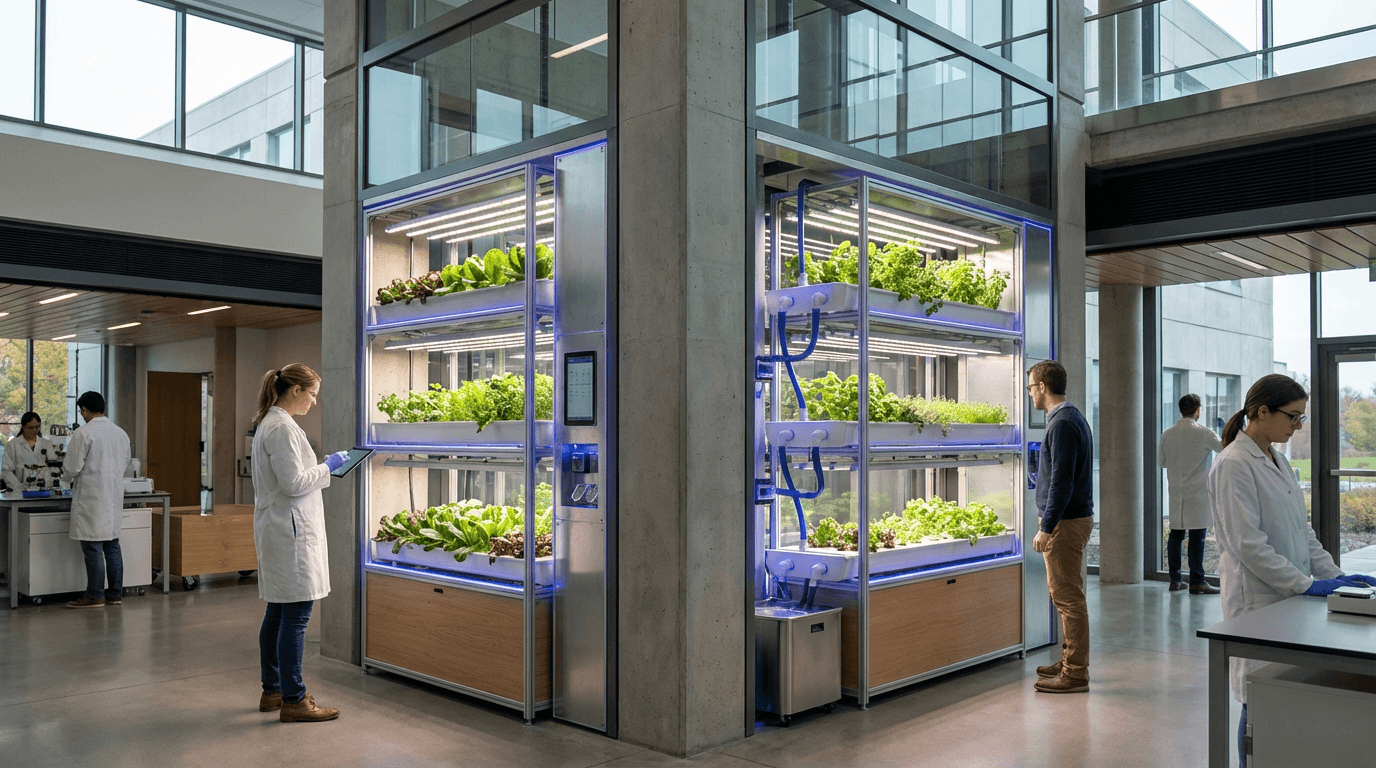
Building-Integrated Agriculture
Building-Integrated Agriculture represents a convergence of architectural design and controlled-environment farming, where food production systems become structural and functional elements of urban buildings rather than separate facilities. This approach embeds vertical farms, hydroponic gardens, and aeroponic installations directly into building facades, rooftops, interior atriums, and even basement spaces. The technical foundation relies on precision environmental controls—IoT sensors continuously monitor and adjust temperature, humidity, light spectrum, and nutrient delivery to optimize plant growth regardless of external conditions. LED grow lights provide tailored wavelengths that maximize photosynthesis while minimizing energy consumption, while hydroponic and aeroponic systems deliver nutrients directly to plant roots without soil, dramatically reducing water usage compared to traditional agriculture. Advanced building management systems integrate these agricultural components with existing HVAC, water recycling, and energy infrastructure, creating symbiotic relationships where building waste heat warms growing environments and plant transpiration contributes to passive cooling.
The fundamental challenge this technology addresses is the inefficiency and environmental cost of conventional urban food supply chains, where produce often travels thousands of kilometres from rural farms to city consumers, losing nutritional value and generating substantial carbon emissions in the process. Urban populations continue to expand while arable land diminishes, creating food security concerns that building-integrated agriculture directly confronts by reclaiming underutilized vertical space for productive use. Beyond food production, these systems tackle multiple urban environmental problems simultaneously—vegetated building surfaces mitigate urban heat island effects by absorbing solar radiation and releasing moisture through evapotranspiration, while plants filter air pollutants and sequester carbon dioxide. The closed-loop potential is particularly compelling: buildings can route greywater and organic waste into nutrient solutions for crops, while rainwater harvesting systems provide irrigation water, reducing both the building's water footprint and its waste output. This integration transforms buildings from purely consumptive structures into partially productive ones, fundamentally altering the economic and environmental equation of urban real estate.
Early implementations have appeared in commercial developments, residential towers, and institutional buildings across major cities, though widespread adoption remains constrained by initial capital costs and the need for specialized maintenance expertise. Pilot projects have demonstrated the viability of producing leafy greens, herbs, and certain vegetables year-round in building-integrated systems, with some installations supplying building restaurants or selling to local markets. Research initiatives continue to expand the range of viable crops and improve system efficiency, while modular design approaches are making these installations more accessible to retrofit projects. As climate change intensifies pressure on traditional agriculture and urban populations demand greater food system resilience, building-integrated agriculture is positioned to evolve from a novel architectural feature into a standard consideration in sustainable building design. The technology aligns with broader movements toward circular urban economies, net-zero buildings, and biophilic design principles that reconnect city dwellers with natural processes, suggesting that future urban skylines may be as green as they are grey.
Related Organizations

Operates a network of high-tech hydroponic greenhouses located on rooftops in urban centers across America.
Built the world's first commercial rooftop greenhouse and operates a direct-to-consumer urban food network in Montreal.

A top-tier university for agricultural research, specifically in greenhouse and vertical farming innovation.

The world's first low-carbon, hydraulic driven vertical farm, addressing land scarcity in Singapore.

Develops automated indoor vertical farming appliances for senior living communities, schools, and corporate cafeterias.

Manufactures the 'Greenery', a self-contained hydroponic farm inside a shipping container, enabling farming anywhere in a city.

Distributes mushroom growing units to restaurants and grocery stores, creating on-site mini-farms.

An international non-profit organization promoting the vertical farming industry through advocacy, education, and standardization.

A technology provider developing aeroponic irrigation systems for indoor farming.
Supporting Evidence
Research this in Signals
Signals turns a topic into a sourced research record you can inspect and rerun. Your first scan is free, and this one starts with Building-Integrated Agriculture already loaded, so edit it or scan as is.