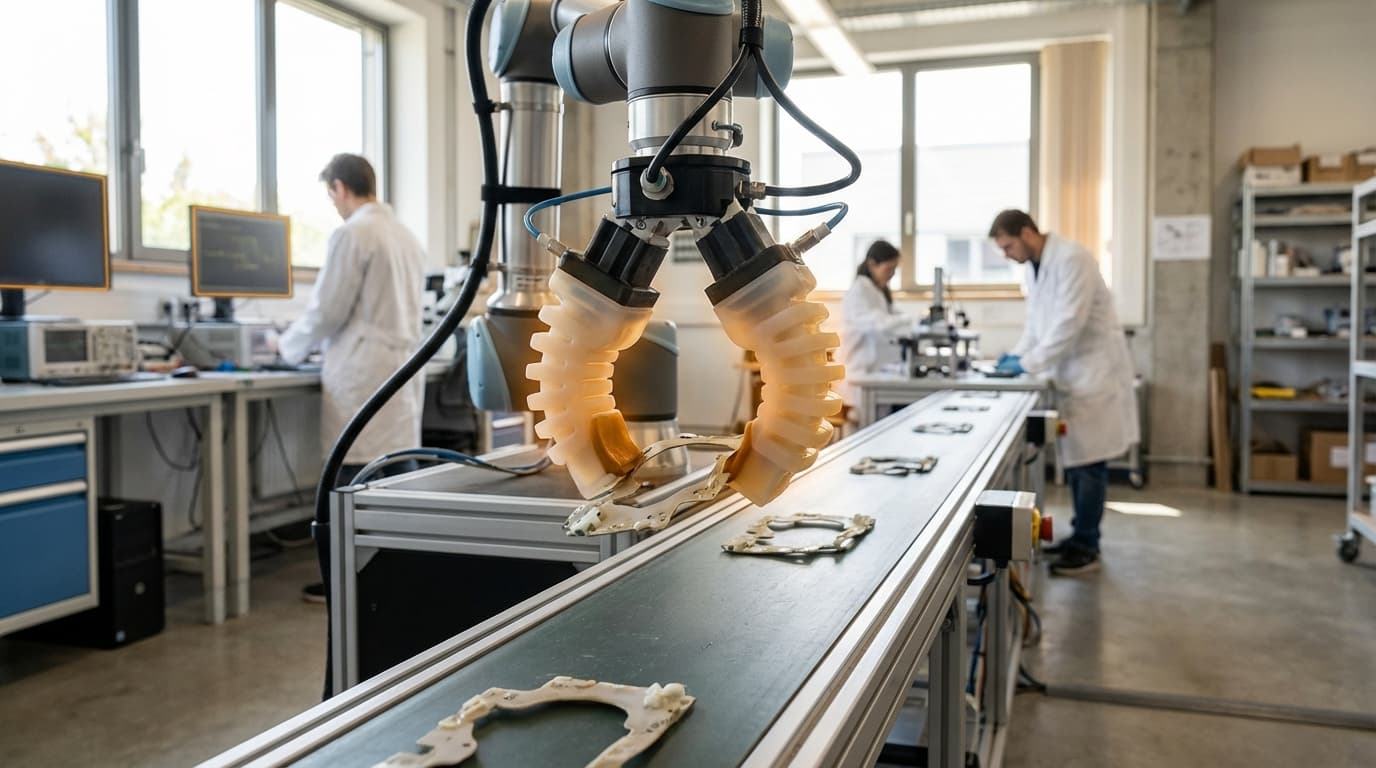
Soft Robotic Grippers
Soft robotic grippers represent a fundamental departure from conventional rigid end-effectors in industrial automation, employing flexible, compliant materials that can safely interact with delicate or irregularly shaped objects. Unlike traditional metallic or hard plastic grippers that rely on precise positioning and controlled force application, soft grippers are typically fabricated from elastomeric materials such as silicone rubber or thermoplastic polyurethanes. These materials can undergo significant deformation without damage, allowing the gripper to conform to the contours of the object being handled. Actuation methods vary, with pneumatic systems being most common—compressed air inflates internal chambers within the gripper structure, causing it to bend, curl, or expand around the target object. Alternative approaches include hydraulic actuation for higher force applications, or cable-driven mechanisms that pull flexible fingers into grasping configurations. The inherent compliance of these materials provides passive adaptation to object geometry, eliminating the need for complex sensing and control systems that would otherwise be required to handle items with unpredictable shapes or positions.
The manufacturing and logistics sectors face persistent challenges when automating the handling of products that are either fragile, irregularly shaped, or highly variable in their physical properties. Traditional rigid grippers excel at manipulating standardised metal or plastic components in automotive assembly, but they struggle with items like fresh produce, baked goods, consumer electronics with delicate screens, or biological specimens that require gentle handling. Soft grippers address this limitation by distributing contact forces over larger surface areas and naturally limiting the maximum pressure applied to objects through their material properties. This capability opens automation opportunities in food processing facilities, where items like strawberries or pastries can now be sorted and packaged without bruising or crushing. In electronics manufacturing, soft grippers can safely handle circuit boards or display panels that would crack under the point loads from rigid jaws. The technology also enables more flexible manufacturing systems, as a single soft gripper design can often handle multiple product types without requiring tool changes, reducing downtime and improving production efficiency in environments where product mix varies frequently.
Early commercial deployments of soft grippers have demonstrated particular success in e-commerce fulfillment centers and agricultural applications, where the diversity of items handled makes traditional automation approaches impractical. Research institutions and robotics companies continue to explore advanced materials and actuation methods, including shape-memory alloys and electroactive polymers that could enable faster response times and more precise control. Industry analysts note growing interest from pharmaceutical manufacturers, where soft grippers show promise for handling vials, syringes, and other medical containers that require both gentle manipulation and contamination-free contact. The technology aligns with broader trends toward collaborative robotics and human-robot interaction, as the inherent safety of compliant materials reduces risks in shared workspaces. As material science advances and manufacturing costs decrease, soft robotic grippers are positioned to become standard equipment in industries where product variability and handling sensitivity have historically limited automation potential, contributing to more adaptable and resilient manufacturing systems.
Related Organizations

Develops soft compliant grippers for industrial food handling and logistics.

A research lab at Harvard University focused on soft robotics and wearable assistive devices.

Manufacturer of end-of-arm tooling for collaborative applications, including the HEX 6-axis force/torque sensors.

Industrial automation company known for its Bionic Learning Network, creating pneumatic artificial muscles and soft-robotic animals.

A VR/AR hardware subsidiary of ByteDance producing the Pico 4 Enterprise with color passthrough capabilities.

A leading research center at Scuola Superiore Sant'Anna, focusing heavily on soft robotics, continuum manipulators, and bio-inspired grasping.

A brand of Wegard GmbH, producing modular, elastic grippers that are lightweight and adaptable for various industrial robots.

Global tire manufacturer developing 'Bridgestone Mobility Solutions' and Webfleet for connected tire management.

A Chinese manufacturer specializing in soft robotic grippers for the food, 3C, and auto parts industries.

R&D arm of Toyota Motor Corporation.
Supporting Evidence
Research this in Signals
Signals turns a topic into a sourced research record you can inspect and rerun. Your first scan is free, and this one starts with Soft Robotic Grippers already loaded, so edit it or scan as is.