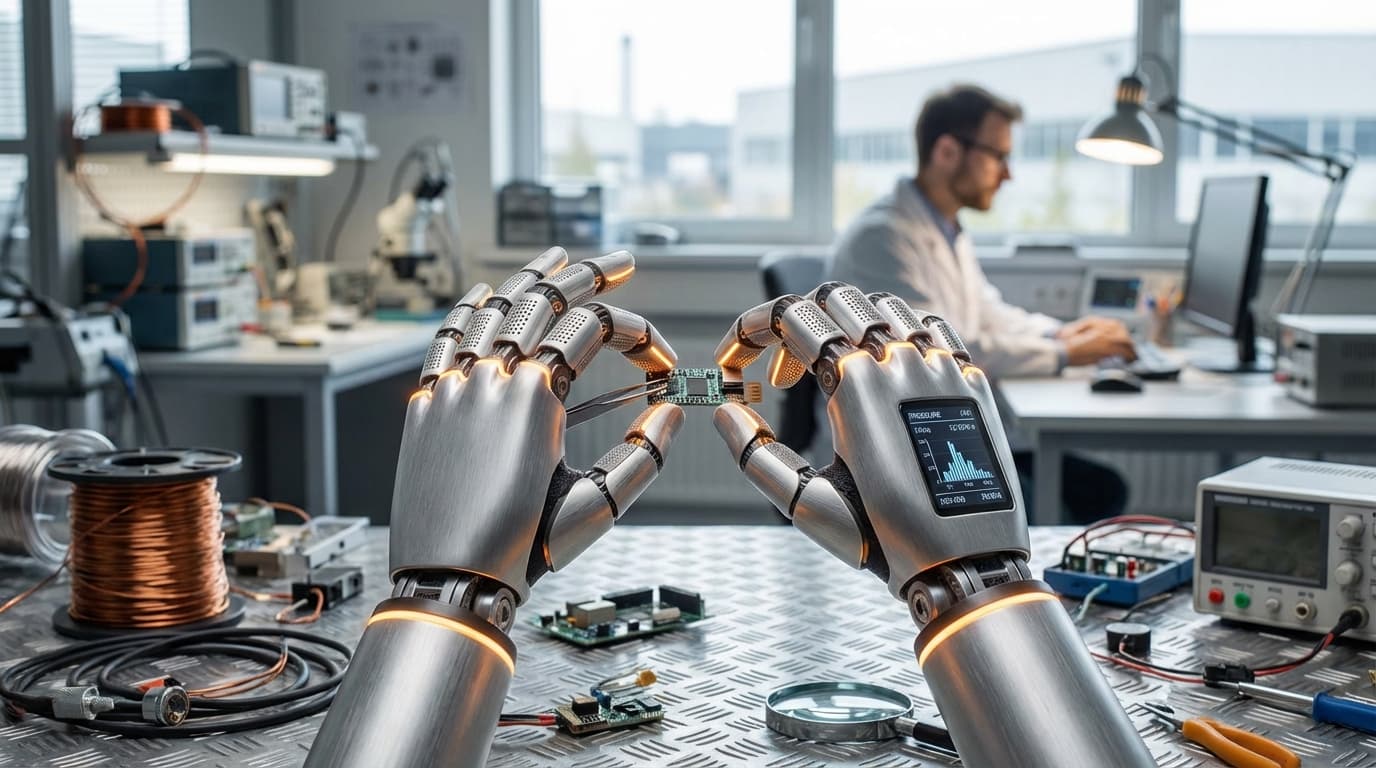
High-Dexterity Tactile Robotic Hands
High-dexterity tactile robotic hands represent a convergence of advanced sensing, actuation, and control technologies designed to replicate the nuanced manipulation capabilities of the human hand. Unlike conventional industrial grippers that rely primarily on position control and predetermined force parameters, these systems integrate dense arrays of tactile sensors—often hundreds or thousands per fingertip—that provide real-time feedback about contact forces, surface textures, slip detection, and object geometry. The mechanical architecture typically combines compliant joints with variable stiffness actuators, allowing the fingers to adapt their shape and grip force dynamically in response to the object being handled. Force-torque sensors embedded at multiple points along each digit enable precise measurement of applied forces in three dimensions, while sophisticated control algorithms process this sensory data to adjust grip parameters within milliseconds. This sensorimotor integration mirrors the feedback loops that allow humans to handle a raw egg with the same hand that can grip a hammer, solving a fundamental challenge in robotics: the ability to manipulate objects with unknown or variable properties without prior programming for each specific item.
The manufacturing sector faces persistent challenges in automating tasks that require fine motor skills, adaptability to part variations, and safe interaction with delicate components. Traditional automation excels at repetitive, high-force operations but struggles with assembly tasks involving flexible cables, fragile electronics, or components with tight tolerances where even minor misalignments can cause damage or production defects. High-dexterity tactile hands address these limitations by enabling robots to "feel" their way through complex assembly sequences, detecting subtle cues like connector alignment, thread engagement in fasteners, or proper seating of components. This tactile awareness also enhances safety in collaborative manufacturing environments, where robots work alongside human operators. The ability to detect unexpected contact and modulate grip force in real-time reduces the risk of injury and allows for closer human-robot collaboration without extensive safety barriers. Industries ranging from electronics assembly to automotive manufacturing benefit from this technology's capacity to handle the variability inherent in real-world production environments, where parts may arrive with slight dimensional differences, surface contamination, or positional uncertainty that would confound conventional automation.
Research prototypes and early commercial systems have demonstrated capabilities in tasks previously considered too complex for automation, including cable harness assembly, surgical instrument handling, and precision placement of optical components. Several robotics companies have introduced tactile gripper systems designed for electronics manufacturing, where the technology enables automated assembly of smartphones, circuit boards, and other devices with fragile components and tight tolerances. The technology is also finding applications in warehouse automation, where the ability to grasp items of varying shapes, sizes, and fragility without damage improves picking efficiency and reduces product loss. Looking forward, advances in soft robotics materials, machine learning for tactile interpretation, and miniaturisation of sensor arrays are expected to further enhance these systems' capabilities. As manufacturing continues its shift toward mass customisation and flexible production lines capable of handling diverse product mixes, high-dexterity tactile hands represent a critical enabling technology. Their development aligns with broader industry trends toward adaptive automation systems that can learn from experience, handle uncertainty, and work safely alongside humans, marking a significant step toward truly general-purpose robotic manipulation in industrial settings.
Related Organizations

Builders of the Shadow Dexterous Hand, a modular end-effector used for advanced manipulation research.

Develops tactile intelligence technology using elastomeric sensors to give robots the sense of touch.

Manufacturers of the Allegro Hand, a lightweight, affordable anthropomorphic hand used extensively in research.

Developing e-skin systems (electronic skin) for robots to give them a sense of touch across their entire surface.

Produces uSkin, a high-density tactile sensor skin for robots that is soft, durable, and capable of 3-axis force sensing.


Produces 'qb SoftHand', an anthropomorphic robotic hand designed for soft-robotics applications and human interaction.

Global leader in gripping systems and clamping technology, offering FT sensors for their grippers.
Supporting Evidence
Research this in Signals
Signals turns a topic into a sourced research record you can inspect and rerun. Your first scan is free, and this one starts with High-Dexterity Tactile Robotic Hands already loaded, so edit it or scan as is.