Reconfigurable Manufacturing Systems (RMS)
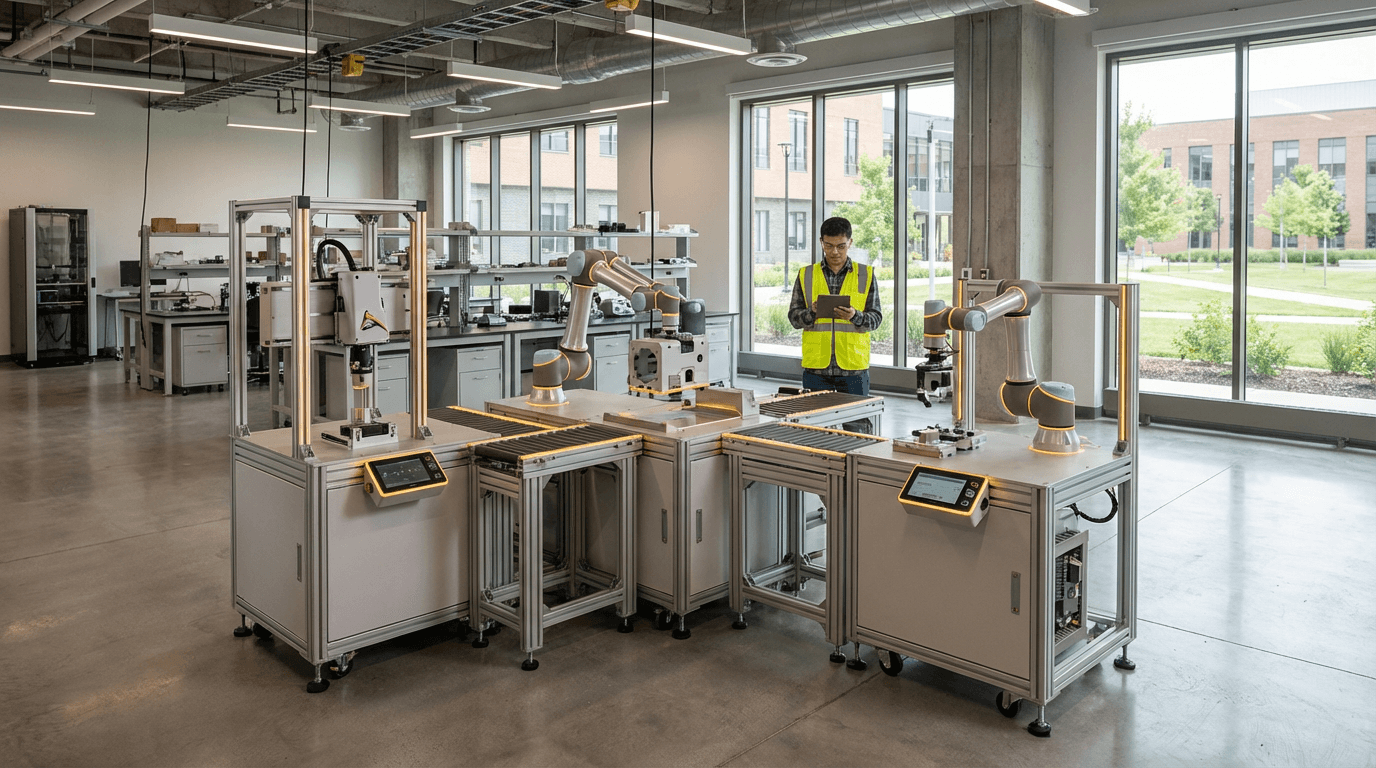
Reconfigurable Manufacturing Systems represent a fundamental shift in how production facilities are designed and operated, moving away from fixed, product-specific assembly lines toward flexible, modular platforms that can be rapidly reorganized to accommodate different products, production volumes, or entirely new manufacturing tasks. Unlike traditional manufacturing systems that are optimized for a single product family and require extensive retooling for changes, RMS architectures are built around standardized hardware and software interfaces that allow machines, conveyors, fixtures, and control systems to be disconnected, repositioned, and reconnected with minimal downtime. The technical foundation rests on mechanical modularity—where production equipment is designed with common mounting points, power connections, and communication protocols—combined with software frameworks that enable rapid reprogramming and digital commissioning. Advanced control systems can simulate new line configurations virtually before physical changes occur, identifying potential bottlenecks and optimizing material flow patterns. This modular approach extends to the physical layout itself, with mobile robotic cells, reconfigurable conveyor segments, and adaptive tooling that can be rearranged like building blocks to match evolving production requirements.
The industrial imperative driving RMS adoption stems from mounting pressures that traditional fixed automation cannot adequately address: shorter product lifecycles, increasing demand for customization, volatile market conditions, and the need to respond rapidly to supply chain disruptions or emergency production requirements. Conventional manufacturing lines represent massive capital investments optimized for high-volume production of standardized goods, making them economically unviable when product demand shifts or new variants proliferate. This rigidity leaves manufacturers vulnerable to market changes and limits their ability to serve niche segments or respond to crises—a vulnerability starkly illustrated when automotive manufacturers struggled to pivot toward medical equipment production during recent global health emergencies. RMS fundamentally alters this economic equation by reducing the cost and time penalty associated with production changes. Where traditional retooling might require weeks of downtime and specialized engineering support, reconfigurable systems can transition between product families in hours or days, preserving capital efficiency while gaining the responsiveness previously associated only with low-volume job shops. This capability enables new business models, including contract manufacturing services that can economically serve multiple clients on the same floor space and mass customization strategies that deliver personalized products at near-mass-production costs.
Early implementations of reconfigurable manufacturing principles have emerged in automotive assembly, where manufacturers face pressure to produce multiple vehicle models on shared platforms, and in electronics manufacturing, where product generations turn over rapidly. Research institutions and industry consortia have demonstrated proof-of-concept facilities that can switch between producing different product types—from automotive components to consumer appliances—by reconfiguring the same modular equipment. The integration of artificial intelligence and machine learning into RMS platforms is advancing the technology further, with optimization algorithms that can automatically generate efficient line layouts based on product specifications and production targets, then orchestrate the physical reconfiguration process through autonomous mobile robots and collaborative robotic systems. As manufacturing continues its trajectory toward greater flexibility and responsiveness, reconfigurable systems represent a convergence of mechanical modularity, digital twin technology, and intelligent automation that addresses the fundamental tension between efficiency and adaptability. The technology positions manufacturers to navigate an increasingly uncertain future where the ability to rapidly pivot production capabilities may prove as valuable as traditional metrics of productivity and cost efficiency.
Related Organizations

Creator of XPlanar and XTS transport systems, which use levitating tiles and modular tracks to create infinitely reconfigurable production flows.

Develops ctrlX AUTOMATION, a smartphone-like control architecture that breaks down boundaries between machine controls, IT, and IoT.

A major manufacturer of industrial robots, including the LBR Med, a lightweight robot certified for integration into medical devices.

Industrial automation leader offering FactoryTalk Analytics, which uses ML to identify equipment anomalies.

Industrial automation company known for its Bionic Learning Network, creating pneumatic artificial muscles and soft-robotic animals.

Develops flexible manufacturing systems and open automation solutions for the automotive and battery industries.

Manufactures linear motion systems and track systems (GFX) that integrate with Beckhoff's XTS for modular machine design.
Supporting Evidence
Research this in Signals
Signals turns a topic into a sourced research record you can inspect and rerun. Your first scan is free, and this one starts with Reconfigurable Manufacturing Systems (RMS) already loaded, so edit it or scan as is.