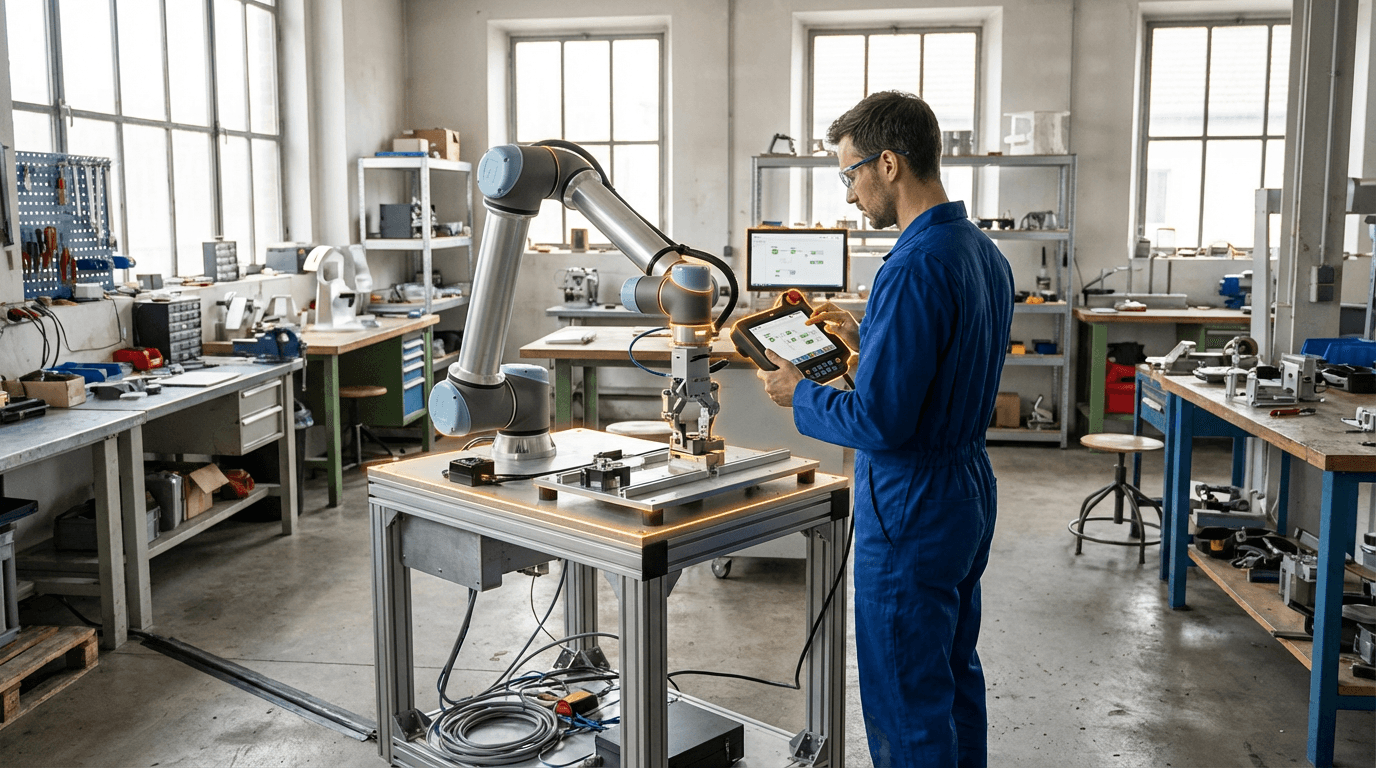
No-Code Automation Workcells
Manufacturing facilities have long faced a fundamental tension between automation's efficiency and the flexibility required for diverse product portfolios. Traditional industrial automation demands specialized programming expertise, lengthy integration cycles, and substantial capital investment—barriers that make it economically viable only for high-volume, repetitive production runs. Small and medium-sized manufacturers, as well as large facilities handling customized or frequently changing products, have struggled to justify automation costs when production runs may last only days or weeks. This challenge has left significant portions of the manufacturing sector reliant on manual labor, limiting productivity gains and making it difficult to compete in markets demanding both customization and cost efficiency.
No-code automation workcells address this integration bottleneck by replacing traditional programming interfaces with intuitive configuration tools accessible to shop-floor personnel. These systems employ kinesthetic teaching methods, where operators physically guide robot arms through desired motions, capturing movement patterns that the system translates into executable programs. Graphical user interfaces present automation logic as visual workflows rather than code, allowing workers to assemble complex sequences from pre-validated building blocks that already incorporate safety protocols, quality checks, and coordination between multiple devices. The underlying architecture abstracts away the complexity of programmable logic controllers, motion planning algorithms, and industrial communication protocols, encapsulating this technical knowledge into reusable templates that can be adapted rather than rebuilt for each new task. This democratization of automation configuration transforms what once required weeks of specialist integration into adjustments that production staff can complete in hours, fundamentally altering the economics of flexible manufacturing.
Early deployments in automotive component manufacturing and electronics assembly indicate that these systems can reduce changeover times from days to hours while maintaining safety and quality standards. Contract manufacturers serving multiple clients with varying specifications have found particular value in the ability to rapidly reconfigure cells without maintaining large programming staffs or accepting long lead times between orders. The technology aligns with broader industry movements toward mass customization and distributed manufacturing, where production facilities must balance efficiency with responsiveness to market demands. As manufacturing continues its shift away from purely high-volume paradigms, no-code automation workcells represent a critical enabler for facilities seeking to capture the productivity benefits of automation while preserving the operational flexibility that modern markets increasingly require.
Related Organizations

Creators of ForgeOS, a hardware-agnostic operating system that provides a common no-code interface for controlling robots from different brands.

Develops a 'Teaching by Demonstration' platform where operators use a trace pen to show robots the path, which is then converted to code.

Offers a no-code AI robotics platform that enables robot programming via iPad and 3D vision without CAD files.

Provides software that allows non-experts to program complex industrial robot trajectories using a digital twin and drag-and-drop tools.
A biotech company providing robotic automation solutions for labs.

Rapid Robotics
United States · Startup
Provides pre-trained, ready-to-work robotic machine operators that can be deployed quickly without integration headaches.

Provides plug-and-play components for collaborative robots, including the FT 300 Force Torque Sensor.

Manufactures 7-axis cobots with an intuitive tablet-based interface for easy programming (acquired by Bosch Rexroth).

The pioneer of collaborative robots (cobots), featuring the PolyScope interface which popularized low-code/no-code programming for arms.
Supporting Evidence
Research this in Signals
Signals turns a topic into a sourced research record you can inspect and rerun. Your first scan is free, and this one starts with No-Code Automation Workcells already loaded, so edit it or scan as is.