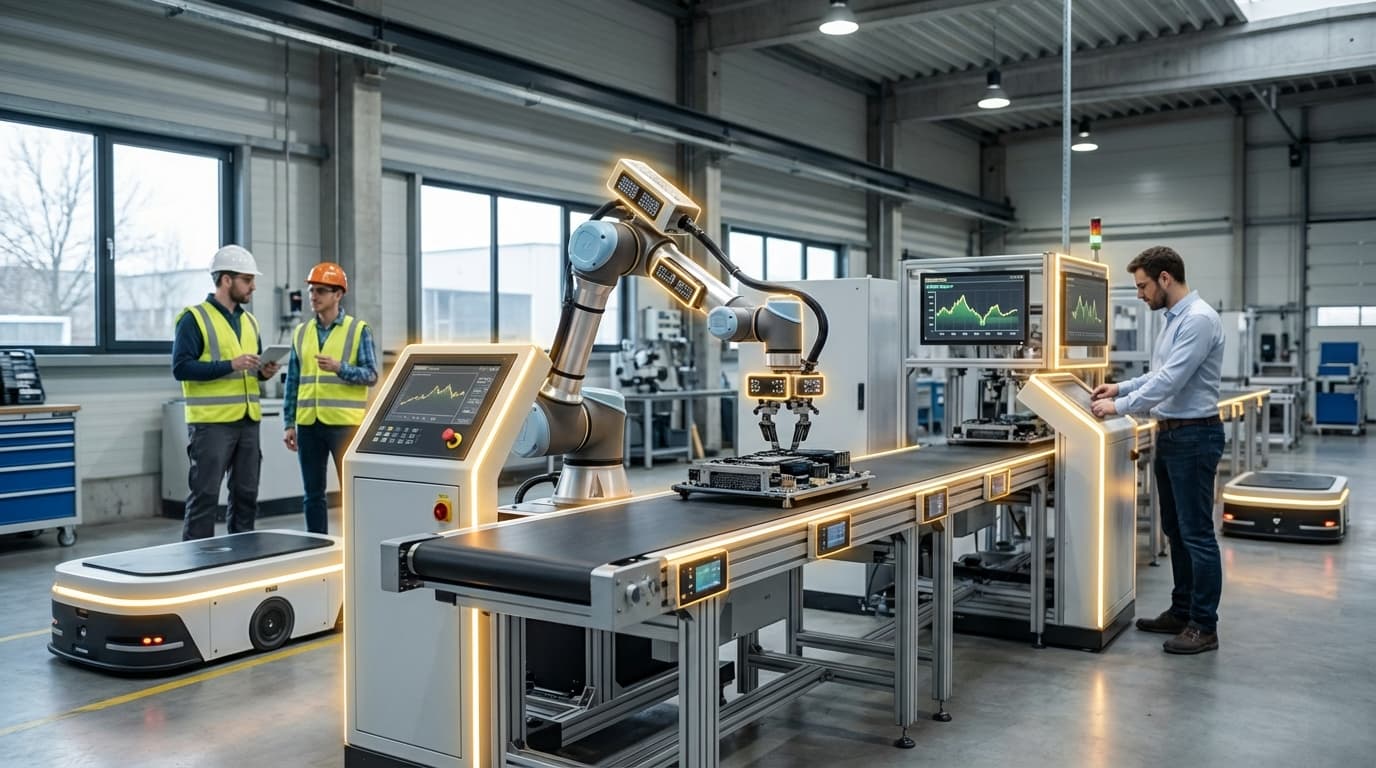
Self-Optimizing Production Lines
Modern manufacturing facilities face mounting pressure to maximize efficiency while minimizing waste, energy consumption, and downtime. Traditional production lines operate according to fixed parameters set during initial configuration, requiring manual intervention when conditions change or inefficiencies emerge. This static approach struggles to adapt to variables like material quality fluctuations, equipment wear, ambient temperature changes, or shifting production demands. The result is suboptimal performance that accumulates into significant losses across millions of production cycles. Self-optimizing production lines address these limitations by embedding artificial intelligence directly into manufacturing systems, enabling them to continuously learn, adapt, and improve their own operations without human oversight.
At the technical core of self-optimizing production lines lies reinforcement learning, a branch of machine learning where systems learn optimal behaviors through trial and error. These systems deploy extensive sensor networks throughout the production environment, capturing real-time data on variables such as machine vibration, temperature, material flow rates, energy consumption, and product quality metrics. Advanced algorithms process this continuous stream of information, identifying patterns and correlations that human operators might miss. When the system detects micro-inefficiencies—perhaps a robotic arm moving slightly slower than optimal, or a conveyor belt consuming excess energy—it autonomously adjusts the relevant parameters. The system learns from each adjustment, building a sophisticated understanding of how different variables interact and affect overall performance. This creates a feedback loop where the production line becomes progressively more efficient over time, adapting to changing conditions and even anticipating potential issues before they impact output.
Early deployments in automotive and electronics manufacturing have demonstrated the potential of this technology, with pilot programs reporting measurable improvements in throughput and reductions in energy consumption. The technology proves particularly valuable in high-volume production environments where even marginal efficiency gains translate into substantial cost savings and environmental benefits. Beyond immediate operational improvements, self-optimizing systems generate valuable data insights that inform broader manufacturing strategy, from predictive maintenance scheduling to supply chain optimization. As Industry 4.0 initiatives accelerate and manufacturing becomes increasingly data-driven, self-optimizing production lines represent a critical evolution toward truly autonomous factories. The technology aligns with broader trends in industrial automation, where the goal extends beyond replacing human labor to creating intelligent systems that continuously improve their own performance, ultimately enabling manufacturers to remain competitive in an era of rapid technological change and rising operational complexity.
Related Organizations

Offers PRESCRIBE, a deep learning solution that proactively prescribes changes to control parameters to prevent defects.

Provides 'White Box AI' software that explains the root causes of production issues and recommends parameter changes to optimize quality.

Provides 'Machine Health' solutions using vibration and magnetic sensors combined with AI to predict machine failures.

An IIoT platform that creates digital twins of production lines to identify optimal operating conditions and stabilize processes.

A global leader in industrial software, providing solutions for asset optimization and autonomous plant operations.

Time series AI platform for manufacturing and defense, recently acquired by IFS to enhance asset management.

The energy portfolio of GE (formerly GE Digital), offering Asset Performance Management (APM) software powered by AI.

Offers a manufacturing optimization platform that uses AI to detect anomalies and defects on assembly lines remotely.

Industrial automation leader offering FactoryTalk Analytics, which uses ML to identify equipment anomalies.

Develops LandingLens, a computer vision cloud platform that enables manufacturers to build and deploy AI visual inspection systems.
Supporting Evidence
Research this in Signals
Signals turns a topic into a sourced research record you can inspect and rerun. Your first scan is free, and this one starts with Self-Optimizing Production Lines already loaded, so edit it or scan as is.