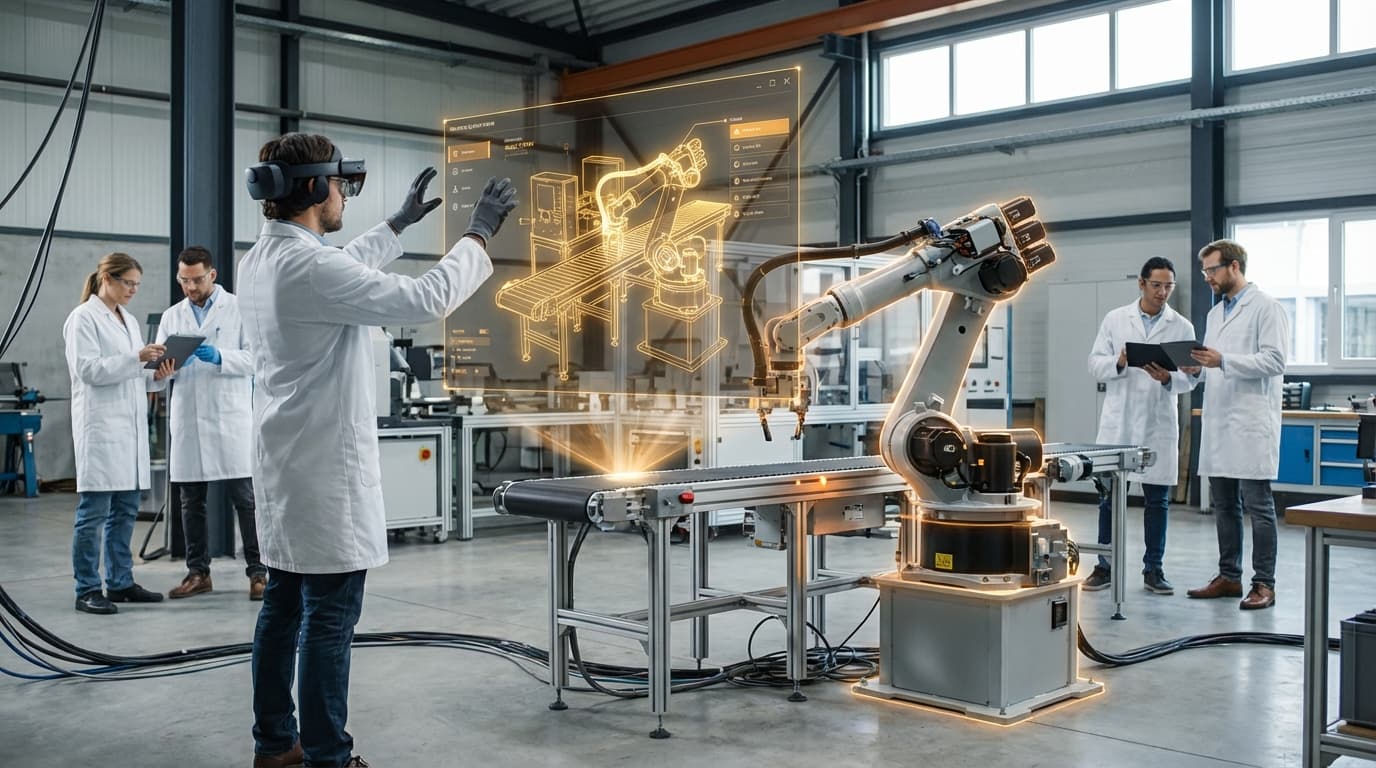
Industrial Metaverse & Spatial Computing
The Industrial Metaverse represents a convergence of augmented reality, virtual reality, and spatial computing technologies that creates persistent digital environments mirroring physical manufacturing facilities and industrial operations. Unlike consumer-focused metaverse platforms, these industrial implementations prioritize precision, real-time data integration, and operational functionality over social interaction. The technical foundation relies on spatial mapping sensors that continuously scan and digitize physical environments, creating detailed 3D models that serve as anchors for virtual content. AR headsets equipped with depth sensors and computer vision algorithms track user position and hand movements with millimeter-level accuracy, while VR systems provide fully immersive environments for design review and simulation. These platforms integrate with existing industrial software ecosystems, pulling data from computer-aided design (CAD) systems, product lifecycle management (PLM) tools, and industrial IoT sensor networks to create dynamic digital twins that reflect real-world conditions in near real-time.
Manufacturing organizations face mounting pressure to reduce time-to-market, minimize costly physical prototyping, and address skills gaps as experienced workers retire. Traditional design review processes require stakeholders to interpret 2D drawings or navigate complex CAD software, creating communication barriers between engineering teams, production staff, and external partners across different geographies and time zones. Physical commissioning of production lines—the process of testing and validating new equipment before full-scale operation—can consume months and require expensive on-site presence from multiple vendors. Worker training on complex machinery traditionally demands hands-on access to equipment, creating scheduling conflicts, safety risks, and production downtime. The Industrial Metaverse addresses these challenges by enabling geographically dispersed teams to simultaneously inhabit and manipulate shared 3D spaces, where they can walk through full-scale virtual factories, identify design conflicts before physical construction, and iterate on layouts without halting production. Virtual commissioning allows engineers to test robotic sequences, conveyor systems, and automated processes in software before installing physical equipment, dramatically reducing installation time and debugging costs.
Early deployments in automotive and aerospace manufacturing indicate substantial reductions in design iteration cycles and training time. Assembly line workers can don AR headsets to receive step-by-step visual instructions overlaid directly onto components, reducing errors and accelerating onboarding for complex tasks. Maintenance technicians access real-time diagnostic data, exploded-view diagrams, and remote expert guidance projected onto the equipment they're servicing, minimizing downtime and reducing the need for specialized on-site expertise. Some facilities report using VR environments to conduct safety training scenarios that would be too dangerous or expensive to replicate physically, from chemical spill responses to high-voltage electrical work. As 5G networks expand industrial connectivity and edge computing reduces latency for real-time spatial data processing, these immersive environments are evolving from isolated pilot programs into integrated components of manufacturing operations. The technology aligns with broader industry movements toward digital transformation and Industry 4.0 principles, where the boundary between physical production and digital planning continues to blur, enabling more agile, data-driven, and globally coordinated manufacturing ecosystems.
Related Organizations

Developing foundation models for robotics (Project GR00T) and vision-language models like VILA.
PTC
United States · Company
Offers ThingWorx, a platform that connects industrial devices, people, and systems.

Provides the High Definition Render Pipeline (HDRP) which supports real-time ray tracing for gaming and industrial visualization.

Develops ruggedized head-mounted tablet devices for industrial frontline workers to access data hands-free.

Provider of mobile mapping systems and reality capture software for indoor spatial intelligence.

Offers 'TeamViewer Frontline', an enterprise AR productivity platform (acquired from Ubimax) for logistics and manufacturing.

Spatial data company that integrated mobile LiDAR support into their capture app, democratizing real estate digital twins.


Manufacturer of 'bionic display' headsets that use a high-density focus display inside a peripheral context display.

Supplier of smart glasses and Augmented Reality (AR) technologies.
Supporting Evidence
Research this in Signals
Signals turns a topic into a sourced research record you can inspect and rerun. Your first scan is free, and this one starts with Industrial Metaverse & Spatial Computing already loaded, so edit it or scan as is.