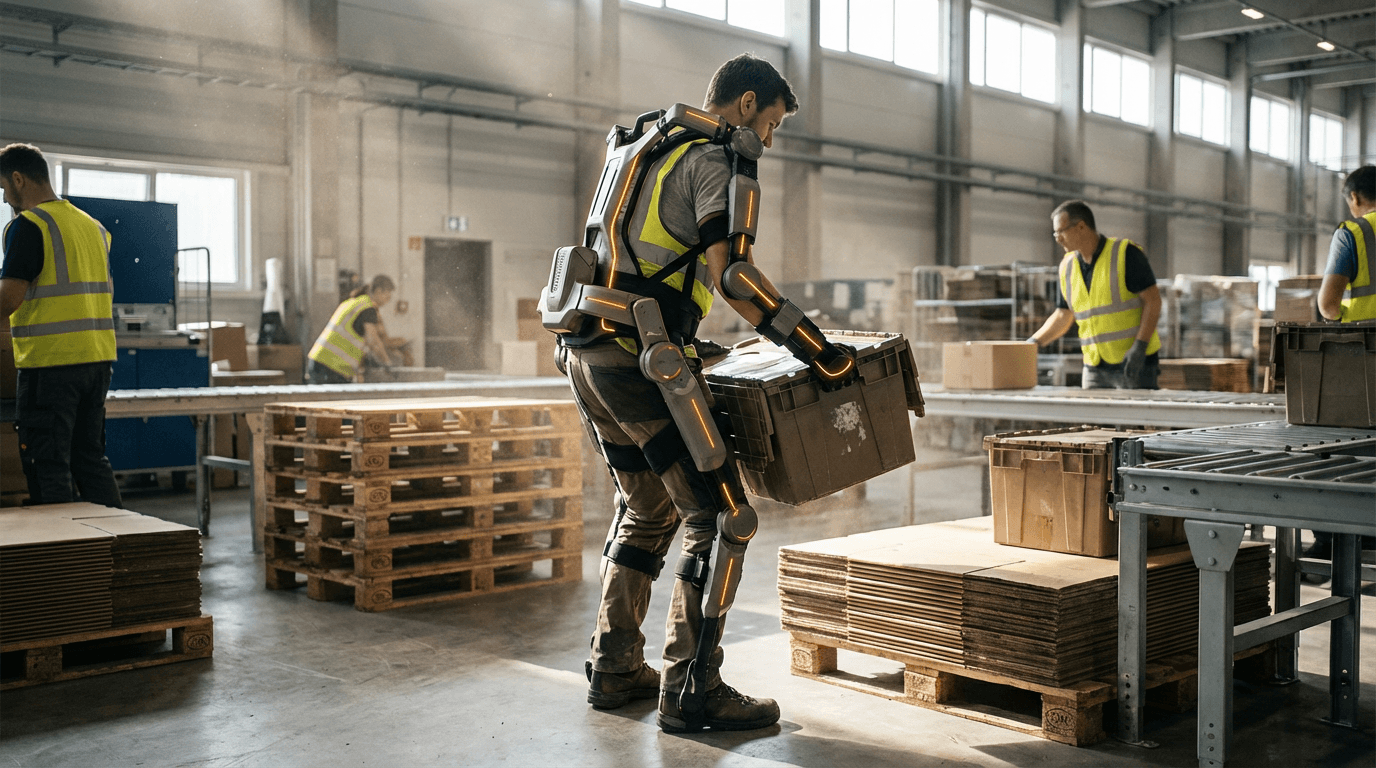
Active Industrial Exoskeletons
Active industrial exoskeletons represent a significant advancement in worker safety and productivity, addressing one of manufacturing's most persistent challenges: work-related musculoskeletal disorders. These powered wearable robotic systems differ fundamentally from their passive counterparts by incorporating motors, actuators, and sophisticated sensor arrays that actively assist workers during physically demanding tasks. The technology operates through a combination of force sensors, motion tracking systems, and predictive algorithms that detect the wearer's intended movements in real-time. When a worker begins to lift a heavy component or assumes a strenuous posture, the exoskeleton's control system interprets these signals and delivers precisely calibrated mechanical assistance through motorized joints at the back, shoulders, or legs. This active support system effectively redistributes load-bearing forces away from vulnerable joints and muscle groups, allowing workers to perform tasks that would otherwise exceed safe biomechanical limits.
The industrial sector faces mounting pressure to address workplace injuries while maintaining the flexibility that human workers provide in complex assembly and logistics operations. Manufacturing environments often involve tasks that are too varied, delicate, or spatially constrained for full robotic automation, yet too physically demanding for workers to perform safely over extended periods. Research indicates that repetitive lifting, prolonged overhead work, and sustained awkward postures account for a substantial portion of workplace injuries and associated costs in manufacturing, warehousing, and construction. Active exoskeletons directly address this gap by enabling workers to maintain their irreplaceable problem-solving abilities and fine motor control while receiving robotic assistance for the most physically taxing aspects of their work. This hybrid approach preserves the economic benefits of human adaptability while mitigating injury risks that have proven resistant to traditional ergonomic interventions. The technology also opens possibilities for extending working careers, as older or previously injured workers can continue contributing their expertise with reduced physical strain.
Early commercial deployments have emerged in automotive assembly plants, aerospace manufacturing facilities, and logistics centers, where workers perform repetitive heavy lifting or sustained overhead operations. These initial implementations have focused on specific high-risk tasks rather than full-shift wear, as current battery technology and device weight still present practical limitations for extended use. Industry analysts note growing interest from sectors beyond traditional manufacturing, including construction, shipbuilding, and even healthcare, where patient handling poses similar injury risks. The trajectory of active exoskeleton development points toward lighter, more intuitive systems with improved battery endurance and increasingly seamless human-machine interaction. As the technology matures alongside advances in lightweight materials, artificial intelligence for motion prediction, and compact power systems, active industrial exoskeletons are positioned to become standard equipment in physically demanding work environments, fundamentally reshaping the relationship between human capability and industrial productivity requirements.
Related Organizations

Produces the Cray X, a connected power suit that supports lifting movements and provides data analytics.

Develops highly mobile, dexterous industrial robots and exoskeletons like the Guardian XO.


Spun out of Harvard, Verve produces the SafeLift, a lightweight soft exosuit that uses sensors and algorithms to detect lifting and provide assistive force.

Global standards organization that develops and publishes voluntary consensus technical standards.

Develops the Ironhand, a soft robotic muscle strengthening system for hands.
Daewoo Shipbuilding & Marine Engineering (DSME)
South Korea · Company
A major shipbuilder that has actively developed and piloted powered exoskeletons to assist workers with heavy lifting in shipyards.

Originally a rehab robotics company, now developing the GR-1 general-purpose humanoid robot.
Supporting Evidence
Research this in Signals
Signals turns a topic into a sourced research record you can inspect and rerun. Your first scan is free, and this one starts with Active Industrial Exoskeletons already loaded, so edit it or scan as is.