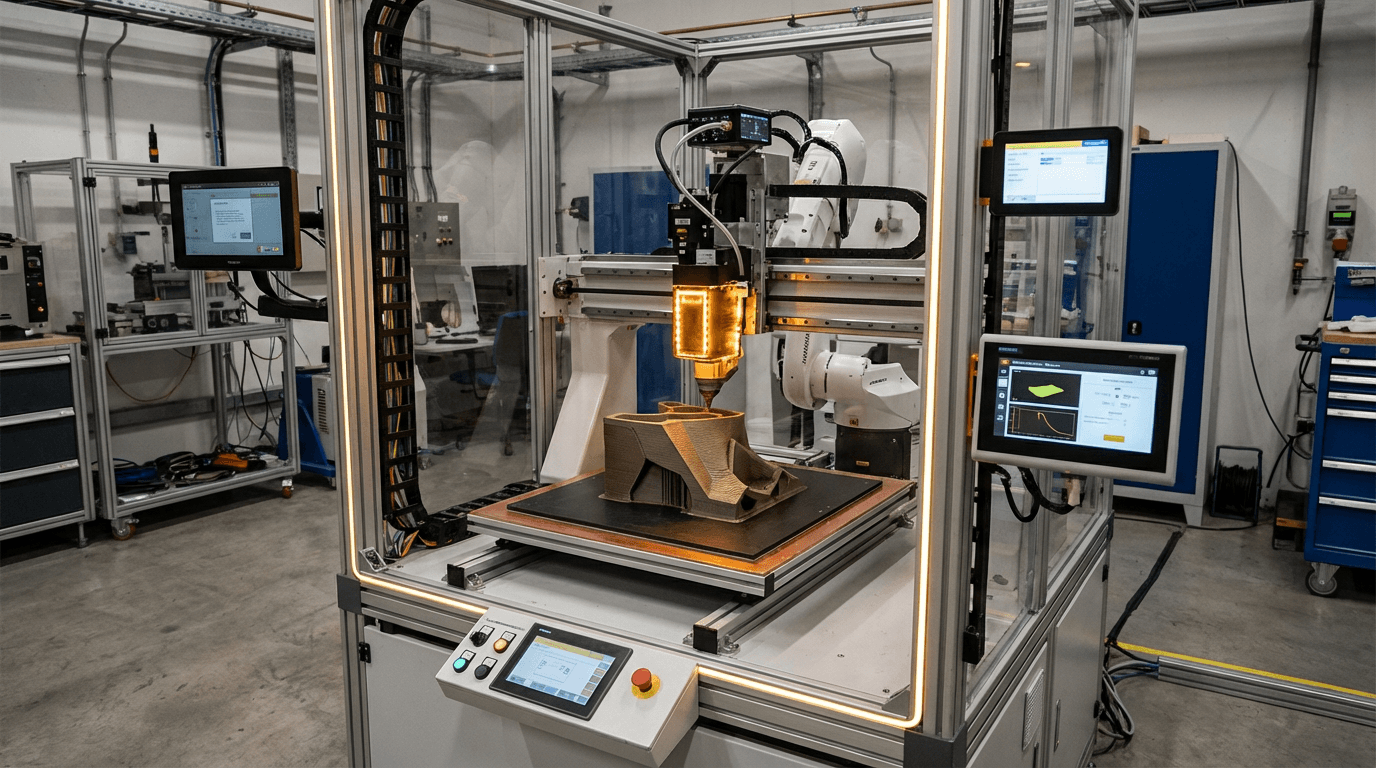
In-Situ Process Monitoring and Closed-Loop Control
In-situ process monitoring and closed-loop control represents a fundamental shift from traditional quality assurance approaches, where defects are detected only after production is complete. This technology embeds advanced sensing systems directly into the manufacturing environment, creating a continuous feedback loop that monitors, analyzes, and adjusts process parameters in real time. The sensing infrastructure typically combines multiple modalities: high-speed thermal cameras track temperature distributions across weld pools or melt zones, acoustic emission sensors detect microscopic crack formation or porosity development, optical systems capture layer-by-layer geometry in additive processes, and spectroscopic instruments analyze material composition and phase transformations. These sensor streams generate massive volumes of data at rates often exceeding thousands of measurements per second, which are then processed by machine learning algorithms trained to recognize the subtle signatures that precede defect formation. When anomalies are detected—such as irregular cooling rates in casting, unstable melt pool dynamics in laser welding, or layer delamination in powder bed fusion—the control system can immediately adjust critical parameters including energy input, material feed rates, protective atmosphere composition, or toolpath strategies to correct the deviation before it manifests as a permanent defect.
The manufacturing sector has long grappled with the challenge of producing high-value, safety-critical components where even minor defects can lead to catastrophic failures or costly scrapping of parts. Industries such as aerospace, medical devices, and energy generation face particularly stringent quality requirements, yet traditional post-process inspection methods are both time-consuming and limited in their ability to detect internal flaws without destructive testing. This creates a fundamental tension between quality assurance and production efficiency, often resulting in conservative process parameters, extensive testing protocols, and significant material waste. In-situ monitoring addresses these challenges by transforming manufacturing from an open-loop process into a self-correcting system. By detecting and correcting deviations during production rather than after completion, manufacturers can achieve "first-time-right" production, dramatically reducing scrap rates and the need for rework. This capability is especially valuable in advanced manufacturing techniques like metal additive manufacturing, where complex geometries and varying thermal histories create numerous opportunities for defect formation, or in high-speed welding operations where millisecond-scale decisions determine joint quality.
Research institutions and industrial consortia have demonstrated the viability of closed-loop control in various manufacturing contexts, with early deployments showing substantial improvements in yield rates and process stability. In laser-based additive manufacturing, pilot implementations have demonstrated the ability to detect and compensate for powder bed irregularities or thermal accumulation effects that would otherwise compromise part integrity. Similarly, in automated welding systems, real-time monitoring has enabled consistent joint quality across varying material thicknesses and joint configurations that previously required extensive operator expertise. As computational capabilities continue to advance and sensor technologies become more affordable, the integration of in-situ monitoring is expanding beyond high-value applications into broader manufacturing contexts. This evolution aligns with the larger trend toward Industry 4.0 and smart manufacturing, where digital twins, predictive maintenance, and autonomous process optimization converge to create more resilient and efficient production systems. The technology's trajectory suggests a future where manufacturing processes become increasingly self-aware and self-correcting, reducing reliance on post-process inspection while enabling the production of components with geometries and material properties that were previously unattainable through conventional quality control approaches.
Related Organizations

US Department of Energy lab that has historically run FACE experiments and currently models data from them.

Provides camera-agnostic computer vision software for real-time monitoring of metal additive manufacturing.

German research institute specializing in laser technology, developing advanced process monitoring for L-PBF and DED.

A global metrology company that integrates advanced sensing (InfiniAM) into their metal AM systems for melt pool monitoring.

Manufacturer of metal 3D printers featuring the Assure quality control system for layer-by-layer tracking.

A major manufacturer of engineered materials and optoelectronic components, including VCSELs for 3D sensing (formerly II-VI).



Provides digital twin technology to predict material behavior and life extension.
Supporting Evidence
Research this in Signals
Signals turns a topic into a sourced research record you can inspect and rerun. Your first scan is free, and this one starts with In-Situ Process Monitoring and Closed-Loop Control already loaded, so edit it or scan as is.