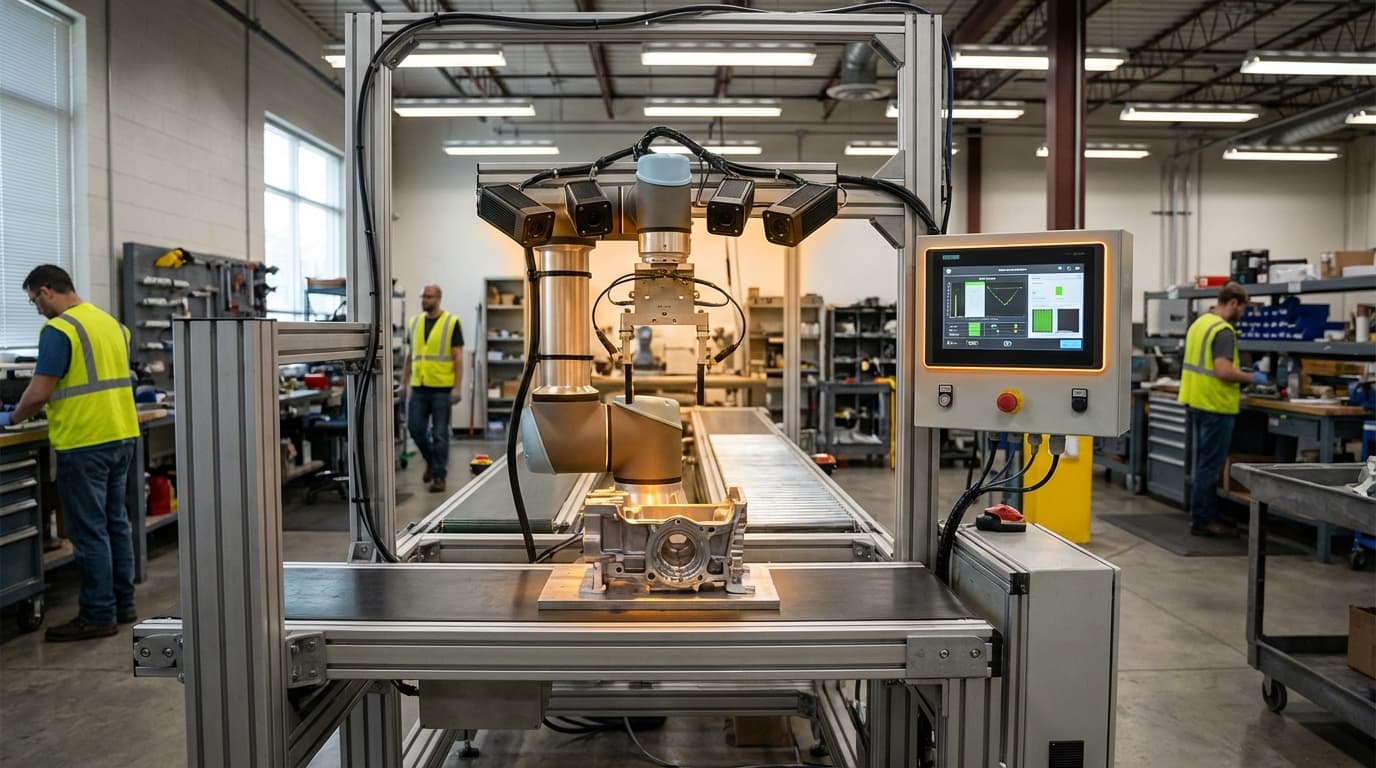
Edge AI Quality Inspection
Edge AI quality inspection represents a fundamental shift in manufacturing quality control, moving computational intelligence from centralized data centers directly onto the factory floor. This approach deploys specialized computer vision systems at the point of production, where high-resolution cameras capture images of components or products as they move along assembly lines. These images are immediately processed by dedicated AI accelerators—compact hardware optimized for neural network inference—mounted directly on or near the production equipment. The system combines advanced imaging techniques, including multispectral lighting and high-frame-rate cameras capable of capturing thousands of images per second, with machine learning models that have been trained to recognize the subtle visual signatures of defects. Unlike traditional rule-based inspection systems that require explicit programming for each defect type, edge AI systems employ deep learning architectures that can identify anomalies through pattern recognition, detecting deviations from learned norms even when those deviations have never been explicitly defined.
The manufacturing sector has long struggled with the limitations of human visual inspection, which is inherently inconsistent, fatiguing, and unable to detect microscopic flaws at production speeds. Traditional automated optical inspection systems, while faster than human inspectors, typically rely on rigid criteria and struggle with the variability inherent in modern manufacturing processes. Edge AI quality inspection addresses these challenges by enabling real-time defect detection without the latency introduced by cloud-based processing, a critical requirement when production lines operate at speeds where milliseconds matter. By processing data locally, these systems avoid the bandwidth constraints and network dependencies that would make cloud-based inspection impractical for high-throughput manufacturing. Furthermore, the continuous learning capabilities of modern AI models allow the system to adapt to subtle changes in materials, lighting conditions, or production parameters without requiring manual recalibration. This adaptability is particularly valuable in industries where product variations are common or where zero-defect manufacturing is essential, such as semiconductor fabrication, automotive assembly, or pharmaceutical packaging.
Early deployments in electronics manufacturing and automotive production indicate that edge AI inspection systems can achieve defect detection rates exceeding human capabilities while operating at production speeds that would be impossible for manual inspection. These systems are increasingly being integrated into smart factory architectures, where they not only flag defective items but also feed quality data back into production control systems, enabling real-time process adjustments that prevent defects from occurring in the first place. The technology aligns with broader industry movements toward lights-out manufacturing and predictive quality management, where the goal is not merely to catch defects but to eliminate their root causes through data-driven process optimization. As AI accelerator hardware becomes more powerful and affordable, and as foundation models trained on vast datasets of manufacturing imagery become more accessible, the barrier to entry for edge AI inspection continues to fall, suggesting a future where real-time intelligent quality control becomes standard across manufacturing sectors rather than a premium capability reserved for high-value production lines.
Related Organizations

Cognex Corporation
United States · Company
A global leader in machine vision that provides the underlying cameras and software libraries used in web inspection systems.

Develops LandingLens, a computer vision cloud platform that enables manufacturers to build and deploy AI visual inspection systems.


Provides Vision Inspection Automation (VIA) software that allows manufacturers to train AI models with very little data.

Basler AG
Germany · Company
A leading international manufacturer of high-quality imaging components for computer vision applications, including high-resolution ace and boost camera series.

Provides a full-stack visual inspection platform combining easy-to-use software with camera hardware for automated quality control.

Provides a turnkey quality control solution combining proprietary edge computing hardware and deep learning software for defect detection.

Offers a manufacturing optimization platform that uses AI to detect anomalies and defects on assembly lines remotely.

Develops AI solutions for visual inspection, including 'Vaira' which adds AI capabilities to existing inspection hardware.

Manufactures edge computing hardware and AI-on-Module solutions tailored for machine vision and industrial automation.
Supporting Evidence
Research this in Signals
Signals turns a topic into a sourced research record you can inspect and rerun. Your first scan is free, and this one starts with Edge AI Quality Inspection already loaded, so edit it or scan as is.