Autonomous Inspection Robots
Industrial facilities face a persistent challenge in maintaining safe, efficient operations while protecting human workers from hazardous environments. Traditional inspection regimes require personnel to enter confined spaces, climb tall structures, navigate extreme temperatures, and work near toxic substances or high-voltage equipment. These manual inspections are not only dangerous but also time-consuming and inconsistent, often occurring on fixed schedules rather than in response to actual equipment condition. The result is a reactive maintenance culture where failures are discovered too late, leading to costly unplanned downtime, safety incidents, and environmental releases. Autonomous inspection robots address these limitations by providing continuous, systematic monitoring of industrial assets without placing human inspectors at risk.
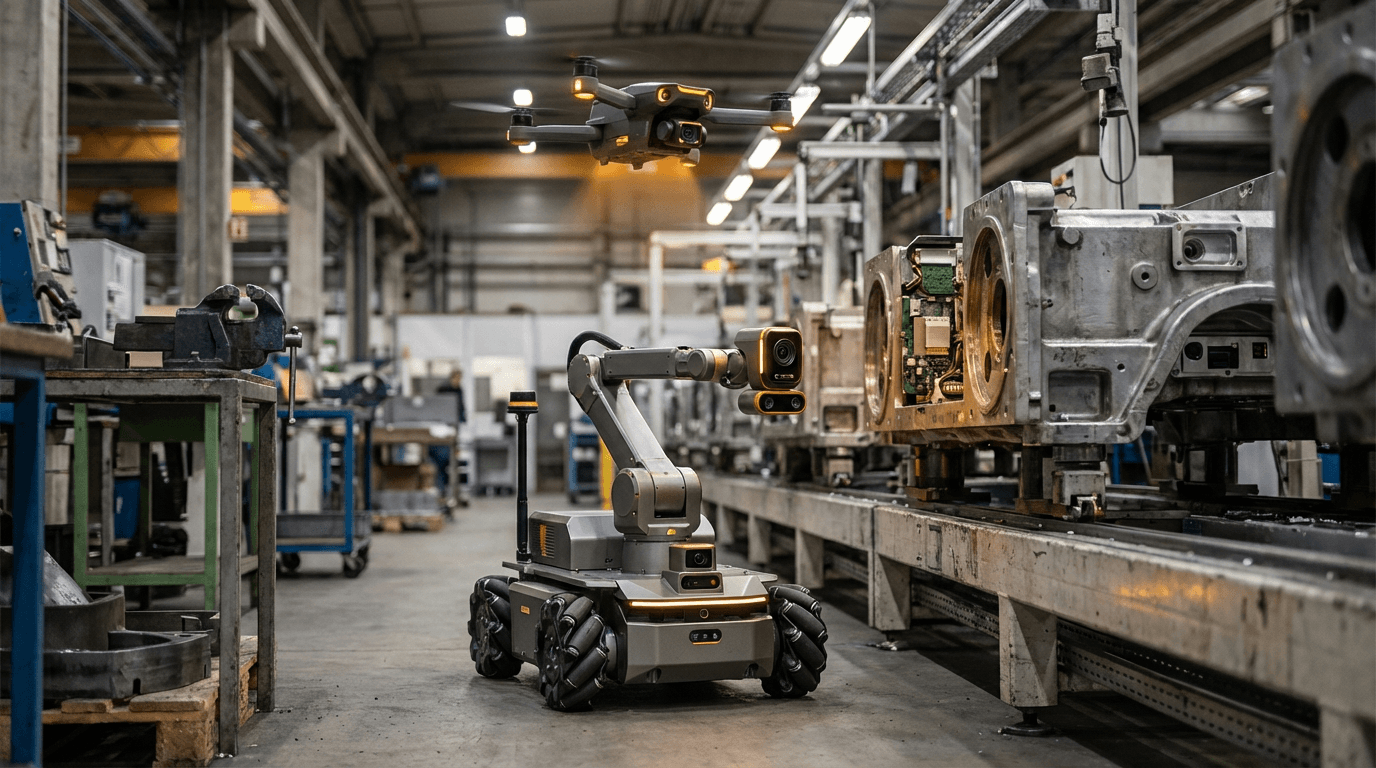
These mobile platforms combine advanced sensor suites with autonomous navigation capabilities to traverse complex industrial environments. Quadruped robots can climb stairs and navigate uneven terrain in refineries and chemical plants, while specialised climbing units scale vertical storage tanks and pressure vessels using magnetic adhesion or suction mechanisms. Indoor drones equipped with collision-avoidance systems inspect overhead piping, cable trays, and structural steel in warehouses and manufacturing halls. The robots carry thermal imaging cameras to identify hot spots indicating electrical faults or insulation degradation, ultrasonic sensors to measure wall thickness and detect internal corrosion, and LiDAR systems to create precise three-dimensional maps of equipment geometry. Onboard processing analyses this sensor data in real time, comparing current conditions against baseline measurements and trained anomaly detection models. When the system identifies deviations—such as gas leaks detected through optical gas imaging, vibration patterns suggesting bearing wear, or thermal signatures indicating overheating components—it automatically generates condition reports and integrates with computerised maintenance management systems to schedule corrective work.
Early deployments in oil and gas facilities, power generation plants, and large-scale manufacturing operations demonstrate measurable improvements in both safety and operational efficiency. Facilities report significant reductions in confined-space entries and work-at-height incidents, while simultaneously increasing inspection frequency from quarterly or monthly intervals to daily or even continuous monitoring. This shift from time-based to condition-based maintenance enables operators to address developing issues before they escalate into failures, reducing unplanned shutdowns and extending asset life. The technology aligns with broader industry movements toward digital twins and predictive maintenance, where physical assets are continuously mirrored in software models that forecast remaining useful life and optimise intervention timing. As sensor miniaturisation continues and machine learning algorithms improve at recognising subtle degradation patterns, autonomous inspection robots are positioned to become standard infrastructure in heavy industry, fundamentally changing how organisations balance operational reliability with workforce safety.
Related Organizations

Develops autonomous legged robots (ANYmal) for industrial inspection.

Famous for Spot and Atlas, now integrating reinforcement learning for dynamic movement.

Builds wall-climbing robots for industrial inspection of tanks, boilers, and pipes.

Provides a hardware-agnostic software platform for autonomous inspection robots, enabling fleets of quadrupeds (Spot, ANYmal) to perform rounds.

Builds collision-tolerant drones for inspection of confined spaces (sewers, tunnels).

Develops 'drone-in-a-box' solutions for autonomous industrial and urban monitoring.

Spun out of UPenn's GRASP Lab, developing Level 4 autonomous aerial robot systems for mapping complex, GPS-denied environments like mines.

Develops ATEX-certified ground robots for inspection in explosive atmospheres, working closely with TotalEnergies.

Provides custom robotic inspection solutions, including crawlers and magnet-wheeled robots, for the resources and energy sectors.

A robotics company known for quadrupeds that recently launched the H1 general-purpose humanoid robot.
Supporting Evidence
Research this in Signals
Signals turns a topic into a sourced research record you can inspect and rerun. Your first scan is free, and this one starts with Autonomous Inspection Robots already loaded, so edit it or scan as is.