Hybrid Additive-Subtractive Manufacturing Cells
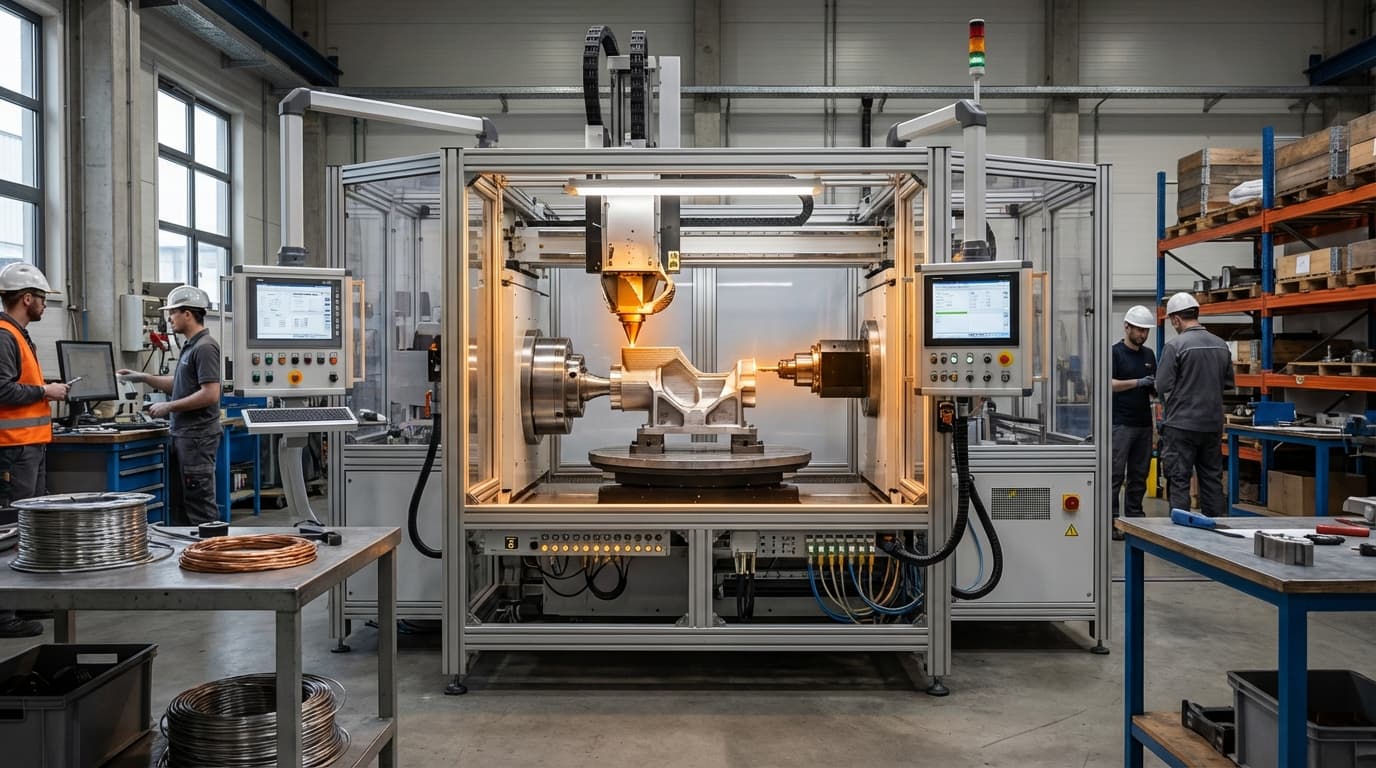
Hybrid additive-subtractive manufacturing cells represent a convergence of two traditionally separate fabrication paradigms: additive manufacturing (3D printing) and subtractive machining (CNC milling, turning, or grinding). These integrated systems house both capabilities within a single machine platform, allowing parts to be built up layer-by-layer through processes such as directed energy deposition, powder bed fusion, or wire arc additive manufacturing, then immediately machined to final tolerances without removal from the build platform. The technical architecture typically includes a multi-axis CNC machine tool equipped with additional print heads or deposition systems, advanced thermal management to handle the heat generated during additive processes, and sophisticated control software that coordinates the switching between additive and subtractive operations. Some systems employ a shared workspace where the same gantry or robotic arm alternates between depositing material and cutting it away, while others feature dedicated zones within the work envelope for each process. This integration eliminates the need for intermediate handling, re-fixturing, and re-alignment that would otherwise be required when transferring parts between separate additive and subtractive machines.
The manufacturing challenges these systems address are substantial, particularly in industries where geometric complexity, material costs, and production timelines create significant bottlenecks. Traditional CNC machining of complex parts from solid billets can waste up to 90% of expensive materials like titanium or Inconel, while pure additive manufacturing often cannot achieve the surface finishes and dimensional tolerances required for critical applications such as aerospace turbine components or medical implants. Hybrid cells solve this by printing near-net-shape geometries that approximate the final form, then machining only the surfaces that require tight tolerances or specific finishes. This approach dramatically reduces material waste, shortens overall cycle times by eliminating queue time between processes, and opens new possibilities for part repair and remanufacturing. High-value components such as aircraft engine blades, injection molds, or large structural parts can be restored by selectively adding material to worn or damaged areas and re-machining them to specification, extending service life at a fraction of replacement cost. The technology also enables design strategies previously impractical with either method alone, such as internal cooling channels that are printed into a part and then sealed by machined surfaces.
Early deployments of hybrid manufacturing cells have appeared primarily in aerospace, defense, and tooling sectors, where the economics of expensive materials and low production volumes justify the capital investment in these sophisticated systems. Research institutions and advanced manufacturing centers have demonstrated the viability of the approach through pilot programs focused on turbine blade repair, custom tooling production, and rapid prototyping of functional metal parts. As the technology matures, industry analysts note growing interest from automotive manufacturers seeking to produce lightweight structural components and from medical device companies requiring patient-specific implants with biocompatible surface finishes. The trajectory of hybrid manufacturing aligns with broader trends toward flexible, digitally-driven production systems that can economically produce small batches of highly customized parts. Future development is likely to focus on expanding material compatibility, improving the seamlessness of process transitions, and developing design software that can automatically partition geometries between additive and subtractive operations to optimize both performance and production efficiency.
Related Organizations
Develops additive manufacturing tools (heads) that can be integrated into existing CNC machines.

DMG MORI
Germany · Company
A leading machine tool manufacturer offering the LASERTEC 3D hybrid series combining 5-axis milling with laser deposition.

Develops the LUMEX Avance series, unique hybrid machines combining powder bed fusion (SLS) with high-speed milling.

Global machine tool builder producing the INTEGREX AG series, which integrates multi-tasking machining with AM.

Okuma Corporation
Japan · Company
Produces the MU-V LASER EX series, super multitasking machines capable of subtractive, additive, and hardening processes.

Offers the OPM series, precision metal 3D printers with integrated linear motor drive milling centers.

Develops 3DMP technology based on wire-arc additive manufacturing, often integrated into CNC-style gantries with milling capabilities.

A major Haas distributor and integrator that developed a hybrid additive-subtractive solution for Haas CNCs.
Manufacturer of 3-axis and 5-axis CNC routers that offers hybrid additive options.

German grinding machine manufacturer that has developed hybrid systems combining grinding and additive manufacturing.
Supporting Evidence
Research this in Signals
Signals turns a topic into a sourced research record you can inspect and rerun. Your first scan is free, and this one starts with Hybrid Additive-Subtractive Manufacturing Cells already loaded, so edit it or scan as is.