Directed Energy Deposition (DED)
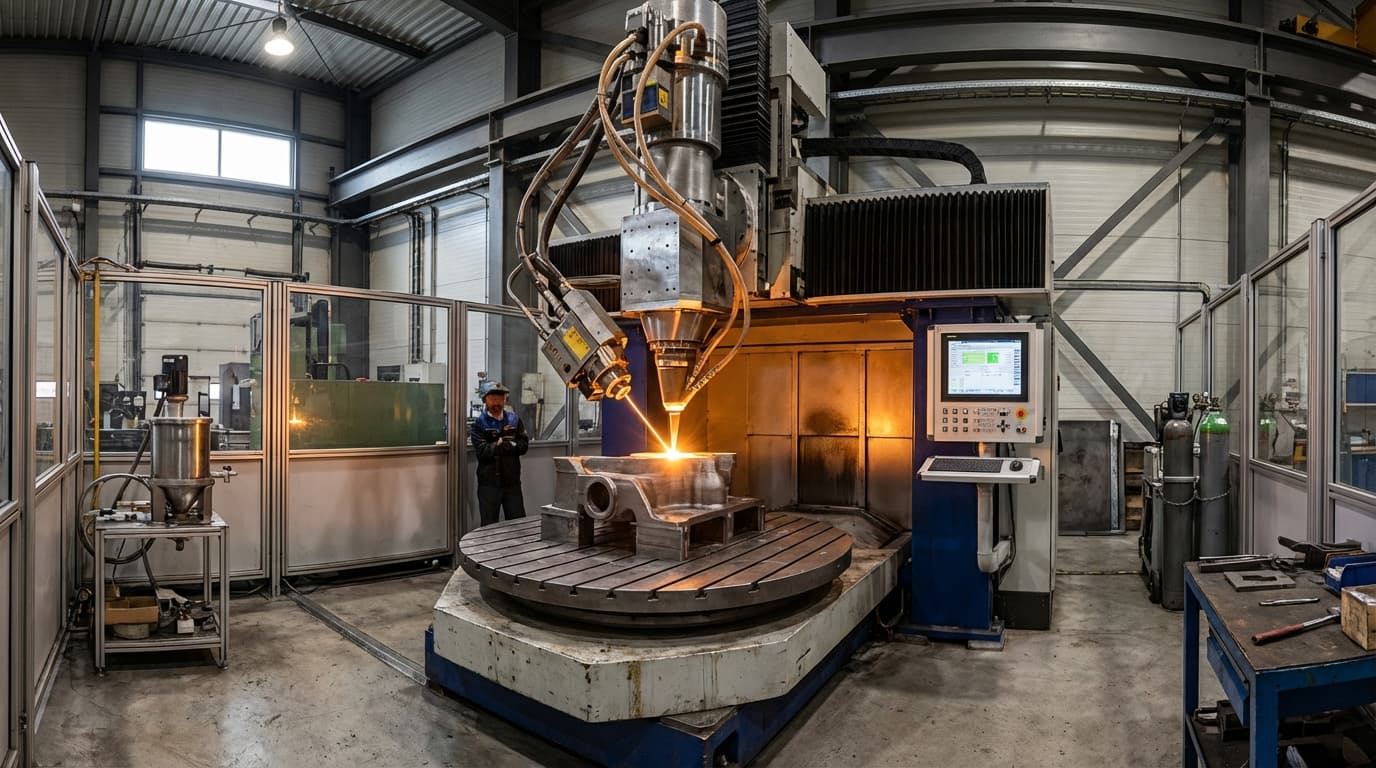
Directed Energy Deposition represents a transformative approach to metal additive manufacturing, distinguished by its ability to build or repair large-scale components through the precise application of focused thermal energy. Unlike powder bed fusion techniques that work within confined build chambers, DED systems use a concentrated energy source—typically a laser, electron beam, or plasma arc—to create a localized melt pool directly on a substrate or existing part. As metal feedstock, delivered either as wire or powder through specialized nozzles, enters this melt pool, it fuses with the underlying material, allowing operators to build up geometry layer by layer or add material to worn surfaces. This process occurs in open-air or controlled atmosphere environments, enabling the fabrication of components that can extend several meters in dimension. The technology's flexibility extends to multi-axis robotic systems that can deposit material along complex toolpaths, creating intricate geometries while maintaining structural integrity. Furthermore, DED systems can switch between different metal powders or wires mid-process, enabling the creation of functionally graded materials where composition and properties transition smoothly within a single part—a capability particularly valuable for components experiencing varying thermal or mechanical stresses.
The manufacturing challenges that DED addresses are particularly acute in industries where component size, repair economics, and material performance intersect. Traditional manufacturing of large metal parts often requires extensive machining from solid billets, resulting in substantial material waste and long lead times. For high-value components like aircraft engine casings, industrial turbines, or large tooling dies, even minor damage has historically necessitated complete replacement at considerable cost. DED fundamentally changes this equation by enabling localized repair, where damaged areas can be rebuilt to original specifications or even enhanced with improved materials. This capability proves especially valuable in aerospace and defense sectors, where a single turbine blade might cost tens of thousands of dollars and require months to replace through conventional supply chains. The technology also overcomes limitations in creating hybrid structures that combine different alloys or integrate dissimilar metals, opening possibilities for components optimized for multiple performance requirements simultaneously. By reducing the buy-to-fly ratio—the amount of raw material needed versus the final part weight—DED addresses both economic and sustainability concerns in metal manufacturing.
Current deployments of DED technology span from production environments to field repair applications, with systems ranging from laboratory-scale research platforms to industrial installations capable of processing components exceeding five meters in length. Aerospace manufacturers have integrated DED into maintenance, repair, and overhaul operations, where technicians can restore worn turbine blades and structural components without removing them from service locations. The oil and gas industry has adopted portable DED systems for on-site repair of drilling equipment and pipeline infrastructure, significantly reducing downtime and logistics costs. In tooling and die manufacturing, companies are leveraging DED to rapidly produce or modify large molds and fixtures, compressing development cycles that once required months into weeks. Research institutions continue advancing the technology's capabilities, exploring applications in functionally graded armor, heat exchangers with optimized thermal properties, and even construction-scale metal structures. As the technology matures, integration with real-time monitoring systems and adaptive process control promises to enhance repeatability and expand the range of manufacturable geometries. The convergence of DED with digital manufacturing workflows positions it as a cornerstone technology for distributed manufacturing networks, where parts can be produced or repaired closer to point of use, fundamentally reshaping supply chain strategies in metal-intensive industries.
Related Organizations

Uses Rapid Plasma Deposition (RPD) to manufacture aerospace-grade titanium components.
Developer of LENS (Laser Engineered Net Shaping) technology for metal additive manufacturing.

Developing the Terran R, a 3D-printed reusable medium-to-heavy lift launch vehicle.

Manufacturer of Electron Beam Additive Manufacturing (EBAM) systems for large-scale metal parts.

Spin-out from Cranfield University providing Wire Arc Additive Manufacturing (WAAM) hardware and software.
Australian company providing Wire Additive Manufacturing (WAM) units and contract manufacturing.

Manufacturer of Directed Energy Deposition (DED) systems and cladding heads.

Develops a wire-laser metal deposition head that can be integrated into CNCs, robots, or standalone printers.

Robotic metal 3D printing company known for printing a steel bridge in Amsterdam.

Industrial laser leader offering Laser Metal Deposition (LMD) machines and heads.

Joint venture between Michelin and Fives, offering DED machines (via acquisition of BeAM).

A multinational manufacturer of welding products.
Supporting Evidence
Research this in Signals
Signals turns a topic into a sourced research record you can inspect and rerun. Your first scan is free, and this one starts with Directed Energy Deposition (DED) already loaded, so edit it or scan as is.