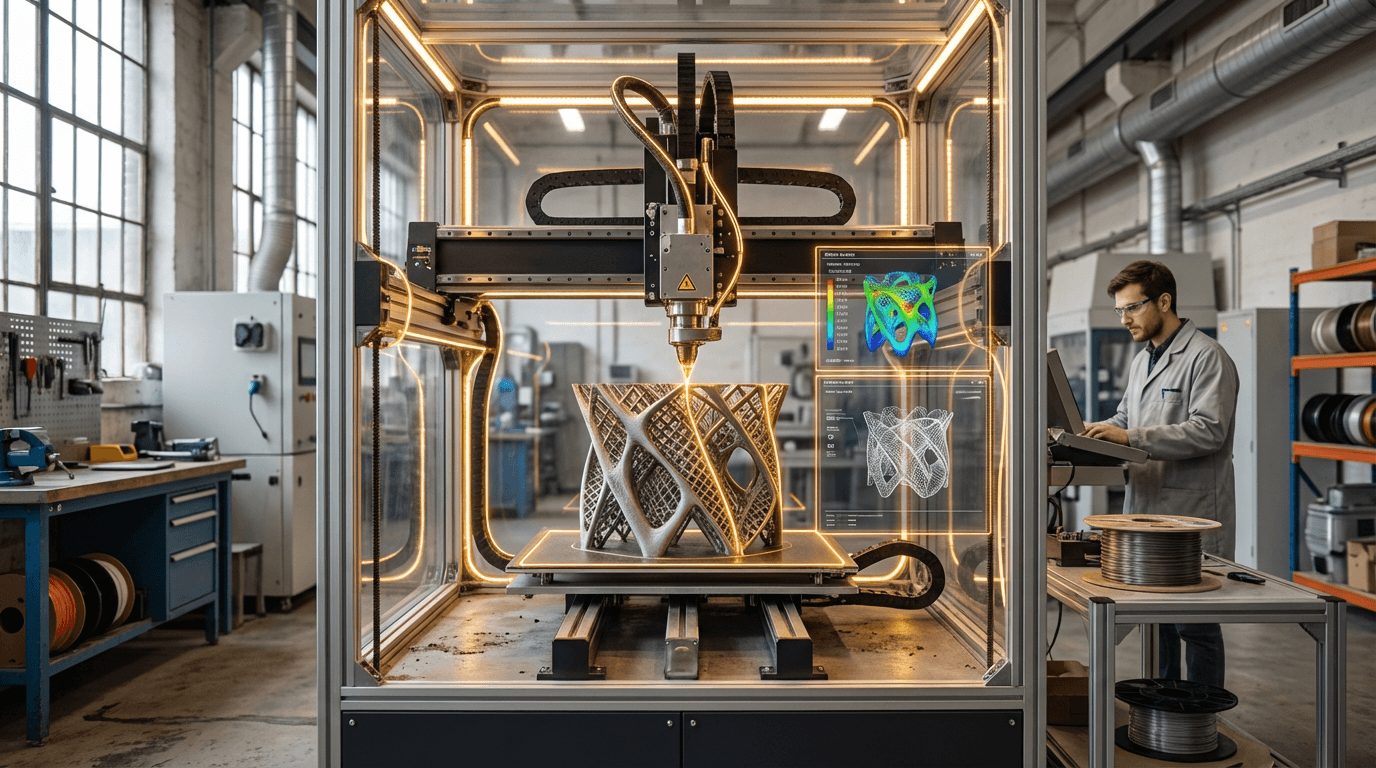
Generative Design for Additive
Generative design for additive manufacturing represents a paradigm shift in how engineers and designers approach product development, leveraging artificial intelligence and computational algorithms to create structures that would be impossible to conceive through traditional design methods. Unlike conventional computer-aided design (CAD) where engineers manually specify every dimension and feature, generative design systems work by defining goals and constraints—such as maximum weight, required strength, material properties, available space, and manufacturing method—then allowing AI algorithms to explore thousands or even millions of possible solutions. The software employs techniques including topology optimization, evolutionary algorithms, and machine learning to iteratively refine designs, mimicking natural selection processes where the fittest solutions survive and evolve. What emerges are often organic, lattice-like structures reminiscent of bone tissue or coral formations, featuring complex internal geometries, variable wall thicknesses, and intricate support structures that distribute loads with remarkable efficiency. These designs are specifically optimized for additive manufacturing processes, taking full advantage of 3D printing's ability to create complex geometries layer by layer without the geometric constraints imposed by traditional subtractive manufacturing methods like milling or casting.
The manufacturing industry has long grappled with the competing demands of reducing material usage and weight while maintaining or improving structural performance—a challenge particularly acute in aerospace, automotive, and medical device sectors where every gram matters. Traditional design approaches often result in over-engineered parts with excess material in non-critical areas, leading to unnecessary weight and material waste. Generative design addresses this fundamental inefficiency by placing material only where structural analysis indicates it's needed, often achieving weight reductions of thirty to fifty percent compared to conventionally designed components while maintaining equivalent or superior strength characteristics. This technology also dramatically accelerates the design iteration process, compressing what might take human engineers weeks or months of analysis and refinement into hours or days of computational processing. Furthermore, it enables mass customization at scale, allowing manufacturers to rapidly generate optimized designs for specific use cases or individual customer requirements without the traditional time and cost penalties associated with custom engineering work.
Early adopters in aerospace and high-performance automotive sectors have already demonstrated the transformative potential of this approach, with components ranging from aircraft brackets and satellite parts to racing car suspension elements showing significant performance improvements. Research initiatives at major universities and corporate laboratories continue to refine the algorithms, expanding their capabilities to account for multi-material printing, thermal management requirements, and manufacturing-specific constraints like support structure minimization and print orientation optimization. The technology is becoming increasingly accessible as cloud-based platforms democratize access to the substantial computational resources required, allowing smaller manufacturers and design firms to leverage capabilities once available only to large corporations with dedicated supercomputing infrastructure. As additive manufacturing technologies themselves advance—with faster print speeds, larger build volumes, and expanded material options including high-performance polymers, metal alloys, and composite materials—the synergy between generative design and 3D printing is expected to fundamentally reshape manufacturing workflows, enabling a future where products are not merely designed for production but co-evolved with their manufacturing process to achieve previously unattainable combinations of performance, efficiency, and sustainability.
Related Organizations

Engineering design software for advanced manufacturing, specializing in implicit modeling.

Owner of the Arnold renderer, which integrates AI denoising to optimize high-end VFX workflows for film and TV.

Simulation and design software provider known for Altair Inspire.
PTC
United States · Company
Offers ThingWorx, a platform that connects industrial devices, people, and systems.

Develops an algorithmic engineering platform that generates parts via code (voxels).

Offers the Xcelerator portfolio, enabling comprehensive digital twins for spacecraft design, manufacturing, and operations.


Partner in the EuroQCI initiative, working on the space segment of the European quantum communication infrastructure.

Digital Light Synthesis (DLS) 3D printing technology company.

Automotive giant using generative design for vehicle lightweighting.

Supporting Evidence
Research this in Signals
Signals turns a topic into a sourced research record you can inspect and rerun. Your first scan is free, and this one starts with Generative Design for Additive already loaded, so edit it or scan as is.