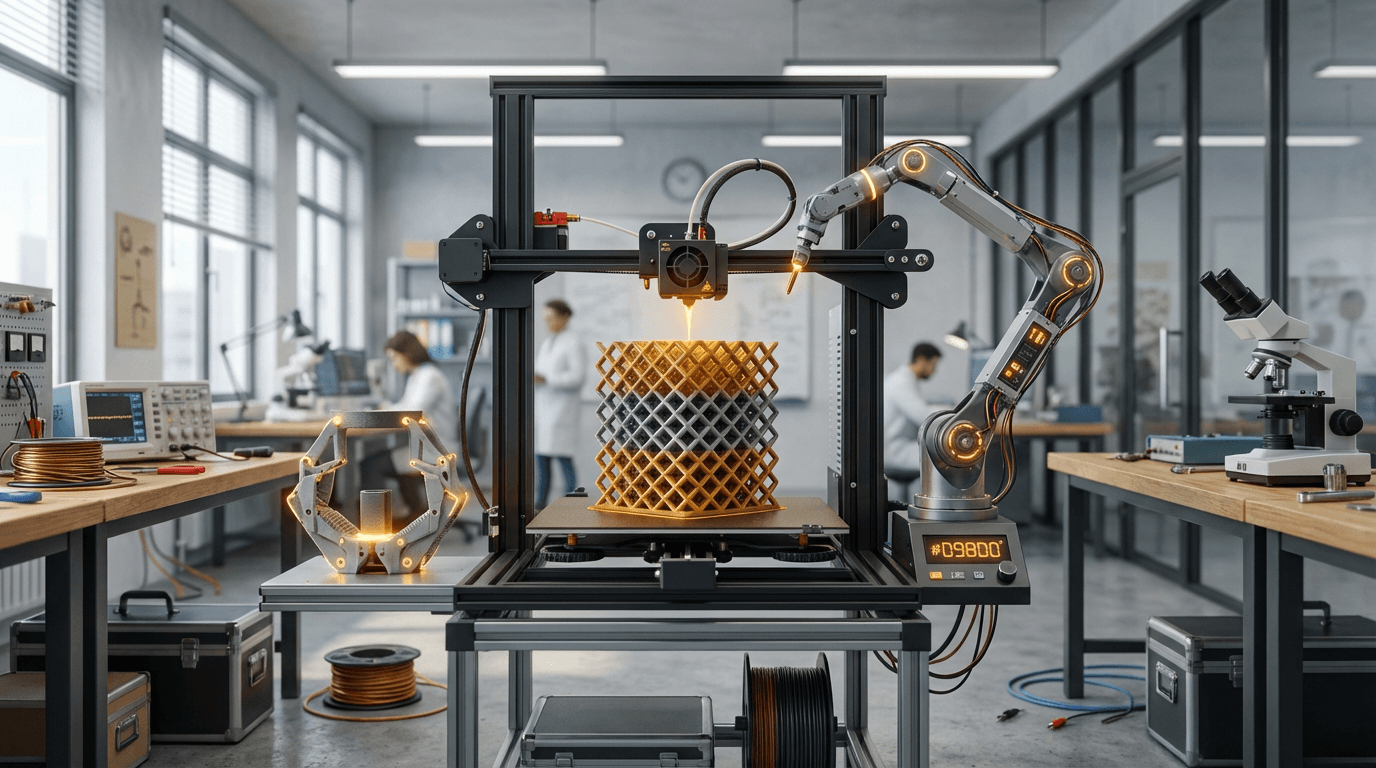
4D Printing
4D printing represents an evolution of additive manufacturing that incorporates time-responsive materials into the fabrication process. Unlike conventional 3D printing, which produces static objects, 4D printing creates structures that can transform their shape, properties, or functionality when exposed to specific environmental stimuli such as heat, moisture, light, magnetic fields, or pH changes. This transformation is achieved through the strategic use of smart materials—including shape-memory polymers, hydrogels, and composite materials—that are programmed during the printing process to respond predictably to external triggers. The technology works by carefully controlling the material composition, internal structure, and geometric design of printed objects, allowing engineers to encode specific transformation behaviors directly into the physical architecture of components. This eliminates the need for complex mechanical systems, motors, or electronic controls that would traditionally be required to achieve similar dynamic behaviors.
The manufacturing sector faces persistent challenges in creating adaptive systems that can respond to changing conditions without adding complexity, weight, or maintenance requirements. Traditional mechanisms that enable movement or transformation typically require assembly of multiple parts, integration of actuators and sensors, and ongoing power supplies—all of which increase cost, potential failure points, and design constraints. 4D printing addresses these limitations by embedding responsive capabilities directly into the material itself, enabling self-assembly, self-repair, and autonomous adaptation. This approach is particularly valuable in environments where conventional electromechanical systems would be impractical, such as in extreme temperatures, remote locations, or applications requiring sterile conditions. The technology also opens new possibilities for supply chain optimization, as flat-packed components could be shipped efficiently and then self-assemble into final forms at their destination, reducing transportation costs and storage requirements.
Research institutions and industrial partners are actively exploring 4D printing applications across diverse sectors. In aerospace and automotive manufacturing, components that can adapt their aerodynamic properties in response to temperature or airflow conditions are under development, potentially improving fuel efficiency and performance. The construction industry is investigating self-deploying structures and infrastructure elements that could transform in response to environmental conditions, such as building facades that adjust their porosity based on humidity or temperature. Medical device manufacturers are particularly interested in implants and surgical tools that can change shape inside the body in response to body heat or pH levels, enabling minimally invasive procedures. Early deployments indicate that the technology is moving beyond laboratory demonstrations toward practical applications, though challenges remain in scaling production, ensuring long-term reliability of material responses, and developing standardized design methodologies. As materials science advances and manufacturing processes become more refined, 4D printing is positioned to become an integral component of next-generation manufacturing strategies, particularly in applications where adaptability, simplicity, and autonomous response capabilities provide competitive advantages over traditional mechanical systems.
Related Organizations

Research lab at MIT developing programmable materials and 4D printing/knitting technologies.

Developed the SWIFT (Sacrificial Writing into Functional Tissue) method for 3D printing vascular channels in living matrices.

Conducts advanced research in bioelectronics and the interface between biological systems and electronic circuits.

Home to the Physical Internet Center, led by Benoit Montreuil (a father of the PI concept), driving core research and industry pilots.

Generative design studio creating 'Kinematics' 4D printed structures.

Owner of the Arnold renderer, which integrates AI denoising to optimize high-end VFX workflows for film and TV.

Federal research facility focusing on national security and nuclear science.


Home to the ARC Centre of Excellence for Electromaterials Science (ACES), focusing on 4D printing.
Supporting Evidence
Research this in Signals
Signals turns a topic into a sourced research record you can inspect and rerun. Your first scan is free, and this one starts with 4D Printing already loaded, so edit it or scan as is.