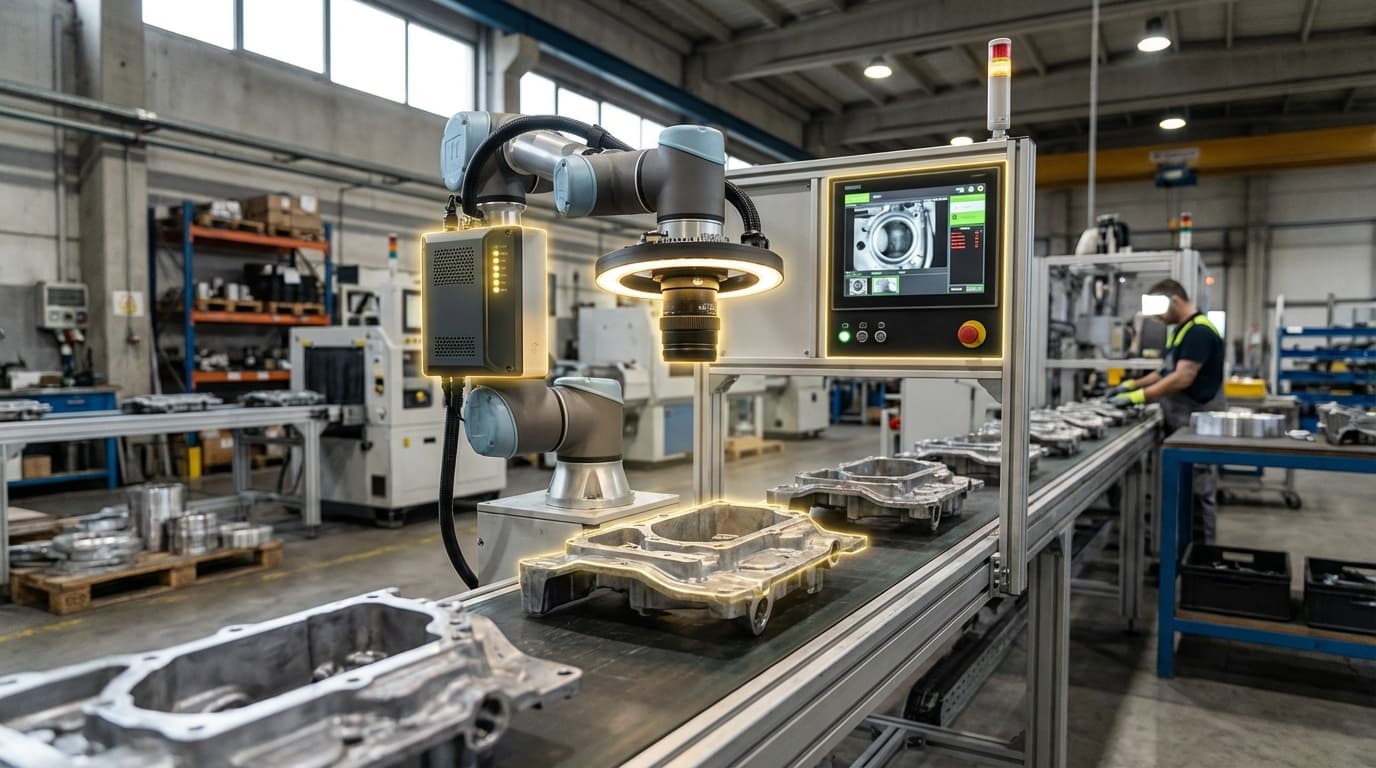
Computer Vision Quality Inspection
Computer Vision Quality Inspection represents a fundamental shift in manufacturing quality control, replacing traditional manual inspection processes with automated visual analysis systems. At its core, this technology employs deep learning algorithms—particularly convolutional neural networks—trained on vast datasets of product images to recognize patterns, anomalies, and defects that deviate from established quality standards. These systems utilize high-resolution cameras, specialized lighting configurations, and edge computing infrastructure to capture and analyze product images in real-time as items move through production lines. The neural networks learn to distinguish between acceptable variations in manufacturing and genuine defects by processing thousands of labeled examples during training, developing the ability to detect surface imperfections, dimensional inconsistencies, color variations, missing components, and assembly errors with remarkable precision. Unlike rule-based machine vision systems that require explicit programming for each defect type, modern computer vision quality inspection continuously improves its detection capabilities through ongoing exposure to new examples and edge cases.
Manufacturing industries face mounting pressure to maintain zero-defect production while simultaneously increasing throughput and reducing labor costs. Traditional human inspection methods, while flexible and adaptable, suffer from inherent limitations including fatigue, inconsistency across shifts, subjective judgment variations between inspectors, and the physical impossibility of examining every product at high production speeds. Computer vision quality inspection addresses these challenges by providing tireless, consistent evaluation at speeds that match or exceed production line velocities. The technology enables manufacturers to implement 100% inspection protocols rather than statistical sampling approaches, catching defects before they reach customers and reducing costly recalls or warranty claims. Beyond simple pass-fail decisions, these systems generate rich data streams about defect patterns, frequencies, and locations, enabling predictive maintenance of production equipment and rapid identification of process drift before it results in significant waste.
Early deployments in automotive manufacturing and electronics assembly have demonstrated the technology's commercial viability, with systems now capable of inspecting complex assemblies, detecting microscopic surface defects, and identifying subtle color variations imperceptible to human observers. Semiconductor fabrication facilities employ computer vision to examine wafers for nanometer-scale defects, while food and beverage producers use it to ensure packaging integrity and label accuracy. The technology has expanded beyond traditional manufacturing into pharmaceutical quality control, where it verifies pill shapes and blister pack completeness, and textile production, where it identifies weaving flaws in real-time. As edge computing capabilities advance and training datasets grow more comprehensive, computer vision quality inspection is evolving toward predictive quality systems that can anticipate defects based on upstream process parameters, representing a crucial enabler of lights-out manufacturing and the broader vision of fully autonomous production facilities.
Related Organizations

Develops LandingLens, a computer vision cloud platform that enables manufacturers to build and deploy AI visual inspection systems.

Provides a full-stack visual inspection platform combining easy-to-use software with camera hardware for automated quality control.

Offers a manufacturing optimization platform that uses AI to detect anomalies and defects on assembly lines remotely.

Provides Vision Inspection Automation (VIA) software that allows manufacturers to train AI models with very little data.

Produces ruggedized tracking hardware, barcode scanners, and RFID readers used in field logistics.
Supporting Evidence
Research this in Signals
Signals turns a topic into a sourced research record you can inspect and rerun. Your first scan is free, and this one starts with Computer Vision Quality Inspection already loaded, so edit it or scan as is.