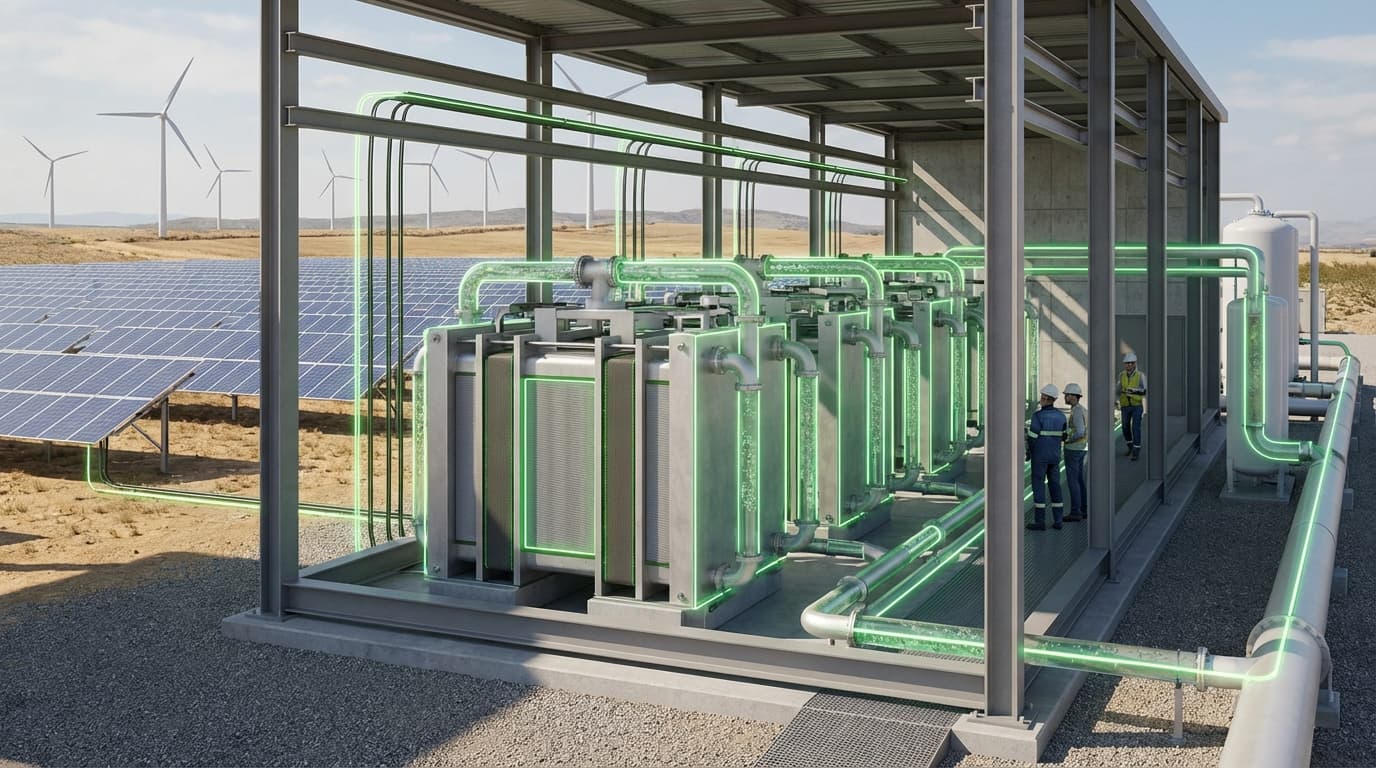
Green Hydrogen Production
Gigawatt-scale hydrogen hubs couple onshore/offshore wind, utility solar, or hydropower with PEM, alkaline, or emerging solid-oxide electrolyzers to produce zero-carbon H₂. Developers in the Middle East, Australia, Chile, and Europe are building integrated complexes with desalination, power conditioning, and storage tanks sized for round-the-clock production. Water treatment, compression, liquefaction, or ammonia conversion units prepare hydrogen for pipelines, shipping, or local industrial use.
Steelmakers (H2 Green Steel, HYBRIT), fertilizer giants, and heavy-transport corridors sign long-term offtake agreements, anchoring financing. Ports retrofit terminals for liquid hydrogen or ammonia exports, while domestic projects feed H₂ into blending pilots, fuel-cell trucking depots, or grid-balancing turbines. Policy support—EU IPCEI, US IRA tax credits, Japanese subsidies—closes cost gaps with gray hydrogen and sets carbon-intensity benchmarks.
Technology is TRL 7–8, but scaling requires affordable renewable PPAs, robust water supplies, and standards for certification (Guarantees of Origin). Supply chains for electrolyzer stacks, power electronics, and storage vessels are racing to keep up. As economies pursue energy security and decarbonized industry, green hydrogen hubs will become anchor tenants of new industrial ecosystems.
Related Organizations
United States · Startup
Manufacturer of high-performance PEM electrolyzer stacks designed specifically for industrial-scale hydrogen production.

Global hydrogen company delivering optimal solutions to produce, store, and distribute hydrogen from renewable energy using Alkaline and PEM electrolyzers.

A joint venture building the world's largest utility-scale, commercial-based hydrogen facility powered entirely by renewable energy.
Specialist in high-efficiency alkaline water electrolysis technology for large-scale industrial applications.

Global metals and green energy company developing massive green hydrogen and ammonia projects worldwide through its energy division.
Australia · Startup
Developing a capillary-fed electrolyzer that operates at 95% system efficiency, significantly higher than incumbent technologies.

Designs and manufactures electrolyzers based on proton exchange membrane (PEM) technology.

Develops high-temperature solid oxide electrolyzers (SOEC) crucial for efficient e-fuel production.
Germany · Company
Manufactures Anion Exchange Membrane (AEM) electrolyzers, which avoid noble metals like iridium.

Developer of massive green hydrogen projects, including the Asian Renewable Energy Hub and Western Green Energy Hub.

Designs and manufactures modular PEM electrolyzers, with significant manufacturing operations in India.

Chemical engineering company providing solid oxide electrolyzers and synthesis technologies for e-fuels.
Supporting Evidence
Research this in Signals
Signals turns a topic into a sourced research record you can inspect and rerun. Your first scan is free, and this one starts with Green Hydrogen Production already loaded, so edit it or scan as is.