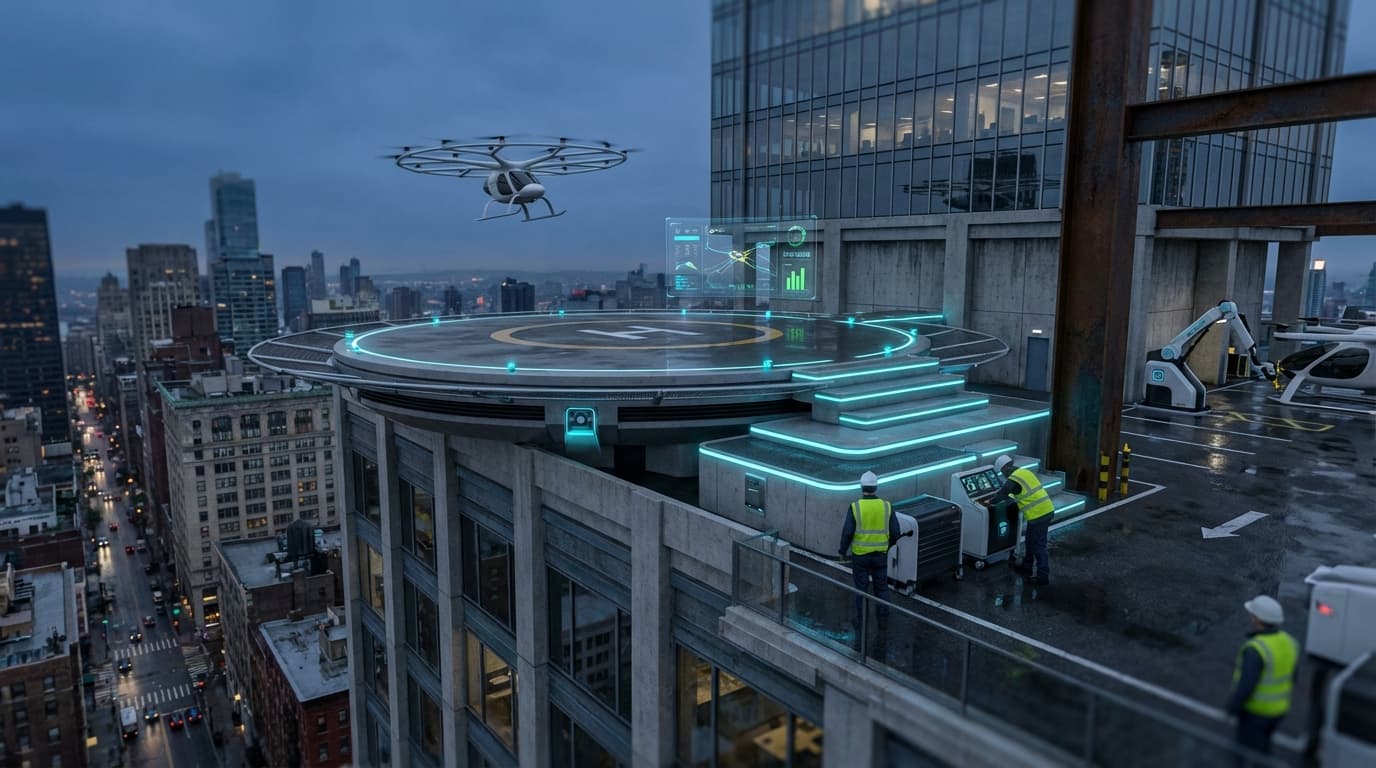
Vertiport Network Deployment & Urban Integration
The emergence of electric vertical takeoff and landing (eVTOL) aircraft has created an urgent need for ground infrastructure capable of supporting urban air mobility at scale. Vertiports serve as the physical nodes in this emerging transportation network, functioning as specialized landing and takeoff facilities designed specifically for eVTOL operations. Unlike traditional helipads, vertiports integrate advanced charging infrastructure, passenger boarding systems, and air traffic coordination capabilities into compact footprints suitable for dense urban environments. These facilities can take various forms—rooftop installations on existing buildings, converted parking structures, or purpose-built standalone terminals—each requiring careful engineering to handle the unique operational demands of electric aircraft. The infrastructure must accommodate rapid turnaround times, provide high-power charging systems capable of replenishing battery packs between flights, and ensure passenger comfort and safety during boarding and deplaning procedures. Additionally, vertiports must integrate seamlessly with local air traffic control systems and emerging unmanned traffic management platforms to coordinate flight operations in increasingly crowded urban airspace.
The deployment of vertiport networks addresses several critical barriers to urban air mobility adoption, most notably the chicken-and-egg problem of infrastructure versus aircraft availability. Cities face complex challenges in integrating these facilities into existing urban fabric, requiring coordination across multiple stakeholders including real estate developers, aviation authorities, municipal planning departments, and local communities. Zoning regulations must be updated to accommodate this new infrastructure category, while comprehensive noise and safety studies are necessary to address community concerns about low-altitude aircraft operations over populated areas. The business models underpinning vertiport development remain in active evolution, with various approaches emerging that balance capital investment from real estate partners, operational revenue from aircraft operators, and public sector support for transportation infrastructure. Early implementations suggest that successful deployment requires careful site selection that considers proximity to demand centers, ground transportation connectivity, and minimal impact on surrounding neighborhoods. The infrastructure must also be designed with sufficient flexibility to accommodate evolving aircraft designs and operational requirements as the technology matures.
Initial vertiport deployments are already underway in multiple global markets, with varying approaches reflecting different regulatory environments and urban contexts. Research suggests that early-stage facilities are focusing on proving operational concepts and building public acceptance before scaling to full network coverage. In the United States, several metropolitan areas are advancing pilot programs that combine existing heliport infrastructure with new purpose-built facilities. European cities are pursuing integrated approaches that emphasize multimodal connectivity and sustainability requirements. Asian markets are exploring high-density deployment models that leverage existing building stock, while Middle Eastern developments often feature purpose-built terminals as part of broader smart city initiatives. Industry analysts note that successful network deployment will require standardization of technical specifications, operational procedures, and safety protocols to enable interoperability across different aircraft types and operators. As urban populations continue to grow and ground-level congestion intensifies, vertiport networks represent a critical enabling infrastructure for three-dimensional urban transportation systems, with the potential to fundamentally reshape how people and goods move through metropolitan areas in the coming decades.
Related Organizations

Operator of Paris airports, actively building a vertiport network in Paris for the 2024 Olympics and beyond.

Leading designer, developer, and operator of vertiport infrastructure for the advanced air mobility industry.

Infrastructure giant establishing a network of vertiports in the US and Europe to support eVTOL operations.

Developer of 'Air-One', a rapidly deployable, modular vertiport hub for drones and eVTOLs.

Building the digital operating system (Vertiport Automation System) to manage high-volume vertiport traffic.
Spain · Company
The advanced air mobility innovation line of Globalvia, focused on vertiport management and infrastructure.
Volatus Infrastructure
United States · Startup
Provides modular vertiport designs and charging infrastructure for the AAM industry.

Provides air traffic navigation and vertiport operation services for autonomous aircraft.

Specializes in the design, construction, and operation of vertiports, with announced corridors in Quebec and Dubai.
Supporting Evidence
Research this in Signals
Signals turns a topic into a sourced research record you can inspect and rerun. Your first scan is free, and this one starts with Vertiport Network Deployment & Urban Integration already loaded, so edit it or scan as is.