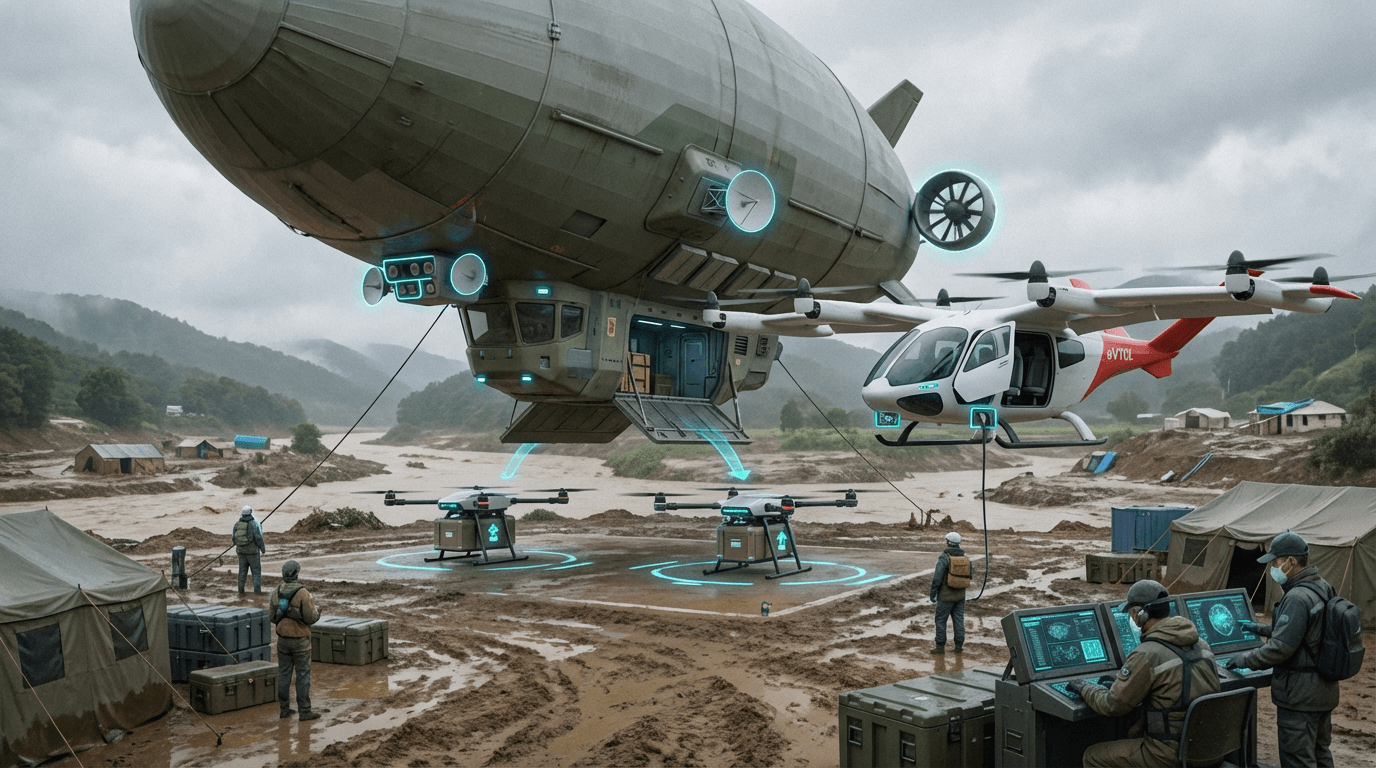
Humanitarian & Disaster Relief Aviation
Humanitarian and disaster relief aviation represents a critical evolution in emergency response capabilities, addressing the fundamental challenge of delivering life-saving supplies to populations cut off by natural disasters, conflict, or infrastructure collapse. Traditional relief efforts have long been hampered by destroyed roads, flooded regions, and remote locations that conventional aircraft cannot reach without functional runways. This emerging class of aviation technologies—encompassing autonomous cargo drones, hybrid airships, and electric vertical takeoff and landing (eVTOL) aircraft—fundamentally reimagines how aid reaches affected populations. These platforms leverage advanced flight control systems, electric propulsion, and autonomous navigation to operate in conditions where conventional logistics fail. Cargo drones can carry payloads ranging from a few kilograms to several hundred, while hybrid airships combine lighter-than-air lift with powered propulsion to transport larger volumes of supplies. eVTOL aircraft offer the versatility of helicopter-like operations with reduced noise signatures and operational costs, making them particularly suited for medical evacuations and time-critical deliveries.
The operational advantages these technologies bring to crisis response are transformative. In the immediate aftermath of earthquakes, floods, or cyclones, when ground transportation networks are severed and traditional airports are inoperable, these aircraft can establish aerial supply chains within hours rather than days. They eliminate the need for extensive ground infrastructure, reducing the time between disaster onset and the arrival of critical medical supplies, water purification equipment, and emergency shelter materials. For ongoing humanitarian operations in conflict zones or regions with chronic infrastructure deficits, these platforms enable sustained delivery of vaccines, blood products, and diagnostic samples that require cold-chain management and rapid transport. The ability to pre-position these assets and deploy them quickly addresses what emergency response professionals call the "golden hours"—the critical window when intervention has the greatest impact on survival rates. Furthermore, autonomous operation reduces the risk to human pilots in dangerous conditions, while lower operational costs compared to traditional helicopters make frequent, smaller deliveries economically viable.
International humanitarian organizations have begun establishing operational frameworks to validate these capabilities in real-world conditions. Pilot programs in East Africa, Southeast Asia, and island nations have demonstrated the viability of drone corridors for routine medical deliveries, providing proof-of-concept for crisis deployment. Early deployments indicate that these systems can reduce delivery times from days to hours in remote areas, while research suggests significant cost reductions compared to ground-based alternatives in challenging terrain. However, scaling these operations faces substantial hurdles. International regulatory harmonization remains fragmented, with airspace rules varying dramatically between jurisdictions and many countries lacking frameworks for autonomous flight operations. Funding models must evolve beyond project-based grants to sustainable operational budgets that can maintain fleets, train personnel, and ensure rapid activation during emergencies. As climate change intensifies the frequency and severity of natural disasters, and as geopolitical instability creates new humanitarian crises, the aviation industry's ability to deliver these technologies at scale will increasingly determine the effectiveness of global emergency response systems, potentially saving thousands of lives in future disasters.
Related Organizations

Operates the United Nations Humanitarian Air Service (UNHAS), the world's largest humanitarian airline.

Operates the world's largest autonomous drone delivery network, specializing in medical supplies and e-commerce delivery.

Airship company backed by Sergey Brin, developing the Pathfinder series of rigid airships for humanitarian aid and cargo.

A faith-based nonprofit operating a fleet of light aircraft to deliver aid and medical transport to the world's most isolated communities.


Developing the LCA60T, a rigid airship solution for transporting up to 60 tons of heavy cargo.

Australian drone logistics company focused on essential health supplies.

Developing the Chaparral, an autonomous VTOL cargo aircraft capable of carrying 300-500 lbs over 300 miles.

Windracers
United Kingdom · Startup
Developers of the ULTRA autonomous drone, designed to carry 100kg of aid over 1000km.

European developer of the 'Black Swan' cargo drone, designed to carry 350 kg over 2,500 km.
Supporting Evidence
Research this in Signals
Signals turns a topic into a sourced research record you can inspect and rerun. Your first scan is free, and this one starts with Humanitarian & Disaster Relief Aviation already loaded, so edit it or scan as is.